
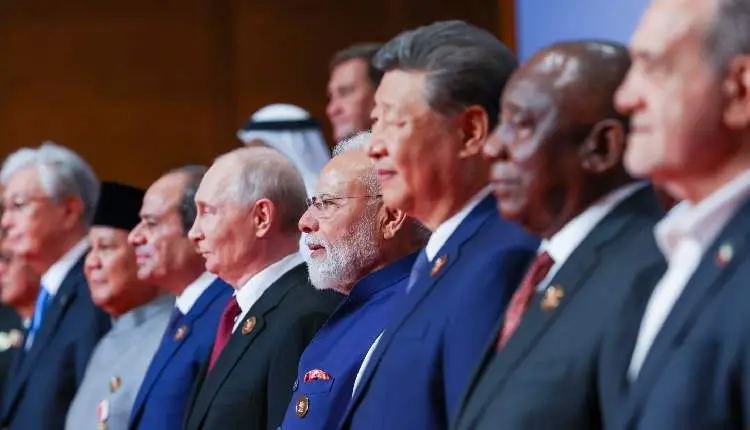
Report says BRICS declaration strengthens India's global credibility
The New Delhi Declaration adopted at the 18th BRICS Summit hosted by India condemned the 2025 Pahalgam terror attack and took a firm position on cross-border terrorism, terror financing, safe havens and double standards, according to a report by Athens-based 'Directus'. It noted Pakistan was not expressly named. The April 22, 2025 attack, carried out by a Pakistan-based group, killed 26 civilians. The report called the declaration an important diplomatic achievement for India.
Source
BRICS / G20 / SCO / Quad · read the original report ↗
Desk check · compared with the source
What the desk checked (4)
- The New Delhi Declaration adopted at the 18th BRICS Summit hosted by India condemned the 2025 Pahalgam attack and addressed cross-border terrorism, terror financing and safe havens. — Attributed to a report by the Athens-based outlet 'Directus' as carried by IANS; declaration text not quoted in full in the source.
- The Pahalgam attack on April 22, 2025 was carried out by a Pakistan-based terrorist group and killed 26 civilians. — Figure and date appear in the source, attributed to the Directus report; no independent official citation given.
- Pakistan was not expressly named in the declaration. — Stated as a direct quote from the report; internally consistent with the rest of the text.
- The declaration reflects PM Narendra Modi's multidirectional foreign policy, with India engaging the Quad, Russia, the US, Gulf states, Israel and China simultaneously. — Analytical opinion attributed to Directus, not a verifiable factual claim.
Analysts’ view opinion
The core of the Athens-based 'Directus' assessment is that the New Delhi Declaration from the 18th BRICS Summit, hosted by India, echoed on a multilateral stage an argument India has been making for decades. Politically, that is a diplomatic gain for the Modi government: extracting shared language on cross-border terrorism, terror financing and safe havens from a grouping of countries with sharply divergent interests is not a small thing. But the declaration does not name Pakistan — a fact, as the report itself notes, that should neither be hidden nor overstated, and one that gives critics their main line of attack.
- As host, India used its agenda-setting leverage to push its core security concerns into the final text — a practical measure of diplomatic craft.
- Opponents can argue that the absence of any direct reference to Pakistan limits the declaration's bite, while the government side will insist the principles in the language matter more than names.
- The report frames the outcome as vindication of a multidirectional foreign policy: Quad membership alongside a leading BRICS role, historic ties with Russia alongside a deepening partnership with the United States.
- Securing consensus language despite major differences with China strengthens India's claim that 'strategic autonomy' works in practice rather than only in theory.
- The report's key political argument is that by turning the Pahalgam attack, in which 26 civilians were killed, into an international diplomatic issue, India prevented it from being quietly forgotten.
What to watch — Watch whether India can repeat this language at other multilateral forums, how Pakistan responds, and whether the domestic opposition seizes on the fact that no country was named.
This is analysis contained in a single foreign report — the story does not establish the official interpretations of other BRICS governments, what was negotiated behind the text, or whether the wording will translate into any concrete action.
Deep dive
Research brief · 8 facts · 3 dates · exam-readyThe brief
Context
India hosted the 18th BRICS Summit, which adopted the New Delhi Declaration. The declaration condemned the April 22, 2025 Pahalgam terror attack in the strongest terms and took a firm stance on cross-border movement of terrorists, terror financing, safe havens and double standards in fighting terrorism. An Athens-based publication, 'Directus', assessed the declaration as an important diplomatic achievement for India, while noting that Pakistan was not expressly named. The report argued the consensus among a geopolitically diverse grouping strengthens India's credibility as an independent global power.
Key facts
- The New Delhi Declaration was adopted at the 18th BRICS Summit, hosted by India.
- The declaration condemned the 2025 Pahalgam terrorist attack in the strongest terms.
- The Pahalgam attack took place on April 22, 2025, and killed 26 innocent civilians.
- The attack was carried out by a Pakistan-based terrorist group, according to the report.
- The declaration includes language on cross-border movement of terrorists, terror financing, safe havens and double standards in addressing terrorism.
- Pakistan was not expressly named in the declaration, the Athens-based 'Directus' report noted.
- The report said the declaration reflects Prime Minister Narendra Modi's multidirectional foreign policy.
- The report noted India participates in the Quad while remaining a principal member of BRICS.
Timeline
- April 22, 2025Pahalgam terror attack, carried out by a Pakistan-based terrorist group, kills 26 civilians.
- Recent (exact date not stated in the source)India hosts the 18th BRICS Summit; the New Delhi Declaration is adopted, condemning the Pahalgam attack.
- After the summitAthens-based 'Directus' publishes a report calling the declaration an important diplomatic achievement for India.
Who has a stake
- India — Secures multilateral endorsement of its long-standing position on cross-border terrorism and boosts credibility as an independent global power.
- BRICS grouping — Demonstrates ability to forge consensus on terrorism language among members with dramatically different geopolitical interests.
- Pakistan — Faces an increasingly uncomfortable question over infrastructure, organisations and ideological networks India accuses of operating from its territory, though it is not named.
- Victims of the Pahalgam attack and their families — The attack that killed 26 civilians gains an international, multilateral dimension rather than being forgotten.
- Prime Minister Narendra Modi — The report credits his multidirectional foreign policy of simultaneous engagement with rival powers.
- Other powers named (Russia, United States, China, Gulf countries, Israel) — India's simultaneous engagement with mutually disagreeing partners tests and demonstrates its strategic autonomy.
Why it matters
The report argues that securing terrorism language from a diverse grouping such as BRICS shows India can place its core security concerns before countries with sharply differing geopolitical interests and win consensus. It also advances India's argument that terrorism in Jammu and Kashmir cannot be seen merely as a political dispute, and that counter-terrorism must target the whole enabling ecosystem, not just the individual attacker.
UPSC angle
Prelims pointers
- New Delhi Declaration: outcome document of the 18th BRICS Summit, hosted by India.
- Pahalgam terror attack: April 22, 2025; 26 civilians killed; attributed to a Pakistan-based terrorist group.
- Declaration language covers cross-border terrorism, terror financing, safe havens and double standards.
- Pakistan was not expressly named in the declaration.
- India is simultaneously part of the Quad and a principal member of BRICS.
- The assessment was published by 'Directus', an Athens-based outlet (reported by IANS).
Mains framing
India has argued for decades that terrorism directed at it is sustained by an ecosystem of weapons, training, finance, communications, recruitment networks and safe havens, and that terrorism cannot be legitimised through political explanations or by selectively distinguishing between terrorists on grounds of strategic convenience. The New Delhi Declaration of the 18th BRICS Summit, by condemning the April 22, 2025 Pahalgam attack that killed 26 civilians in the strongest terms and pairing this with language on cross-border terrorism, financing, safe havens and double standards, gave that argument multilateral endorsement within a grouping of states with divergent geopolitical interests. The limitation, as the Directus report itself concedes, is that Pakistan is not expressly named, a fact that should be "neither concealed nor exaggerated"; the political weight instead lies in the terminology accepted. Analytically, the episode illustrates the utility of India's strategic autonomy and multidirectional diplomacy — Quad and BRICS, Russia and the United States, Gulf states and Israel, engagement with China where national interests require — in converting a bilateral security concern into a multilateral norm. The way forward suggested by the source is to keep pressing the question of how long international narratives on cross-border terrorism can remain detached from the infrastructure and networks India accuses of operating from Pakistani territory.
Key terms
- BRICS
- Grouping of major emerging economies; India hosted its 18th Summit, which adopted the New Delhi Declaration.
- New Delhi Declaration
- Outcome document of the 18th BRICS Summit, condemning the Pahalgam attack and addressing cross-border terrorism, financing and safe havens.
- Cross-border terrorism
- Terrorist activity involving movement of terrorists across national frontiers; explicitly addressed in the declaration.
- Safe havens
- Territory from which terrorists can organise and operate; named as a concern in the declaration.
- Double standards in addressing terrorism
- Selectively distinguishing between terrorists based on strategic convenience, rejected in the declaration's stance.
- Strategic autonomy
- India's policy of engaging rival powers simultaneously without becoming an appendage of any geopolitical bloc.
Practice questions
- Examine how multilateral groupings such as BRICS can advance a member state's counter-terrorism objectives, using the New Delhi Declaration as a case study.
- "Counter-terrorism requires action against the entire enabling ecosystem, not merely the individual attacker." Discuss in the light of India's position on cross-border terrorism.
- Does India's multidirectional foreign policy strengthen or complicate its strategic autonomy? Analyse with reference to its simultaneous engagement with the Quad, BRICS, Russia, the United States, the Gulf, Israel and China.
Grounded only in the source report — figures and dates are the source's, not inferred.