
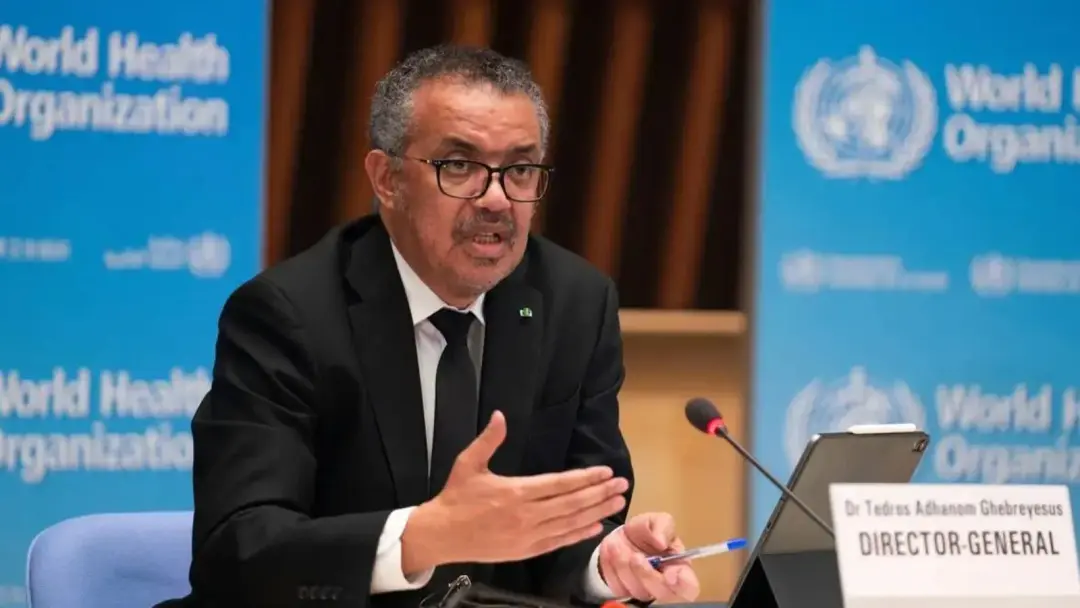
US rejoining WHO is 'matter of time', says Tedros
WHO Director-General Tedros Adhanom Ghebreyesus said it is a matter of time until the United States rejoins the global health agency, disclosing that he has been in talks with US Health and Human Services Secretary Robert F. Kennedy Jr. He spoke at a Health Coverage Fellowship programme at the Harvard T H Chan School of Public Health in Boston. The US notified its withdrawal in January 2026, citing WHO's COVID-19 handling. WHO says the US contributed $1.284 billion in 2022-23.
Source
WHO · read the original report ↗
Desk check · compared with the source
What the desk checked (5)
- Tedros said it is 'a matter of time' until the US rejoins WHO and that he has held talks with US HHS Secretary Robert F. Kennedy Jr. — Direct quote and disclosure attributed to Tedros at a Harvard T H Chan School of Public Health programme in Boston.
- The US formally notified WHO of its withdrawal in January 2026, citing the agency's handling of COVID-19. — Stated in source as fact without a named document or official; date appears in source.
- The US contributed $1.284 billion during the 2022-23 biennium. — Figure attributed to WHO in the source.
- WHO says all hypotheses on COVID-19 origins remain on the table, including a lab-related origin, as some requested data from China was not provided. — Attributed to Tedros; reflects WHO's stated position, not independently verifiable here.
- India has made significant progress in reducing maternal, infant and under-five mortality. — Attributed to Tedros; no supporting statistics given in source.
Analysts’ view opinion
Tedros's line that a US return is "a matter of time" is a diplomatic signal, not evidence of a deal — it is an effort to keep the negotiating door open. What is at stake for the agency is not only money but the technical reach of institutions like the CDC and NIH, and the surveillance networks that underpin global health security. Because a US-shaped vacuum invites other powers to compete for influence in multilateral health bodies, this is as much a geopolitical question as a public-health one.
- The withdrawal of WHO's largest historical donor — $1.284 billion in the 2022-23 biennium — has, by the agency's own account, forced reprioritisation of programmes and cost containment.
- The strategic loss exceeds the fiscal one: US technical capacity in surveillance, emergency response and polio, HIV and TB programmes is not easily substituted.
- Tedros disclosing direct contact with US Health Secretary Robert F. Kennedy Jr suggests a strategy of managing Washington's objections through engagement rather than confrontation.
- His statement that China has not supplied all requested COVID-origins data, and that all hypotheses including a lab-related origin remain open, exposes a persistent trust deficit in information-sharing between major states.
- His warning against depending on a single country for medicines and vaccines — even while praising India as the "pharmacy of the world" — reflects classic supply-chain resilience logic applied to health security.
What to watch — Watch the level and form of US representation at the September 25 UN General Assembly high-level meeting on pandemic preparedness, and how the leadership transition after Tedros's term ends next year reshapes the talks.
The story establishes no indication that Washington is preparing to return: there is no US response, no conditions and no timeline here — only the WHO chief's stated hope.
Deep dive
Research brief · 8 facts · 5 dates · exam-readyThe brief
Context
The World Health Organization, the UN's specialised health agency, lost its largest single donor when the United States formally notified its withdrawal in January 2026, citing dissatisfaction with WHO's handling of the COVID-19 pandemic. Speaking to reporters at a Health Coverage Fellowship programme run by the Centre for Health Communication at the Harvard T H Chan School of Public Health in Boston, WHO Director-General Tedros Adhanom Ghebreyesus said it is "a matter of time" until the US rejoins, and revealed he has been in talks with US Health and Human Services Secretary Robert F. Kennedy Jr. His remarks came ahead of the second UN General Assembly high-level meeting on Pandemic Prevention, Preparedness and Response on September 25, and touched on COVID-19 origins, pandemic preparedness and India's role in global health.
Key facts
- WHO chief Tedros Adhanom Ghebreyesus said "It is a matter of time until the US joins the WHO," and disclosed continuing communication with US HHS Secretary Robert F. Kennedy Jr.
- The US formally notified WHO of its withdrawal in January 2026, citing concerns over the agency's handling of the COVID-19 pandemic.
- The US has historically been WHO's largest donor; it contributed $1.284 billion during the 2022-23 biennium, according to WHO.
- WHO says the loss of US support has created major funding gaps, forcing it to reprioritise programmes and contain costs.
- Tedros's second term as WHO Director-General ends next year; he has rejected several claims made by the US administration.
- The second UN General Assembly high-level meeting on 'Pandemic Prevention, Preparedness and Response' was scheduled for September 25.
- On COVID-19 origins, WHO's position is that all hypotheses remain on the table, including a possible laboratory-related origin, as China has not provided some requested information.
- Tedros cited India's progress in reducing maternal, infant and under-five mortality and named Ayushman Arogya Mandirs as an initiative relevant to the Global South.
Timeline
- 2022-23 bienniumThe US contributed $1.284 billion to WHO in assessed and voluntary funding, per WHO figures.
- January 2026The US formally notified WHO of its withdrawal, citing the agency's handling of the COVID-19 pandemic.
- Weekend before the remarksTedros spoke with India's Union Minister of Health, he told reporters.
- September 25Second UNGA high-level meeting on Pandemic Prevention, Preparedness and Response, ahead of which Tedros spoke.
- Next yearTedros's second term as WHO Director-General ends.
Who has a stake
- World Health Organization — Faces major funding gaps and programme reprioritisation after losing its largest donor; seeks US return for money, expertise and leadership.
- United States government / HHS Secretary Robert F. Kennedy Jr. — Withdrew citing WHO's COVID-19 handling; is in talks with Tedros over a possible return.
- US health institutions (CDC, NIH) — Their expertise and global reach, which Tedros said no other body can replace, are lost to WHO collaboration.
- China — WHO says it has repeatedly requested data on COVID-19 origins that has not been fully provided, leaving the investigation incomplete.
- India — Cited as a model for the Global South on health outcomes and as the "pharmacy of the world" for generic medicines and vaccines.
- Africa and Global South countries — Need expanded pharmaceutical and vaccine manufacturing, technology transfer and stronger surveillance for health security and equity.
- World Bank / Pandemic Fund — Partnering WHO and countries to address gaps in pandemic preparedness.
Why it matters
The US was WHO's single largest funder, and its exit has already forced the agency to cut and reprioritise programmes spanning emergency response, polio eradication, HIV, TB, immunisation and maternal and child health. Because outbreak detection and response depend on pooled surveillance and data-sharing, a weakened WHO and incomplete COVID-19 origins investigation leave the world less ready for the next pandemic. For India, the moment is an opening: its mortality gains and vaccine-manufacturing scale are being held up as a template for the Global South, even as WHO warns against supply chains dependent on one country.
UPSC angle
Prelims pointers
- Tedros Adhanom Ghebreyesus is WHO Director-General; his second term ends next year.
- The US notified WHO of its withdrawal in January 2026, citing COVID-19 pandemic handling.
- US contribution to WHO in the 2022-23 biennium: $1.284 billion (assessed plus voluntary funding).
- The Pandemic Fund is run by WHO with countries and the World Bank to close preparedness gaps.
- Amended International Health Regulations aim to strengthen country responsibilities, cooperation and information-sharing.
- Ayushman Arogya Mandirs focus on health promotion, disease prevention, early detection and primary healthcare.
Mains framing
The US withdrawal from WHO, notified in January 2026 over the agency's COVID-19 handling, exposes the structural fragility of a global health architecture that depends on a handful of large donors: a single exit by a country that gave $1.284 billion in 2022-23 has produced funding gaps forcing WHO to reprioritise programmes across emergency response, polio, HIV, TB, immunisation and maternal health. The loss is not only financial — Tedros stressed the irreplaceable expertise and reach of institutions such as the CDC and NIH, and WHO's unique coordinating role in crises like Ebola. Compounding this are political stresses: the "politicising" and "weaponising" of pandemics, which Tedros warned weakens cooperation, and China's incomplete data-sharing on COVID-19 origins, which keeps all hypotheses including a lab-related origin open and erodes confidence in routine international cooperation. The way forward, as framed in the source, lies in restoring US engagement through dialogue, using the amended International Health Regulations and the WHO-World Bank Pandemic Fund to strengthen surveillance and response where capacity is weakest, cross-party solidarity during health emergencies, and diversifying manufacturing beyond any single country through technology transfer and capacity-building in Africa and the Global South — with India's mortality-reduction experience and primary-care model as a reference.
Key terms
- Assessed vs voluntary contributions
- Assessed contributions are mandatory member-state dues to WHO; voluntary funding is additional, often earmarked, donor money — the US gave both.
- Pandemic Fund
- Financing mechanism through which WHO works with countries and the World Bank to plug gaps in pandemic preparedness.
- International Health Regulations (amended)
- Legally framed rules meant to strengthen countries' responsibilities and cooperation on outbreak reporting, surveillance and preparedness.
- Public health emergency of international concern (PHEIC)
- WHO's highest alert designation for an outbreak; Tedros said no serious new pathogens were circulating beyond existing PHEICs.
- Ayushman Arogya Mandirs
- Indian initiative cited by Tedros focusing on health promotion, disease prevention, early detection and primary healthcare.
- "Pharmacy of the world"
- Description of India's role as a major producer of generic medicines and vaccines, aiding global affordability and access.
Practice questions
- The withdrawal of a single large donor has destabilised WHO's programme budget. Examine the risks of donor-dependent financing in global health governance and suggest measures to make multilateral health institutions more resilient.
- "All hypotheses remain on the table." Discuss how gaps in international information-sharing on disease origins affect pandemic preparedness, and assess whether the amended International Health Regulations are adequate.
- India is called the "pharmacy of the world," yet WHO cautions against supply chains dependent on one country. Critically evaluate India's role in global health equity and the case for diversifying manufacturing to Africa and the Global South.
Grounded only in the source report — figures and dates are the source's, not inferred.