
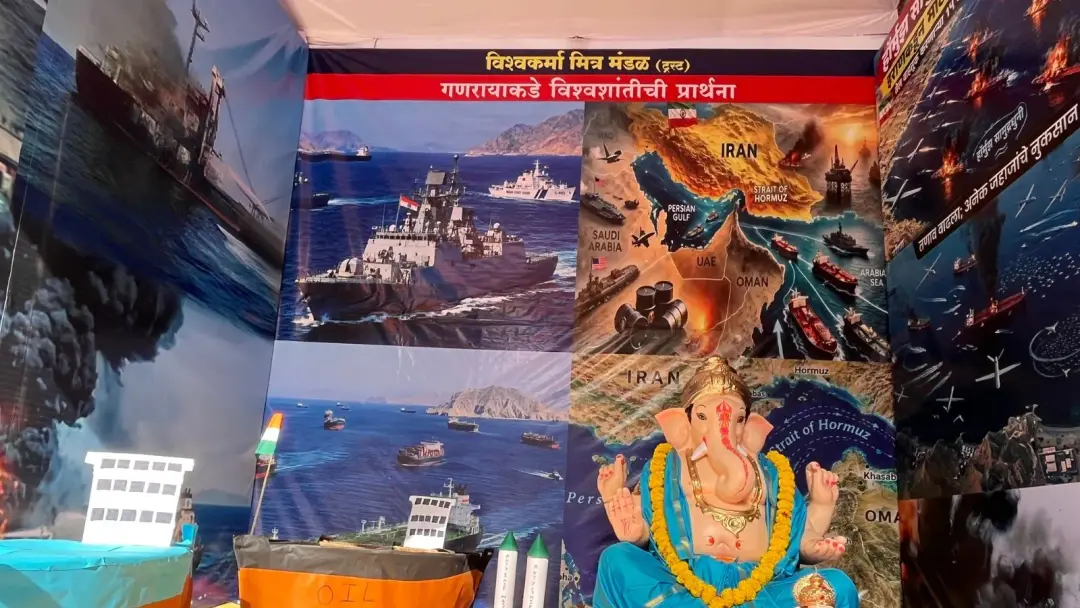
Pune Ganesh pandal recreates Strait of Hormuz crisis
The Vishwakarma Mitra Mandal Trust in Narayan Peth, Pune, has themed its Ganesh pandal this year on tensions in the Strait of Hormuz instead of traditional mythology. The open-air installation features mock Indian-flagged ships marked 'Oil' and 'Gas', missiles, fighter jets and smoke-emitting tankers, with a map showing Iran, Saudi Arabia, Oman and the UAE. A section titled 'The Economic Ripple Effect' explains fuel price rises. Organiser Sachin Dabke said the aim was public awareness of what causes petrol hikes.
Source
Indian Express — Cities · read the original report ↗
Desk check · compared with the source
What the desk checked (5)
- Vishwakarma Mitra Mandal Trust in Narayan Peth, Pune, built a pandal themed on the Strait of Hormuz conflict. — Attributed to the source's on-site reporting; mandal named in source.
- The installation shows mock Indian-flagged ships marked 'Oil' and 'Gas', missiles, fighter jets and damaged tankers, with a map naming Iran, Saudi Arabia, Oman and the UAE. — Descriptive detail reported in the source; figures and names appear as given.
- A section titled 'The Economic Ripple Effect' explains how naval blockades raise crude supply costs, fuel prices and inflation. — Described as an exhibit panel in the source; economic claim is the display's, not independently assessed.
- Organiser Sachin Dabke said the aim was to promote scientific temperament and awareness of geopolitics. — Direct quote attributed to a named organiser.
- The mandal displayed the message 'Ganraykade Vishwashantichi Prarthana' (a prayer to Lord Ganesha for world peace). — Appears in source as observed detail.
Analysts’ view opinion
Pune's Ganesh pandals have long doubled as public platforms that mirror popular mood, and the Narayan Peth mandal's switch from mythology to Strait of Hormuz tensions is a notable turn in that tradition. By framing fuel price rises as a consequence of distant maritime geopolitics rather than domestic policy choices, the display offers a narrative some parties will find convenient and others awkward. That said, the organisers state their aim is promoting a scientific temperament, and the story names no party and records no political endorsement.
- In Maharashtra, festival pandals are a well-established channel for social and political messaging, so the choice of an international-affairs theme is itself significant.
- An explanation that pins petrol prices on global supply chokepoints can indirectly blunt opposition attacks on pricing.
- Equally, pushing fuel prices into festival-season conversation is politically sensitive for any incumbent — the exhibit can cut both ways.
- The accompanying prayer for world peace signals a deliberate neutrality that avoids blaming any single country and keeps the mandal out of controversy.
- If 'awareness' installations catch on, pandals could become an attractive messaging space for parties and campaign managers alike.
What to watch — Watch whether other prominent mandals adopt similar geopolitical or economic themes this season, and whether political leaders visit and comment on the installation.
The story establishes no party or government involvement in the pandal, and offers no evidence of a political motive behind the theme.
Deep dive
Research brief · 8 facts · 2 dates · exam-readyThe brief
Context
Ganesh pandals in Pune are temporary festival installations that traditionally draw on mythology, heritage or live performance themes. This year the Vishwakarma Mitra Mandal Trust in Narayan Peth has instead built an open-air installation on maritime tensions in the Strait of Hormuz, a vital shipping choke point, to show how a distant geopolitical crisis affects household fuel bills. The display combines mock Indian-flagged oil and gas ships, missiles and a regional map with an explanatory section on the economic fallout.
Key facts
- The pandal is set up by the Vishwakarma Mitra Mandal Trust in Narayan Peth, Pune, and is themed this year on the escalating conflict in the Strait of Hormuz.
- The open-air installation depicts naval standoffs, missiles and international maritime tensions.
- Mock Indian-flagged ships labelled 'Oil' and 'Gas' are shown alongside active missiles, mirroring maritime standoffs in the choke point.
- A detailed map behind the main Ganpati idol identifies Iran, Saudi Arabia, Oman and the UAE as key regional players.
- Artistic depictions show ships stuck in maritime congestion across the Arabian Sea, fighter jets overhead and black smoke rising from damaged tankers.
- A section titled 'The Economic Ripple Effect' shows how naval blockades choke global crude supplies, raising local fuel prices and contributing to everyday inflation.
- Organiser Sachin Dabke said: "People should be aware of how and what causes petrol hikes", adding the mandal wanted to promote a more scientific temperament.
- The mandal has displayed the message 'Ganraykade Vishwashantichi Prarthana' (a prayer to Lord Ganesha for world peace).
Timeline
- This year's Ganesh festivalVishwakarma Mitra Mandal Trust, Narayan Peth, unveils a Strait of Hormuz geopolitics-themed pandal instead of a mythological theme.
- Before the festival returns next yearThe mandal's displayed message expresses hope that the global conflict will subside.
Who has a stake
- Vishwakarma Mitra Mandal Trust, Narayan Peth — Organiser of the pandal; seeks to use festival footfall to spread awareness of geopolitics and scientific temperament.
- Sachin Dabke, organiser — Wants visitors to understand the causes of petrol price hikes and take more interest in geopolitics.
- Pandal visitors and Pune residents — Audience for the display; as consumers they face fuel price rises and everyday inflation explained in the exhibit.
- Other Ganesh mandals — Conventionally use mythology, heritage or live-performance themes; face an alternative model of issue-based pandal design.
- Regional players shown on the map - Iran, Saudi Arabia, Oman, UAE — Depicted as key actors around the Strait of Hormuz whose tensions affect global crude supply.
Why it matters
A neighbourhood festival installation is being used as a public-education tool, linking a distant maritime standoff to the petrol pump price Indian households pay. It shows how mass religious festivals can carry civic and scientific messaging, and it underlines how dependent India's daily economy is on crude flowing through a single shipping choke point.
UPSC angle
Prelims pointers
- Strait of Hormuz: a vital shipping choke point for global crude oil, the theme of the Narayan Peth pandal.
- Countries identified on the pandal's map: Iran, Saudi Arabia, Oman and the UAE.
- Vishwakarma Mitra Mandal Trust, Narayan Peth, Pune, is the organising mandal.
- The exhibit's economic section is titled 'The Economic Ripple Effect', linking naval blockades to fuel prices and inflation.
- Ships in the installation are shown stuck in maritime congestion across the Arabian Sea.
- 'Ganraykade Vishwashantichi Prarthana' - a prayer to Lord Ganesha for world peace - is displayed at the pandal.
Mains framing
The Pune pandal illustrates how India's energy security is tied to a narrow maritime choke point: as the installation's 'Economic Ripple Effect' section argues, naval blockades or standoffs in the Strait of Hormuz can choke global crude supplies, raise local fuel prices and feed everyday inflation. The depiction of Indian-flagged 'Oil' and 'Gas' ships amid missiles and congested Arabian Sea traffic captures the vulnerability of import-dependent supply chains and the exposure of commercial shipping to conflict. Equally significant is the communication dimension: the organiser explicitly frames the theme as an attempt to build awareness of what causes petrol hikes and to promote a 'scientific temperament' rather than only mythological or performance themes, using a mass festival as a civic classroom. The way forward, on the source's own terms, lies in wider public literacy about geopolitics and supply chains, alongside the mandal's stated prayer for world peace and hopes that the conflict subsides before the next festival; the source does not detail any government or policy response.
Key terms
- Strait of Hormuz
- The vital maritime shipping choke point, site of the escalating conflict recreated by the pandal.
- Ganesh pandal
- Temporary festival installation housing the Ganpati idol, usually themed on mythology or heritage.
- Vishwakarma Mitra Mandal Trust
- The Narayan Peth, Pune mandal that created the geopolitics-themed open-air installation.
- The Economic Ripple Effect
- Section of the exhibit showing how blockades cut crude supply, push up fuel prices and fuel inflation.
- Ganraykade Vishwashantichi Prarthana
- Message at the pandal meaning 'a prayer to Lord Ganesha for world peace'.
- Scientific temperament
- The outlook the organiser says the pandal wants to promote through an issue-based, informative theme.
Practice questions
- How do disruptions in maritime choke points such as the Strait of Hormuz transmit into domestic fuel prices and inflation in India? Discuss with reference to the themes depicted in the Pune pandal.
- Community festivals are increasingly used as platforms for public awareness. Examine the potential and limits of such spaces in building scientific temperament and civic literacy.
- Discuss India's energy import vulnerability with reference to the Gulf region actors - Iran, Saudi Arabia, Oman and the UAE - highlighted in the installation.
Grounded only in the source report — figures and dates are the source's, not inferred.