
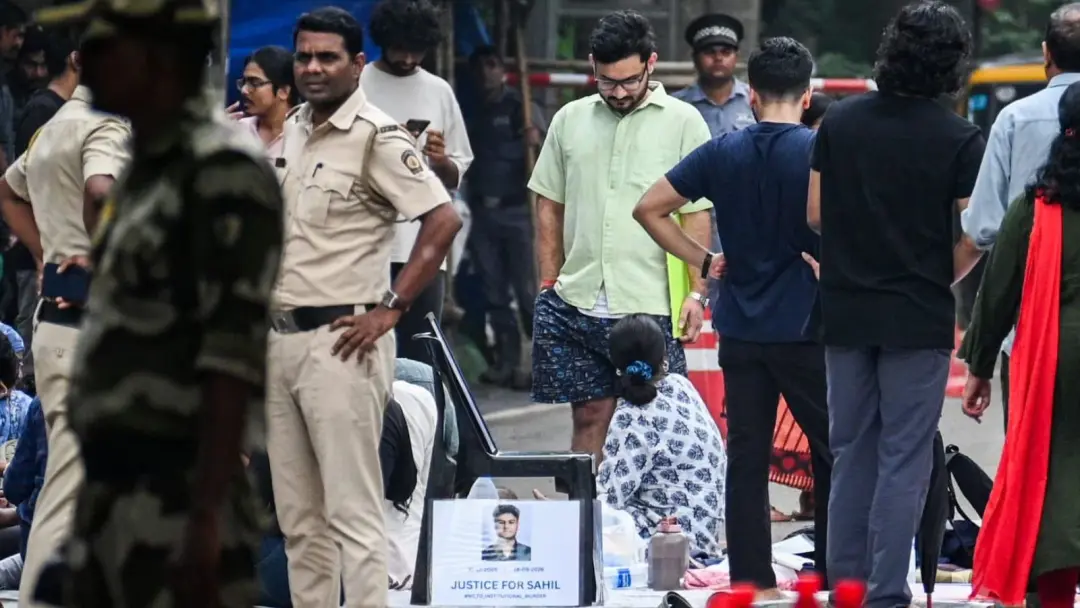
IIT Bombay panel to review exam misconduct action after student's death
IIT Bombay has constituted a committee with equal faculty and student representation to frame student-friendly Standard Operating Procedures for invigilators, days after second-year BTech student Sahil Wakode died by suicide following allegations that he was found with a mobile phone in an examination hall. Proposals include letting a student speak to a mentor before facing a disciplinary committee and printing malpractice consequences on answer sheets. Remaining mid-semester exams were deferred to October 10 and 11.
Source
Indian Express — Cities · read the original report ↗
Desk check · some claims need care
What the desk checked (5)
- Sahil Wakode, a second-year BTech student, died by suicide at an IIT Bombay hostel after allegedly being found with a mobile phone in an exam hall — Reported as alleged in the source; institute's initial statement cited use of an AI platform to seek answers.
- A newly constituted committee with equal faculty and student representation will frame student-friendly SOPs for invigilators — Attributed to an email from the General Secretary (Academics), quoted in the source.
- Remaining mid-semester exams, earlier moved to September 26-27, will now be held on October 10 and 11 — Attributed to a communication from the Dean Academic Programmes; dates appear in source.
- Proposals include letting students speak to a student mentor before facing a disciplinary committee and printing malpractice consequences on answer sheets — Attributed only to unnamed sources; no official confirmation in source text.
- The institute is reviewing disciplinary rules for academic malpractice notified in July 2026 — Attributed to sources; the date is internally inconsistent with the story's timeline and needs verification.
Analysts’ view opinion
IIT Bombay's response is a classic post-crisis governance correction: the substantive rules on academic misconduct are not being torn up, but the process around them is being redesigned so that enforcement does not itself become the harm. The two headline proposals — a mentor conversation before a student faces a disciplinary committee, and printing the consequences of malpractice on the answer sheet's first page — are low-cost, procedural fixes aimed at transparency and de-escalation rather than leniency. The most consequential structural change may be the quietest one: equal faculty-student representation on the committee, which partly answers a student demand charter and shifts who gets a seat when disciplinary norms are written.
- The design logic here is procedural rather than punitive — the review targets how existing misconduct rules are implemented, not whether malpractice should carry consequences.
- Printing consequences on the answer sheet addresses an information asymmetry problem: institutions often assume rules are known, when unclear stakes can cause students to both under- and over-estimate the fallout.
- Equal student representation on a rule-framing committee is a notable governance departure from the usual faculty-led disciplinary architecture, and follows students' own demand for a voice in decision-making bodies.
- Implementation will hinge on invigilators, who are being asked to follow step-by-step SOPs in high-pressure, real-time situations — training and consistency, not drafting, are the harder part.
- The requirement of Senate approval before rollout is a real safeguard against ad-hoc, grief-driven rulemaking, but it also means the timeline and final shape remain open.
What to watch — Watch whether the Senate adopts the SOPs largely intact and how the mentor-consultation step is operationalised without delaying or diluting due process — and whether other IITs pick up a similar model.
The story does not establish any causal link between the alleged exam incident, the handling of it and the student's death, nor does it resolve the separate caste-bias allegations made by the family; the committee's proposals are still under discussion, not adopted policy.
Deep dive
Research brief · 8 facts · 5 dates · exam-readyThe brief
Context
Sahil Wakode, a second-year BTech student at IIT Bombay, died by suicide at a campus hostel after allegedly being found with a mobile phone inside an examination hall during mid-semester examinations; the institute's initial statement said he was allegedly found using an AI platform to seek answers. His death triggered campus protests, an FIR and allegations by his parents of caste bias. IIT Bombay has now constituted a committee with equal faculty and student representation to frame student-friendly Standard Operating Procedures (SOPs) for invigilators and to review how suspected academic misconduct cases are handled. Remaining mid-semester exams have been deferred again, to October 10 and 11.
Key facts
- Sahil Wakode, a second-year BTech student at IIT Bombay, died by suicide at a hostel after allegedly being found with a mobile phone in an exam hall during mid-semester examinations.
- IIT Bombay's initial statement said he was allegedly found using an AI platform to seek answers to questions.
- A newly constituted IIT Bombay committee with equal representation of faculty and students will frame student-friendly SOPs for invigilators and revise academic misconduct rules.
- Students submitted a charter of 18 demands to the IIT Bombay director on September 20, including greater representation in decision-making bodies.
- Mid-semester papers, postponed on September 18 and rescheduled for September 26 and 27, will now be held on October 10 and 11, per a Dean Academic Programmes communication.
- One proposal allows a student accused of malpractice to speak to their student mentor before appearing before a disciplinary committee; every fresher is assigned a senior student mentor.
- Another proposal is to print the rules and possible consequences of exam malpractice on the first page of the answer sheet, for clarity and as a deterrent.
- The revised SOP and rules will be placed before the Senate for approval before implementation; the institute is reviewing disciplinary rules for academic malpractice notified in July 2026 (as stated in the source).
Timeline
- September 18Remaining mid-semester examinations postponed after the incident; papers rescheduled for September 26 and 27.
- September 20Students submit a charter of 18 demands to the IIT Bombay director, including greater student representation in decision-making bodies.
- Days after the student's deathAn FIR is filed; parents allege caste bias; protests rock the campus.
- Subsequently (date not stated in the source)New committee with equal faculty-student representation constituted; General Secretary (Academics) emails students about it.
- October 10 and 11Remaining mid-semester examinations to be held after further postponement.
Who has a stake
- Family of Sahil Wakode — Loss of their son; parents have alleged caste bias and regret telling him to ignore casteist remarks; an FIR has been filed.
- IIT Bombay students — Fairness and transparency of misconduct proceedings, exam schedules, mental health support and representation in decision-making bodies.
- IIT Bombay administration / Dean Academic Programmes — Credibility of exam integrity processes and duty of care; must revise procedures and reschedule examinations.
- Invigilators and faculty — Need clear, step-by-step instructions on conducting exams and handling suspected misconduct at each stage.
- IIT Bombay Senate — Final approval authority for the revised SOP and academic misconduct rules before implementation.
- Student mentors and General Secretary (Academics) — Proposed role in supporting accused students and communicating changes to the student body.
Why it matters
A student's death has forced a premier technical institute to ask whether its disciplinary process itself becomes a source of unbearable stress, not just whether its rules are correct. The response — equal student representation on the reviewing committee, mentor access before a disciplinary hearing, and consequences printed on answer sheets — reframes exam integrity as a question of due process and mental health, with implications for campuses across India, especially as AI tools complicate what counts as malpractice.
UPSC angle
Prelims pointers
- Sahil Wakode was a second-year BTech student at IIT Bombay; institute said he was allegedly found using an AI platform in an exam hall.
- New IIT Bombay committee: equal faculty and student representation; task is student-friendly SOPs for invigilators plus revised misconduct rules.
- Students' charter of 18 demands submitted to the IIT Bombay director on September 20 sought greater representation in decision-making bodies.
- Exam timeline: postponed September 18, rescheduled to September 26-27, then deferred to October 10-11.
- Revised SOP and rules require approval of the IIT Bombay Senate before implementation.
- Proposals: mentor consultation before disciplinary committee; malpractice consequences printed on page one of answer sheets.
Mains framing
The IIT Bombay case illustrates how institutional disciplinary processes, even when substantively justified, can generate disproportionate psychological harm when they lack procedural clarity, support and student voice. The immediate trigger was a suspected exam malpractice case involving a mobile phone and, per the institute's initial statement, an AI platform — an area where rules are still catching up with technology. The deeper causes flagged in the episode include students' unfamiliarity with the consequences of malpractice, absence of step-by-step guidance for invigilators, the isolating effect of being summoned before a disciplinary committee, and unaddressed grievances about representation and, as the parents allege, caste bias. The institute's response is instructive as a template: a committee with equal student representation, SOPs specifying action at each stage, access to a senior student mentor before a hearing, printing rules and consequences on the first page of answer sheets as both notice and deterrent, Senate approval for revised rules, and recirculation of information on campus mental health support. The way forward lies in separating the integrity function from the punitive experience — ensuring proportionality, prior notice, a support person, timely resolution and grievance redress — while keeping examination conduct fair and consistent.
Key terms
- Standard Operating Procedure (SOP)
- A written, step-by-step protocol; here, for invigilators handling exams and suspected academic misconduct, including action at each stage.
- Academic misconduct / exam malpractice
- Violations such as copying or using prohibited devices in an exam hall, attracting disciplinary consequences under institute rules.
- Disciplinary committee
- The institute body before which a student accused of malpractice appears and which decides consequences.
- Senate (IIT Bombay)
- The institute's academic decision-making body; the revised SOP and misconduct rules must be approved by it before implementation.
- Student mentor
- A senior student, with three to four years on campus, assigned to every fresher; proposed as first point of contact for a student accused of malpractice.
- General Secretary (Academics)
- Elected student office-bearer who communicated the committee's constitution and exam schedule changes to students.
Practice questions
- Disciplinary processes in higher education institutions must balance academic integrity with students' mental well-being. Examine in the light of the IIT Bombay case and the reforms proposed by its new committee.
- How does student representation in institutional decision-making bodies improve the legitimacy and fairness of disciplinary action? Discuss with reference to the 18-point charter submitted at IIT Bombay.
- The use of AI tools has blurred the boundaries of examination malpractice. Suggest procedural safeguards institutions should adopt while framing and enforcing rules on academic misconduct.
Grounded only in the source report — figures and dates are the source's, not inferred.