
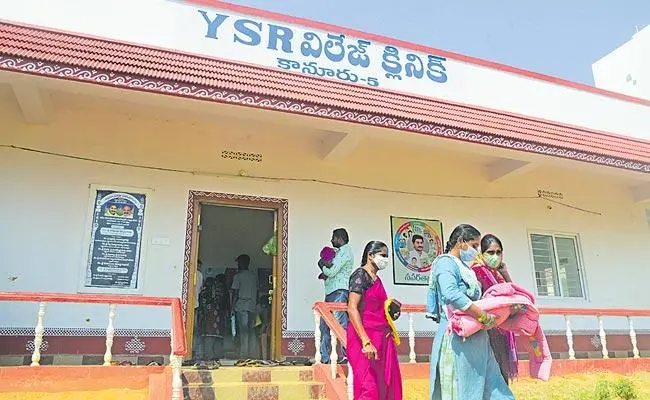
Andhra Pradesh to review village clinic health officers monthly
The Andhra Pradesh medical and health department will review the performance of community health officers at YSR village clinics every month, with the aim of improving services for rural residents. Fourteen indicators have been finalised, including OP and telemedicine services, identification of high-risk pregnant women, and immunisation. Incentives of up to Rs 15,000 a month are linked to performance. The state's 10,032 clinics offer 12 medical services, 14 tests and 67 medicines.
Source
Bhadradri Kothagudem — ఆరోగ్యం · read the original report ↗
Desk check · compared with the source
What the desk checked (5)
- 10,032 village clinics have been set up across Andhra Pradesh. — Figure appears in the source, attributed to the state government; no document or official named.
- CHO performance will be reviewed monthly against 14 finalised indicators. — Attributed to the medical and health department in the source; indicator list partially itemised.
- CHOs receive performance-based incentives of up to Rs 15,000 a month. — Figure stated in source as the department's existing practice; no order number or source given.
- Clinics offer 12 types of medical services, 14 types of tests and 67 medicines. — Figures appear in the source without independent attribution.
- PHC doctors visit village clinics twice a month under the family doctor system. — Stated in source as current practice; not attributed to a named official.
Analysts’ view opinion
This marks a shift in primary health policy from building infrastructure to measuring performance. With 10,032 village clinics in place and BSc nursing graduates appointed as Community Health Officers, the state is now tying a monthly review across 14 indicators to an incentive of up to Rs 15,000. The choice of indicators — OP load, telemedicine, high-risk pregnancy identification, full immunisation, NCD survey progress — signals clear priorities around maternal-child health and prevention, but the real test of any indicator-linked incentive lies less in its design than in how the data is verified.
- This is not a new scheme so much as a governance reform: it standardises measurement for an incentive that already existed.
- If the indicators lean heavily on countable activity — registrations, surveys, OP numbers — there is a familiar risk of volume being rewarded over quality of care.
- Including telemedicine is sensible, but performance there depends on connectivity and specialist availability, factors largely outside a CHO's control.
- PHC doctors visiting village clinics twice a month gives the review a ready supervisory channel, though the reviewer and the reviewed need clear separation.
- Without adjustment for population size, terrain and remoteness, CHOs posted in the hardest areas could score worst for reasons unrelated to effort.
What to watch — Watch whether the weightage of the 14 indicators, the data-verification method and an appeals route are published — and whether incentives are actually disbursed on time each month.
The story does not set out the full list of indicators, their weightage, who audits the data or the consequences of low scores, and it does not establish that monthly review will translate into better health outcomes.
Deep dive
Research brief · 8 facts · 3 dates · exam-readyThe brief
Context
Andhra Pradesh has set up 10,032 YSR Village Clinics across the state as the first point of care in rural areas, staffed by Community Health Officers (CHOs) recruited from B.Sc Nursing graduates. These clinics are linked to Primary Health Centres through telemedicine and the state's Family Doctor scheme. The medical and health department has now finalised a set of indicators to review CHO performance every month, with monthly incentives tied to the assessment.
Key facts
- The AP medical and health department will review the performance of Community Health Officers (CHOs) at YSR Village Clinics every month.
- 14 indicators have been finalised to assess CHO service delivery and performance over a one-month period.
- CHOs receive a performance-linked incentive of up to Rs 15,000 per month from the health department.
- The state has set up 10,032 village clinics to deliver medical care within villages.
- B.Sc Nursing qualified candidates have been appointed as CHOs in these clinics.
- Village clinics provide 12 types of medical services, 14 types of tests and stock 67 types of medicines.
- Indicators include OP and telemedicine services, identification and counselling of high-risk pregnant women, child registration on the RCH portal, full immunisation of children under one year, and NCD survey progress.
- Under the Family Doctor system, PHC doctors visit each village clinic twice a month.
Timeline
- Earlier (date not stated in the source)Government establishes 10,032 YSR Village Clinics statewide and appoints B.Sc Nursing graduates as CHOs.
- OngoingTelemedicine consultations with PHC doctors and hub specialists, and twice-monthly PHC doctor visits under the Family Doctor system.
- Now (as reported)14 performance indicators finalised; monthly review of CHOs to be used as the basis for incentives of up to Rs 15,000.
Who has a stake
- Community Health Officers (CHOs) — Monthly performance assessment on 14 indicators determines their incentive of up to Rs 15,000 per month.
- AP Medical and Health Department — Seeks measurable improvement in rural health service delivery through village clinics.
- Rural residents of Andhra Pradesh — Access to 12 medical services, 14 tests, 67 medicines and specialist consultation without travelling far.
- Pregnant women and children under one year — High-risk pregnancy identification, counselling, RCH portal registration and full immunisation are review indicators.
- PHC doctors and hub specialists (general medicine, gynaecology, paediatrics) — Provide telemedicine consultations and twice-monthly visits under the Family Doctor system.
Why it matters
Village clinics are the first contact point for rural healthcare, and their effectiveness depends largely on a single frontline provider, the CHO. Linking a monthly review on 14 measurable indicators to an incentive of up to Rs 15,000 shifts rural primary care towards outcome-based accountability in areas like immunisation, maternal risk detection and non-communicable disease screening.
UPSC angle
Prelims pointers
- Andhra Pradesh has 10,032 YSR Village Clinics; CHOs there are B.Sc Nursing qualified.
- Each village clinic offers 12 types of medical services, 14 types of tests and 67 types of medicines.
- CHO performance to be reviewed monthly on 14 indicators; incentive up to Rs 15,000 a month.
- RCH portal is used for registration of children; full immunisation of under-one children is an indicator.
- Telemedicine links village clinics to PHC doctors and hub specialists in general medicine, gynaecology and paediatrics.
- Under the Family Doctor system, PHC doctors visit village clinics twice a month.
Mains framing
Andhra Pradesh's decision to review Community Health Officers at its 10,032 YSR Village Clinics every month against 14 finalised indicators reflects a shift from input-based to performance-linked primary healthcare delivery. The chosen indicators — outpatient and telemedicine consultations, identification and counselling of high-risk pregnant women, registration of children on the RCH portal, full immunisation of infants and progress of the NCD survey — map onto the key gaps in rural health: maternal risk detection, child immunisation coverage and the rising burden of non-communicable diseases. Tying an incentive of up to Rs 15,000 a month to these measures can sharpen frontline accountability, while telemedicine access to PHC doctors and hub specialists in general medicine, gynaecology and paediatrics, plus twice-monthly PHC doctor visits under the Family Doctor system, supplies the clinical backstop a single nursing-trained officer needs. The way forward lies in ensuring that the indicators measure quality rather than mere numbers, that data reporting burdens do not crowd out patient care, and that supply-side support — the 67 medicines, 14 tests and referral linkages — is uninterrupted, so that the review drives real health outcomes rather than paperwork.
Key terms
- YSR Village Clinic
- Andhra Pradesh's village-level health facility, 10,032 in number, offering 12 medical services, 14 tests and 67 medicines.
- Community Health Officer (CHO)
- B.Sc Nursing qualified frontline officer posted at a village clinic, whose performance is now reviewed monthly.
- Telemedicine
- Remote consultation facility at village clinics with PHC doctors and hub specialists such as general physicians, gynaecologists and paediatricians.
- RCH portal
- Reproductive and Child Health portal where registration of children is recorded; one of the 14 performance indicators.
- Family Doctor system
- Arrangement under which PHC doctors visit each village clinic twice a month.
- NCD survey
- Non-communicable disease screening survey whose progress is tracked as a CHO performance indicator.
Practice questions
- Discuss how performance-linked monitoring of frontline health workers can strengthen rural primary healthcare, using Andhra Pradesh's monthly review of Community Health Officers as an example.
- Examine the role of telemedicine and the Family Doctor system in bridging the specialist shortage at the village level.
- What are the risks of indicator-based incentives in public health delivery, and how can states guard against target-chasing at the cost of quality of care?
Grounded only in the source report — figures and dates are the source's, not inferred.