
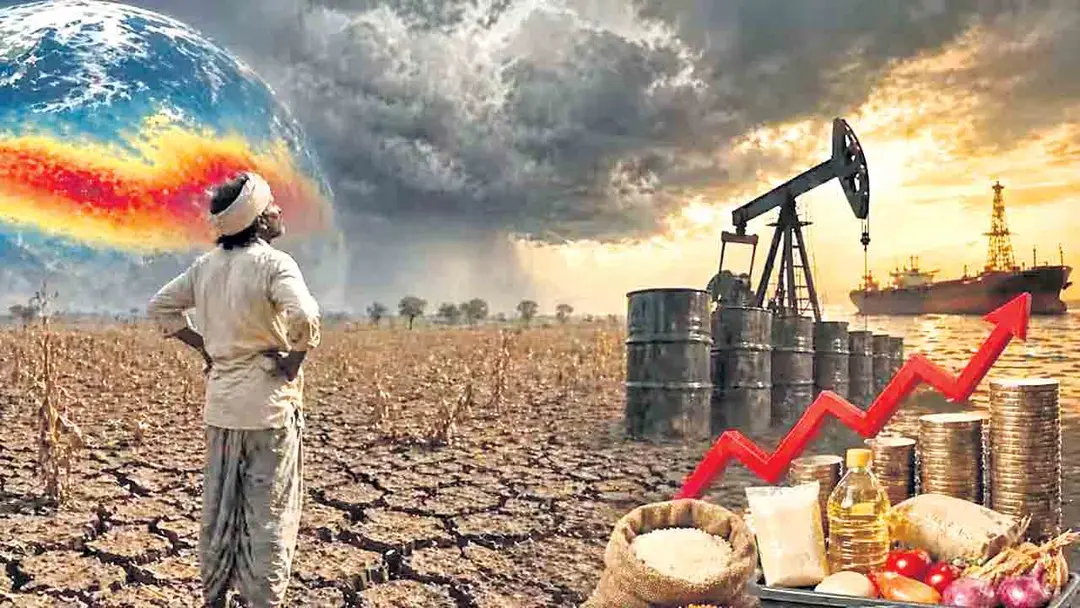
Moody's warns of inflation risk for India on oil, weak rains
Global credit ratings agency Moody's has warned that India faces an inflation risk from rising crude oil prices and rainfall deficits caused by El Nino. Amid renewed Middle East tensions, crude has crossed $100 a barrel, weighing on India, which meets most of its energy needs through imports. Poor rains have left crops short of water, raising expectations of tighter food supply. Moody's, however, raised India's 2026-27 GDP growth forecast to 7% from 6%.
Source
Namasthe Telangana · read the original report ↗
Desk check · some claims need care
What the desk checked (5)
- Moody's has warned India faces inflation risk from rising crude oil prices and El Nino-linked rainfall deficits — Attributed to Moody's Ratings in the source; no report title or spokesperson cited.
- Crude oil has crossed $100 a barrel amid Middle East tensions involving the US, Israel and Iran — Figure appears in source but is unattributed; no market data or date reference given.
- Iran is attacking Gulf countries and disrupting shipping in the Strait of Hormuz — No source given; sensitive geopolitical claim an editor should verify independently.
- Moody's raised India's GDP growth forecast for 2026-27 to 7% from 6% — Attributed to Moody's in the source; specific figures stated without report reference.
- Weak monsoon rainfall is leaving crops without irrigation and may curb food supply — Presented as observation in the source with no data or official agency cited.
Analysts’ view opinion
Moody's is not telling two contradictory stories — it is describing two sides of the same coin. On one side is a price threat (imported crude plus a rain-deficit squeeze on food supply); on the other is an upgrade of the growth forecast from 6% to 7% — meaning the economy is absorbing the shock, but the shock is landing on the household as higher prices. With crude past $100 a barrel, a country meeting most of its fuel needs through imports sees the cost seep into every sector via the import bill and freight. Crucially, this is supply-side inflation, not demand-driven — which is exactly the kind that is hardest for policymakers to control.
- Fuel and food rising together is the most painful combination, because both take the largest share of an ordinary household budget.
- The burden falls mainly on lower-income households and transport-dependent small businesses; the gainers are oil-exporting economies and larger firms with pricing power and inventory cushions.
- If rainfall deficits cut yields, farm incomes and rural purchasing power weaken, which can slow demand in consumption-facing sectors.
- A higher growth forecast does not cancel the price risk — output can stay strong while real incomes get eroded by inflation.
- Interest rates are a blunt tool against supply shocks, which tightens the trade-off between monetary tightening and the fiscal cost of cushioning consumers.
What to watch — Watch the actual crop output numbers as the monsoon season closes, and whether shipping through the Strait of Hormuz stays unimpeded — those two will set the price direction over the coming months.
The story does not establish how high inflation may go, over what period, or what the policy response will be — this is one rating agency's assessment, not a settled outcome.
Deep dive
Research brief · 8 facts · 4 dates · exam-readyThe brief
Context
Global credit ratings agency Moody's Ratings has flagged an inflation risk for India arising from two simultaneous shocks: crude oil prices crossing $100 a barrel amid the US and Israel-Iran conflict in West Asia, and a monsoon rainfall deficit linked to El Nino. India imports the majority of its energy needs, so higher crude prices feed directly into domestic costs, while its largely rain-fed agriculture is vulnerable to weak rains. Even so, Moody's raised India's GDP growth forecast for the current financial year (2026-27) to 7 per cent from 6 per cent, citing India's resilience to the West Asia crisis.
Key facts
- Moody's Ratings warned that India faces an inflation risk from rising crude oil prices and rainfall deficits caused by El Nino (report dated September 18, New Delhi).
- Crude oil in the international market has crossed $100 a barrel amid the US and Israel-Iran war.
- India meets the majority of its energy requirements through imports, so high crude prices hit it hard.
- Iran is attacking Gulf countries for allegedly backing the US and is disrupting cargo ship movement in the strategic Strait of Hormuz.
- El Nino has significantly reduced rainfall this season; with the monsoon nearing its end, there have been no notable rains.
- Crops are drying up in many areas for want of irrigation water, raising expectations that food supply may fall short of market demand.
- Moody's raised India's GDP growth forecast for the current financial year (2026-27) to 7 per cent, up from 6 per cent earlier.
- Moody's said India is withstanding the impact of the West Asia crisis strongly, which is why it raised its estimates.
Timeline
- Earlier (period not specified in the source)Crude oil prices had eased after an initial spike, before rising again.
- Current monsoon seasonEl Nino-linked conditions cut rainfall sharply; crops dry up in many regions as the season nears its end.
- September 18 (New Delhi)Moody's warns of inflation risk from crude prices above $100 a barrel and rain deficits, while raising the 2026-27 GDP growth forecast to 7 per cent from 6 per cent.
- September 19, 2026, 02:15 AM ISTReport published.
Who has a stake
- Moody's Ratings — Global credit ratings agency whose assessment of India's inflation risk and growth outlook influences investor perception.
- Indian economy / government — Faces imported inflation from crude above $100 a barrel even as growth is projected at 7 per cent for 2026-27.
- Indian farmers and agriculture sector — Largely rain-fed; deficient rainfall and lack of irrigation water are causing crops to dry up.
- Consumers — Risk of higher fuel and food prices if food supply falls short of demand.
- Iran, Israel, the US and Gulf countries — Conflict and attacks are disrupting energy production, supply and shipping through the Strait of Hormuz.
Why it matters
India's inflation path is being squeezed from both the supply sides that it controls least: imported crude and the monsoon. With oil above $100 a barrel due to West Asian conflict and rain-fed crops failing in many regions, fuel and food prices could rise together even as headline growth stays strong at a projected 7 per cent.
UPSC angle
Prelims pointers
- Moody's is a global credit ratings agency; it warned of India's inflation risk on crude and rainfall deficits.
- Moody's GDP growth forecast for India for 2026-27 raised to 7 per cent from 6 per cent.
- Crude oil crossed $100 a barrel amid the US and Israel-Iran war.
- Strait of Hormuz: key chokepoint where Iran is disrupting cargo shipping, affecting energy supply.
- El Nino is cited as the cause of this season's sharp rainfall deficit in India.
- India meets the majority of its energy needs through imports; its agriculture is largely rain-fed.
Mains framing
India's inflation risk, as flagged by Moody's, is essentially a twin supply shock. On the external side, the US and Israel-Iran conflict, Iranian attacks on Gulf countries and disruption of shipping through the Strait of Hormuz have pushed crude past $100 a barrel; because India imports most of its energy, this transmits directly into transport, input and retail costs. On the domestic side, El Nino has cut rainfall sharply this season, and with agriculture largely rain-fed and irrigation water unavailable in many areas, crops are drying up and food supply may lag demand, raising food inflation risk. The paradox is that growth momentum appears intact: Moody's raised the 2026-27 GDP growth forecast to 7 per cent from 6 per cent, saying India is withstanding the West Asia crisis strongly. The policy challenge, therefore, is managing price stability without derailing this growth. The source does not detail specific policy responses; analytically, the implications point to the need to reduce import dependence for energy, strengthen irrigation and drought resilience in agriculture, and monitor supply-side management of food, while remaining alert to geopolitical escalation around critical shipping chokepoints.
Key terms
- Moody's Ratings
- Global credit ratings agency that assesses sovereign and corporate credit risk and issues growth and inflation assessments.
- El Nino
- Climate phenomenon cited in the source as the cause of the sharp rainfall deficit affecting Indian agriculture this season.
- Strait of Hormuz
- Strategic sea passage where Iran is disrupting cargo ship movement, hitting energy supply to India and other countries.
- Crude oil price per barrel
- International benchmark for oil; it has crossed $100 a barrel, raising India's import bill.
- GDP growth forecast
- Projected pace of economic expansion; Moody's put India's 2026-27 figure at 7 per cent, up from 6 per cent.
- Rain-fed agriculture
- Farming dependent on monsoon rainfall rather than assured irrigation, making output vulnerable to rain deficits.
Practice questions
- Examine how crude oil price volatility driven by West Asian conflict transmits into domestic inflation in an import-dependent economy like India.
- India's rain-fed agriculture remains a key source of food inflation. Discuss with reference to the El Nino-linked rainfall deficit cited by Moody's.
- Moody's has raised India's 2026-27 growth forecast to 7 per cent while warning of inflation risk. How should policymakers reconcile growth momentum with price stability?
Grounded only in the source report — figures and dates are the source's, not inferred.