
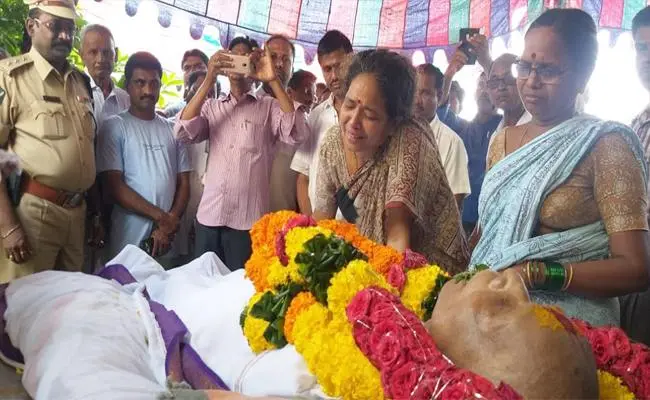
Former MP Narasimha Rao Dora, father of MLA Kalavathi, dies at 95
Vishwaraya Narasimha Rao Dora, 95, former MP and father of Palakonda MLA Vishwaraya Kalavathi, died on Monday after prolonged illness. He began his political career as sarpanch of Vandava in 1956 and won the Parvathipuram Lok Sabha seat as an independent in 1967. He was elected MLA in 1972, 1978 and 1985. He also served as Tribal Corporation chairman and PCC general secretary during a 40-year career. Ministers and MLAs offered condolences.
Source
Palakonda — MLA & నియోజకవర్గం · read the original report ↗
Desk check · compared with the source
What the desk checked (5)
- Former MP Vishwaraya Narasimha Rao Dora, 95, father of Palakonda MLA Vishwaraya Kalavathi, died on Monday after prolonged illness. — Stated in the source; no attending doctor, family member or official named as source.
- He began his political career as sarpanch of Vandava in 1956 and won as an independent MP from Parvathipuram in 1967. — Dates and constituencies appear in the source; no records cited.
- He was elected MLA from Kotturu as an independent in 1972, again in 1978 with the Janata Party, and a third time in 1985 after joining the Congress. — Figures appear in the source as reported history, unattributed.
- He served as Tribal Corporation chairman, PCC general secretary and president of Vandava and Veeraghattam societies over a 40-year political career. — Listed in the source without documentary attribution.
- Ministers and MLAs expressed condolences over his death. — Reported in general terms; no individual named.
Analysts’ view opinion
The death of Viswaraya Narasimha Rao Dora marks the closing of a generation in north Andhra's tribal politics. A career that ran from independent MP to a hat-trick of assembly wins via the Janata Party and then the Congress illustrates how, in agency constituencies, personal and community standing often mattered more than the party symbol. His daughter Kalavathi holds the Palakonda seat on that inherited base, and condolences from ministers and MLAs point to a family respected across party lines.
- Winning as an independent in 1967 and again in 1972 before moving through the Janata Party and the Congress shows how a leader's personal credibility could outweigh the party label in tribal belts.
- Posts such as Tribal Corporation chairman and PCC general secretary illustrate how local community standing was converted into state-level party office.
- Welfare-based credibility built on getting schools and hospitals sanctioned is exactly the kind of record that hardens into a multi-generational support base in agency areas.
- A 40-year arc from village sarpanch in 1956 to MP and MLA represents a grassroots-upward leadership model that has become rarer, making this passing symbolically significant.
- For Kalavathi the loss is personal, but it also raises the political burden of visibly sustaining her father's legacy in the constituency.
What to watch — Watch which party most actively claims this tribal leadership legacy in the Palakonda–Parvathipuram belt through condolence meetings and memorial gestures.
The story records only his life and offices; it establishes nothing about how his death affects current party equations or Kalavathi's political trajectory.
Deep dive
Research brief · 8 facts · 6 dates · exam-readyThe brief
Context
Vishwaraya Narasimha Rao Dora, a veteran tribal leader from the Palakonda-Parvathipuram belt of north coastal Andhra Pradesh, died on Monday at the age of 95 after a prolonged illness. He was a former MP and three-time MLA whose political career spanned about 40 years, beginning as a village sarpanch in 1956. He was the father of sitting Palakonda MLA Vishwaraya Kalavathi, who entered politics as his political heir. Ministers and MLAs offered condolences on his death.
Key facts
- Vishwaraya Narasimha Rao Dora died on Monday at the age of 95 after a prolonged illness.
- He began his political career in 1956 as sarpanch of Vandava.
- In 1967 he contested from the then Parvathipuram parliamentary constituency as an independent and won as MP.
- In 1972 he was elected MLA from Kotturu assembly constituency, again as an independent.
- In 1978 he joined the Janata Party and became MLA for a second time.
- In 1985 he joined the Congress party and completed a hat-trick of MLA wins.
- He served as Tribal Corporation chairman, PCC general secretary, and president of the Vandava and Veeraghattam societies over a 40-year political career.
- Sardar Gouthu Latchanna and Gorle Sriramulu Naidu were his political mentors.
Timeline
- 1956Begins political career as sarpanch of Vandava.
- 1967Wins the Parvathipuram Lok Sabha seat as an independent candidate.
- 1972Elected MLA from Kotturu as an independent.
- 1978Joins the Janata Party and is elected MLA for a second time.
- 1985Joins the Congress and wins as MLA for a third time.
- Monday (date not stated in the source)Dies at 95 after prolonged illness; ministers and MLAs offer condolences.
Who has a stake
- Vishwaraya Kalavathi, Palakonda MLA — Daughter and political heir of the deceased; broke down at her father's body, per the source.
- Tribal communities of the Parvathipuram-Palakonda region — Beneficiaries of schools sanctioned in tribal hamlets and villages and hospitals built during his tenure.
- Congress party / PCC — He was a PCC general secretary and won as a Congress MLA in 1985.
- Janata Party — He contested and won on its platform in 1978.
- Tribal Corporation — He served one term as its chairman, shaping tribal welfare delivery.
- Ministers and MLAs of Andhra Pradesh — Offered condolences, reflecting his standing as a senior political figure.
Why it matters
His career maps how tribal leadership in north coastal Andhra moved from panchayat-level office to Parliament and the assembly, often outside party labels before aligning with Janata and then Congress. The source credits him with getting schools sanctioned in tribal hamlets and villages and building hospitals for tribals at a time when such facilities were scarce, illustrating the link between political representation and basic service delivery in Scheduled Areas.
UPSC angle
Prelims pointers
- Vishwaraya Narasimha Rao Dora: former MP from the then Parvathipuram parliamentary constituency, won as an independent in 1967.
- Elected MLA three times: 1972 (Kotturu, independent), 1978 (Janata Party), 1985 (Congress).
- Began public life as sarpanch of Vandava in 1956; total political career of about 40 years.
- Held posts of Tribal Corporation chairman and PCC general secretary.
- Sardar Gouthu Latchanna and Gorle Sriramulu Naidu were described as his political mentors.
- His daughter Vishwaraya Kalavathi is the sitting MLA of Palakonda.
Mains framing
The life of Vishwaraya Narasimha Rao Dora offers a case study in the evolution of tribal political representation in India. Starting as a sarpanch in 1956, he used the panchayat tier as an entry point, won a Lok Sabha seat as an independent in 1967 and an assembly seat as an independent in 1972, before moving through the Janata Party (1978) and the Congress (1985) — a trajectory that reflects both the strength of personal, community-rooted mandates in tribal constituencies and the eventual pull of organised parties. As per the source, his substantive contribution lay in converting representation into infrastructure: sanctioning schools in tribal hamlets and villages where schooling facilities were lacking, and building hospitals for tribals suffering from serious diseases; he also held institutional positions as Tribal Corporation chairman, PCC general secretary and society president. The implication is that leadership continuity matters — his daughter now represents Palakonda as MLA — but so does the question of whether welfare delivery in tribal areas remains dependent on individual leaders rather than institutionalised systems. The way forward suggested by such careers is strengthening local self-government and corporation-level institutions so that tribal education and health outcomes do not hinge on personal political capital.
Key terms
- Sarpanch
- Elected head of a gram panchayat, the village-level unit of local self-government; Dora's first office, at Vandava in 1956.
- Parvathipuram parliamentary constituency
- The Lok Sabha seat, as it then existed, from which Dora won as an independent in 1967.
- PCC (Pradesh Congress Committee)
- State-level unit of the Congress party; Dora served as its general secretary.
- Tribal Corporation
- State body for tribal welfare and development; Dora was its chairman for one term.
- Janata Party
- Party Dora joined in 1978, winning his second MLA term on its platform.
- Independent candidate
- A contestant without a party ticket; Dora won both his 1967 MP and 1972 MLA elections this way.
Practice questions
- Trace how panchayat-level offices have served as an entry point for tribal leadership in Indian politics, using the career of Vishwaraya Narasimha Rao Dora as an illustration.
- Independents winning Lok Sabha and assembly seats was more common in the 1960s and 1970s than today. Discuss the factors behind this shift in Indian electoral politics.
- Evaluate the role of elected tribal representatives and bodies like state Tribal Corporations in expanding education and health infrastructure in Scheduled Areas.
Grounded only in the source report — figures and dates are the source's, not inferred.