
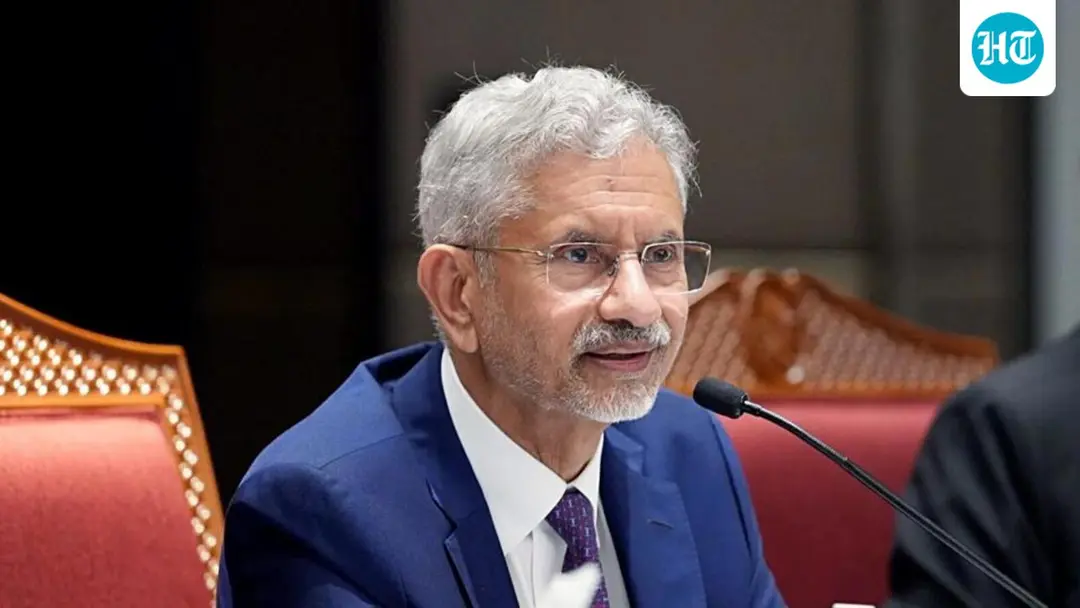
Jaishankar to lead Indian delegation at UN General Assembly
External affairs minister S Jaishankar will lead the Indian delegation to the United Nations General Assembly this week, the external affairs ministry said on Sunday. His address at the high-level session of the 81st General Assembly in New York is scheduled for September 26. Prime Minister Narendra Modi skipped the Assembly last year too, when Jaishankar led the delegation. The general debate runs September 22-28. It is the last session for UN Secretary-General Antonio Guterres.
Source
Hindustan Times — India · read the original report ↗
Desk check · compared with the source
What the desk checked (5)
- Jaishankar will lead the Indian delegation to the UN General Assembly this week. — Attributed in source to the external affairs ministry, stated on Sunday.
- Jaishankar's address at the high-level session of the 81st UNGA in New York is scheduled for September 26. — Attributed to the ministry in the source.
- The general debate runs September 22-28; session theme is 'Restoring trust, managing transformation: A UN that delivers for all'. — Figures and theme appear in the source; no separate attribution given.
- Bangladesh foreign minister Khalilur Rahman will preside over the session, and Bangladesh PM Tarique Rahman speaks on September 24, followed by Pakistan PM Shehbaz Sharif. — Stated in source without attribution; designations are unusual and warrant editorial verification.
- This will be the last General Assembly session for UN Secretary-General Antonio Guterres, whose second five-year term ends in December. — Stated in source without attribution.
Analysts’ view opinion
For the second year running, the Prime Minister is skipping the UN General Assembly and handing the delegation to S. Jaishankar — a choice that looks deliberate rather than accidental, reflecting how this government allocates the PM's scarce political time and normalises ministerial-level representation at multilateral summits. It further consolidates Jaishankar's standing as the public face of Indian foreign policy. With the Pakistani and Bangladeshi prime ministers due to speak from the same podium, the opposition could frame the absence as a downgrade, while the government will defend it as a matter of priorities.
- A second consecutive year of ministerial-level leadership suggests a settled pattern rather than a one-off scheduling call.
- Delivering India's address at the General Assembly further elevates Jaishankar as the government's foreign-policy standard-bearer.
- That the Pakistani and Bangladeshi prime ministers are slated to speak at the same session gives the opposition an easy political talking point.
- The absence of a PM-level speech reduces the high-visibility optics, but the bilateral and plurilateral meetings on the margins offer more transactional diplomatic value.
- With this being Guterres's final session, the visit could also hint at how India positions itself ahead of the succession at the UN's top job.
What to watch — Watch the themes Jaishankar foregrounds in his September 26 address, which bilaterals he holds on the margins, and how sharply the opposition-versus-government exchange over the PM's absence plays out.
The story does not establish why the Prime Minister is not attending, nor what Jaishankar will say or whom he will meet.
Deep dive
Research brief · 8 facts · 7 dates · exam-readyThe brief
Context
The United Nations General Assembly's annual general debate, when heads of state and government set out their countries' positions, is the UN's biggest diplomatic gathering of the year. India's delegation to the 81st session will be led by external affairs minister S Jaishankar rather than Prime Minister Narendra Modi, repeating the arrangement of last year. The session is also the final one for UN Secretary-General Antonio Guterres, whose second five-year term ends in December.
Key facts
- The external affairs ministry said on Sunday that EAM S Jaishankar will lead the Indian delegation to the UN General Assembly this week.
- Jaishankar's address at the high-level session of the 81st UN General Assembly in New York is scheduled for September 26.
- The general debate runs from September 22 to 28, featuring statements by heads of state and government.
- PM Narendra Modi skipped the UN General Assembly last year too, when Jaishankar led the Indian delegation.
- The session theme is "Restoring trust, managing transformation: A UN that delivers for all".
- Per the source, Bangladesh foreign minister Khalilur Rahman will preside over the General Assembly session.
- Bangladesh PM Tarique Rahman addresses the general debate on September 24, followed by Pakistan PM Shehbaz Sharif the next day.
- This is the last General Assembly session for UN Secretary-General Antonio Guterres, whose second five-year tenure ends in December.
Timeline
- Last yearPM Modi skipped the UN General Assembly; Jaishankar led the Indian delegation.
- Sunday (ahead of the session)External affairs ministry announces Jaishankar will lead the Indian delegation.
- September 22-28General debate of the 81st UN General Assembly session in New York.
- September 24Bangladesh PM Tarique Rahman addresses the general debate.
- September 25Pakistan PM Shehbaz Sharif addresses the general debate.
- September 26Jaishankar's address at the high-level session of the 81st UNGA.
- DecemberSecond five-year tenure of UN Secretary-General Antonio Guterres ends.
Who has a stake
- S Jaishankar / Ministry of External Affairs — Presents India's positions at the high-level session and holds plurilateral and bilateral meetings on the margins.
- Prime Minister Narendra Modi — Absent from the UNGA for a second consecutive year, leaving representation to the EAM.
- UN Secretary-General Antonio Guterres — Final General Assembly session before his second five-year term ends in December.
- Bangladesh — Foreign minister Khalilur Rahman presides over the session; PM Tarique Rahman speaks on September 24.
- Pakistan — PM Shehbaz Sharif addresses the general debate on September 25.
- UN member states and the Global South — Session aims to revitalise global cooperation and push the Sustainable Development Goals, climate action and pandemic preparedness.
Why it matters
The general debate is the one annual occasion where India's positions on peace, development and reform of multilateralism are stated before the entire membership, and the level of representation signals how New Delhi ranks the forum. With the session covering SDGs, climate and just transition, sea-level rise and pandemic preparedness, and Pakistan and Bangladesh speaking days before India, the platform also shapes regional narratives. It is Guterres's last session, making it a transition moment for the UN's leadership.
UPSC angle
Prelims pointers
- The 81st UN General Assembly general debate is held September 22-28 in New York; India's address is on September 26.
- Session theme: "Restoring trust, managing transformation: A UN that delivers for all".
- The source says Bangladesh foreign minister Khalilur Rahman will preside over the General Assembly session.
- Antonio Guterres is UN Secretary-General; his second five-year tenure ends in December.
- Side events include the 40th anniversary of the Declaration on the Right to Development and a high-level meeting on pandemic prevention, preparedness and response.
- A plenary meeting marks the International Day for the Total Elimination of Nuclear Weapons.
Mains framing
India's decision to be represented at the 81st UN General Assembly by the external affairs minister rather than the Prime Minister, for the second year in succession, invites analysis of how middle powers calibrate their investment in universal multilateral forums versus plurilateral and bilateral diplomacy — Jaishankar's programme itself combines the high-level address on September 26 with plurilateral and bilateral meetings. The session's agenda, framed by the theme \"Restoring trust, managing transformation: A UN that delivers for all\", concentrates on revitalising global cooperation, giving a critical push to the Sustainable Development Goals, and collective action for peace, dignity and equality on a healthy planet, with dedicated meetings on climate action and just transition, sea-level rise as an existential threat, pandemic prevention and preparedness, the 40th anniversary of the Declaration on the Right to Development, and nuclear disarmament. That agenda maps closely onto India's stated development and climate concerns, giving New Delhi an opening to press Global South priorities. With this being Guterres's final session before his term ends in December, the way forward for India lies in using the general debate and its margins to shape the reform and leadership transition conversation while advancing concrete development and climate outcomes.
Key terms
- UN General Assembly (UNGA)
- Principal deliberative organ of the UN where all member states meet; its 81st session's general debate runs September 22-28.
- General debate
- Annual meeting of heads of state and government at the start of a UNGA session where leaders outline national positions.
- Sustainable Development Goals (SDGs)
- Global development goals the session aims to give a critical push to.
- Declaration on the Right to Development
- UN declaration whose 40th anniversary is being commemorated with a high-level meeting during the session.
- Just transition
- Subject of a session meeting on climate action, concerning a fair shift away from high-emission economies.
- Plurilateral meetings
- Talks among a limited group of countries, which Jaishankar will attend alongside bilateral meetings during the visit.
Practice questions
- What does India's choice to be represented by the external affairs minister rather than the Prime Minister at successive UN General Assembly sessions suggest about its multilateral diplomacy? Discuss.
- The 81st UNGA agenda covers SDGs, just transition, sea-level rise and pandemic preparedness. Examine how these priorities intersect with India's national development and climate concerns.
- Evaluate the significance of the general debate as a platform for shaping regional narratives in South Asia, given that Bangladesh, Pakistan and India speak within days of each other.
Grounded only in the source report — figures and dates are the source's, not inferred.