
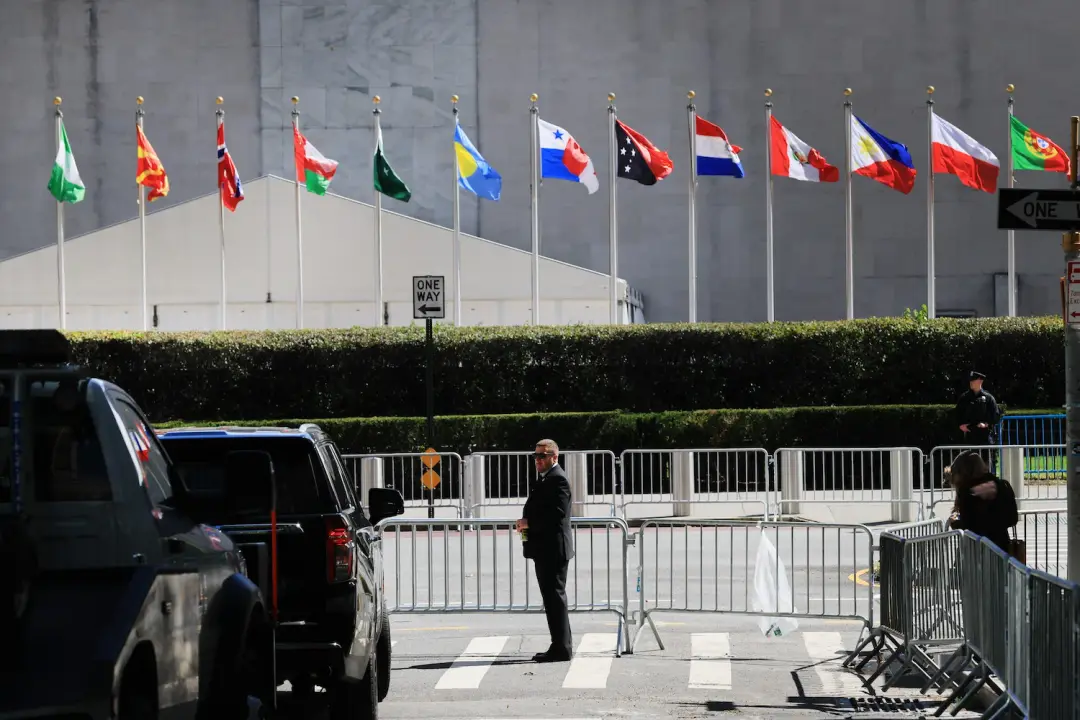
UNGA high-level week opens; Trump to address assembly Tuesday
The high-level week of the 81st U.N. General Assembly session has opened in New York, with more than a dozen leaders including U.S. President Donald Trump due to speak on Tuesday morning. Washington paid over $800 million in pending dues last week but still owes more than $3 billion. Secretary-General Antonio Guterres steps down at year-end, with seven candidates in the race to succeed him. Guterres urged international cooperation on artificial intelligence governance.
Source
Foreign Policy · read the original report ↗
Desk check · some claims need care
What the desk checked (5)
- The U.S. paid more than $800 million in pending U.N. dues, leaving over $3 billion outstanding. — Figures appear in the source, attributed to the reporting; no document cited.
- Guterres will step down at the end of the year after leading the U.N. since 2017. — Stated as fact in the source; no separate attribution given.
- The race to succeed Guterres is down to seven candidates after Michelle Bachelet withdrew, with Rebeca Grynspan the straw-poll front-runner. — Withdrawal attributed to a video on Bachelet's Instagram; straw-poll result described as 'reportedly', so sourcing is indirect.
- Trump will address UNGA Tuesday and host Xi Jinping in Washington on Wednesday, with AI on the agenda. — Scheduled plans attributed to U.S. Ambassador Mike Waltz and the source's reporting; a U.S.-China AI dialogue is described as not formalized.
- A Pew Research Center survey of 37 countries found more than half view the U.N. favourably; Israel had the highest unfavourable share at nearly 80 percent. — Attributed to a named research organisation and dated last month; figures as given in source.
Analysts’ view opinion
This year's General Assembly high-level week is less a speech festival than a simultaneous contest over three things: who funds the UN, who leads it, and who writes the rules for emerging technology. Washington's payment of more than $800 million in dues gives the institution immediate breathing room, but with over $3 billion still outstanding, the United States retains considerable leverage over UN operations including peacekeeping. Guterres's departure at the end of the year, with seven candidates in the running, marks the first leadership transition in a decade — a shift that could set the direction of multilateral diplomacy for years.
- Because the arrears are only partly cleared, financial pressure on the UN budget — particularly peacekeeping — can translate directly into strategic pressure.
- With Trump speaking Tuesday morning, both allies and rivals will read his remarks as a signal of how much the United States intends to invest in multilateral institutions.
- More than a dozen leaders speaking from the same rostrum is a reminder that the real diplomacy at such gatherings usually happens in the meetings alongside the speeches, not in them.
- Guterres's call for international cooperation on artificial intelligence reflects AI's shift from an economic file to a security file, though any framework will remain weak without the major technology powers at the table.
- Choosing a secretary-general is never a purely administrative exercise; it is also a contest of influence among the major powers on the Security Council.
What to watch — Watch the tone Trump takes on the UN and its funding, whether any clarity emerges on the remaining arrears, and which way consensus tilts in the secretary-general race.
The story does not establish what Trump will actually say, when the remaining $3 billion-plus will be paid, or which of the seven candidates will prevail.
Deep dive
Research brief · 8 facts · 10 dates · exam-readyThe brief
Context
The high-level week of the 81st session of the United Nations General Assembly (UNGA) has opened at U.N. headquarters in New York's Turtle Bay, the world's biggest annual diplomatic gathering. Over a dozen leaders, including U.S. President Donald Trump, are scheduled to address the general debate on Tuesday morning. The week is shadowed by U.S. funding arrears and pressure to shrink the U.N. budget, the impending departure of Secretary-General Antonio Guterres at the end of the year, and an intensifying debate over global governance of artificial intelligence.
Key facts
- The general debate of the 81st UNGA session opens with over a dozen leaders set to speak from 9 a.m. ET on Tuesday, including Trump, Brazil's Lula, Turkey's Erdogan and France's Macron.
- The Trump administration paid more than $800 million in pending U.S. dues last week, including part of its peacekeeping fees.
- Washington's pending debt to the U.N. still exceeds $3 billion across the regular budget and peacekeeping functions.
- The U.N. has been pushed to shrink its annual budget this year for the first time in its eight-decade history.
- Secretary-General Antonio Guterres, in office since 2017, steps down at the end of this year; the race to succeed him is down to seven candidates.
- Michelle Bachelet, former Chilean president and U.N. human rights chief, withdrew over the weekend after a secret straw poll on Friday reportedly showed weak support.
- UNCTAD Secretary-General Rebeca Grynspan of Costa Rica emerged as front-runner in the straw poll and could become the first woman to lead the U.N.
- A Pew Research Center survey of 37 countries published last month found more than half view the U.N. favourably; Israel had the highest unfavourable rating at nearly 80 percent.
Timeline
- 2017Antonio Guterres becomes U.N. Secretary-General.
- March (this year)Actor Joseph Gordon-Levitt appointed U.N. global advocate for human-centric digital governance.
- Last monthPew Research Center publishes 37-country survey on views of the U.N.
- Last weekThe U.S. pays over $800 million in pending U.N. dues, including part of peacekeeping fees.
- FridaySecret straw poll on the next Secretary-General; Grynspan emerges as front-runner.
- WeekendMichelle Bachelet withdraws her candidacy via an Instagram video.
- SundayU.S. and China discuss a new, not-yet-formalised U.S.-China AI dialogue.
- MondayHigh-level week opens; Guterres holds final pre-UNGA press conference themes on AI; 'Digital Cooperation Day' held.
- TuesdayGeneral debate addresses by over a dozen leaders including Trump; FP Energy Forum and Tech and AI Forum.
- WednesdayTrump returns to Washington to host Chinese President Xi Jinping for a bilateral summit with AI high on the agenda.
Who has a stake
- United States / Trump administration — Largest funder in arrears of over $3 billion; pushing a leaner U.N. 'on a diet' while seeking diplomatic wins at UNGA.
- United Nations Secretariat and Guterres — Faces budget contraction, leadership transition and pressure to deliver on AI governance.
- Seven candidates for Secretary-General — Contest for the U.N.'s top job; Grynspan could be the first woman to hold it.
- U.N. peacekeeping operations — Dependent on assessed contributions; partially affected by unpaid U.S. peacekeeping fees.
- China — One of the two dominant AI powers; its engagement with the U.S. at the Trump-Xi summit shapes global AI norms.
- Other 191 U.N. member states — Many investing in AI and frontier models; per envoy Amandeep Singh Gill, they need not wait for Washington and Beijing to act.
- Mike Waltz, U.S. Ambassador to the U.N. — Fronts the U.S. 'Make the U.N. Great Again' agenda and Trump's bilateral schedule.
Why it matters
UNGA high-level week is where the state of multilateralism is tested in public, and this year it coincides with a U.S. funding squeeze, the first budget contraction in the U.N.'s eight decades and the first leadership transition in ten years. Whether the U.S. and China engage on AI safety will shape whether global governance of the technology is cooperative or fragmented. For India and other member states, the outcomes affect peacekeeping finances, the credibility of the U.N. system and the space smaller powers have to set rules on emerging technologies.
UPSC angle
Prelims pointers
- The 81st session of the UNGA general debate opened with leaders addressing the assembly from 9 a.m. ET Tuesday in New York (Turtle Bay).
- U.S. arrears to the U.N. exceed $3 billion after a payment of over $800 million; the U.N. budget is being shrunk for the first time in eight decades.
- Antonio Guterres, Secretary-General since 2017, leaves at the end of the year; seven candidates remain in the race.
- Rebeca Grynspan of Costa Rica is UNCTAD Secretary-General and straw-poll front-runner to be the first woman U.N. chief.
- Amandeep Singh Gill is U.N. Under-Secretary-General and Special Envoy for Digital and Emerging Technologies.
- Pew Research Center 37-country survey: majority favourable to the U.N.; highest favourability in Sweden, Indonesia and Kenya.
Mains framing
The 81st UNGA high-level week captures a multilateral order under financial and political strain. The United States, while paying over $800 million in arrears, still owes more than $3 billion and is openly pressing for a leaner organisation, having exited several U.N. programmes and pushed the first budget reduction in the institution's eight-decade history; the result is an organisation asked to do more on peace, security and technology with less money. Simultaneously, the leadership transition as Guterres departs at year-end, with seven candidates remaining after Bachelet's withdrawal, raises questions about the selection process's transparency, given that a secret straw poll effectively narrowed the field. The third strand is artificial intelligence: Guterres has called for "genuine international cooperation" and warned against "a race to the bottom on AI safety", but the two dominant AI powers, the U.S. and China, are negotiating bilaterally through a not-yet-formalised AI dialogue. The way forward suggested by the source lies in predictable funding of assessed contributions, a credible and open succession, and a governance framework in which, as Special Envoy Amandeep Singh Gill argues, the remaining 191 member states exercise agency rather than wait for Washington and Beijing.
Key terms
- UNGA high-level week
- The annual opening period of the U.N. General Assembly session when heads of state and government address the general debate in New York.
- Assessed dues and peacekeeping fees
- Mandatory member-state contributions to the U.N. regular budget and peacekeeping; U.S. arrears here exceed $3 billion.
- Straw poll
- Informal, secret indicative vote among Security Council members used to gauge support for Secretary-General candidates.
- UNCTAD
- U.N. Conference on Trade and Development, headed by Rebeca Grynspan, the reported front-runner for Secretary-General.
- Digital Cooperation Day
- Event hosted by the U.N. Office of the Special Envoy for Digital and Emerging Technologies on digital and AI governance.
- 'MUNGA'
- Ambassador Mike Waltz's rebranding slogan, 'Make the U.N. Great Again', for the U.S. reform agenda at the U.N.
Practice questions
- Chronic arrears by major contributors weaken the United Nations' capacity to deliver on peace and security. Examine with reference to the current U.S. dues situation and the U.N. budget contraction.
- Discuss the challenges of building a global governance framework for artificial intelligence when the two leading AI powers prefer bilateral engagement. What role can other member states play?
- The process of selecting the U.N. Secretary-General has been criticised as opaque. Critically evaluate in light of the 2025 succession race.
Grounded only in the source report — figures and dates are the source's, not inferred.