
ORF analysis: quality of manpower key for India's IBGs
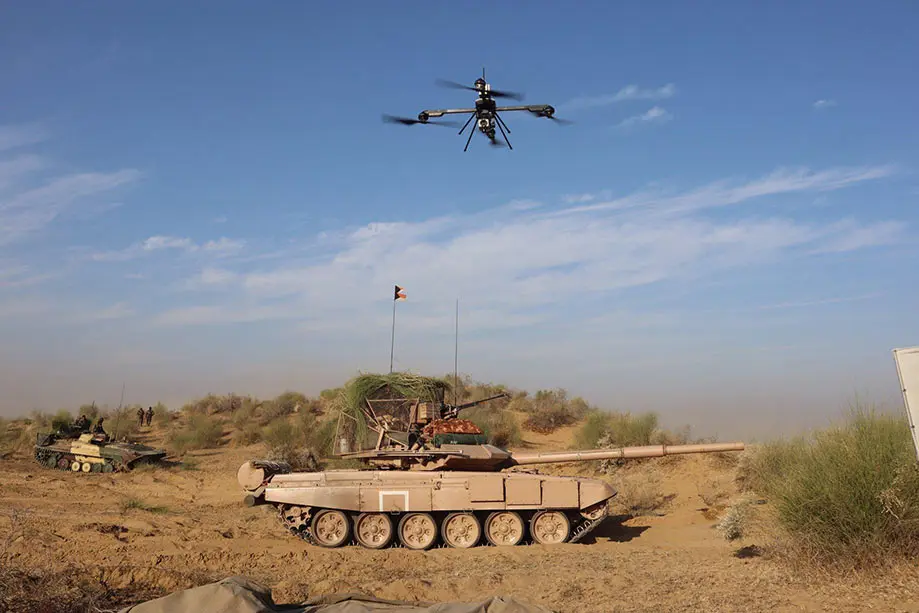
Indian Army Integrated Battle Groups (IBGs) need a Persistent Robotic Overwatch (PRO) bubble to shield tanks from saturated drone attacks, writes Kartik Bommakanti, Senior Fellow at the Observer Research Foundation. Russia's Rubicon Center, set up in 2024-25, grew from about 1,450 personnel in March 2025 to roughly 9,000 by the first quarter of 2026. Rapid expansion lowered recruitment standards and undermined quality, a lesson for India facing China and Pakistan.
Source
Observer Research Foundation (ORF) · read the original report ↗
Desk check · compared with the source
What the desk checked (5)
- Russia's Rubicon Center was established in 2024-25 for research, procurement, training and operational deployment of unmanned systems. — Figure and description appear in the source, attributed to the ORF author's analysis; no primary document cited.
- Rubicon had about 1,450 personnel in March 2025 against a sanctioned 2,500, and roughly 9,000 by the first quarter of 2026. — Numbers appear in the source and are internally consistent; no external source given.
- Russia's Unmanned Systems Forces had about 87,000 personnel, with plans for 165,000 by end-2026, while the 50th Unmanned Systems Brigade expands from 1,300 to 7,000. — Figures appear in the source without attribution to any document; treat as the author's assessment.
- Russia is unable to meet monthly recruitment targets and has lowered standards, undermining quality. — Unattributed analytical claim by the author; not independently verifiable here.
- India's IBGs need a Persistent Robotic Overwatch bubble for offensive and defensive missions against China and Pakistan. — Opinion/recommendation by the named author, published as ORF expert commentary.
Analysts’ view opinion
On the surface this is a technical defence argument, but its political edge is clear: the ORF analysis reframes modernisation as a human-capital question, not just a procurement one. Russia's Rubicon Centre reportedly growing from roughly 1,450 personnel in March 2025 to about 9,000 by the first quarter of 2026 — while having to lower recruitment standards — becomes a political talking point for "skill before numbers". Restructuring IBGs, drone manufacturing and operator training slot neatly into India's existing political conversation around self-reliance and defence jobs.
- Think-tank analyses often serve as the pre-political ground for policy debate, and this one strengthens the case for shifting budget priority from platforms towards manpower, training and a domestic drone industry.
- The framing of a twin China-Pakistan threat is politically useful to anyone arguing for higher defence outlays.
- The observation that the duration of a war would not be fully within India's control is an implicit caution to those who treat military action as politically controllable.
- The emphasis on skilled drone operators and technical personnel could feed debates on recruitment models and training pipelines.
- There is no official government position here — this is an independent expert's view, which limits its immediate political weight.
What to watch — Watch for any official statement from the government or the Army on IBG structuring, drone units and operator training, and whether the theme surfaces in parliamentary defence discussions.
The story is one expert's analysis and does not establish that the government or the Army has accepted these recommendations or taken any decision on IBGs.
Deep dive
Research brief · 8 facts · 5 dates · exam-readyThe brief
Context
The Indian Army has been reorganising parts of its strike and holding formations into Integrated Battle Groups (IBGs) — agile, mixed brigade-sized units for rapid, high-tempo operations. Drone warfare in Ukraine has exposed the vulnerability of crewed tanks, since armour enhancements and Active Protection Systems cannot stop saturated drone attacks, prompting calls for a "Persistent Robotic Overwatch" (PRO) bubble of unmanned systems around armour. In this ORF analysis, Kartik Bommakanti of the Observer Research Foundation examines Russia's Rubicon Center as a template for such a capability and argues that the quality — not just quantity — of manpower is the decisive variable for India's IBGs facing China and Pakistan.
Key facts
- Russia's Rubicon Center was established in 2024-25 as an overarching organisation for research, procurement, training and operational deployment of unmanned systems, including doctrinal development of tactics, techniques and procedures.
- In March 2025 the Rubicon Center had roughly 1,450 personnel against a sanctioned limit of 2,500; by the first quarter of 2026 it had roughly 9,000 personnel.
- Rubicon's specialised combat units include FPV quadcopters, reconnaissance systems such as the Orlan-10 and Supercam, and Counter-UAV and electronic warfare squads.
- Rubicon competes for talent with Russia's 50th Unmanned Systems Brigade, which is expanding from 1,300 to 7,000 personnel.
- Russia's Unmanned Systems Forces had roughly 87,000 personnel, with plans to raise this to 165,000 by the end of 2026.
- Russia is currently unable to meet monthly recruitment targets and has lowered recruitment standards to meet quotas, undermining quality.
- Rubicon recruited experienced UAS teams from conventional formations, depleting those units' ISR and fire-support capabilities.
- Ukraine saw a similar pattern, temporarily weakening capabilities when it expanded drone line regiments and brigades too quickly.
Timeline
- 1965India-Pakistan war, cited as an example of armour-intensive offensive operations securing a territorial quid pro quo.
- 2024-25Russia establishes the Rubicon Center for research, procurement, training and operational deployment of unmanned systems.
- March 2025Rubicon Center strength at roughly 1,450 personnel against a sanctioned limit of 2,500.
- First quarter of 2026Rubicon Center strength reaches roughly 9,000 personnel.
- By end of 2026 (planned)Russia aims to expand Unmanned Systems Forces from roughly 87,000 to 165,000 personnel.
Who has a stake
- Indian Army (IA) and its Integrated Battle Groups — Must build a PRO bubble for both offensive and defensive armour-intensive operations, backed by quality and quantity of skilled personnel.
- Indian tank crews / armoured formations — Crewed armoured vehicles are especially vulnerable to cheap, saturated drone attacks that armour and APS cannot fully counter.
- Russia's Rubicon Center and Unmanned Systems Forces — Rapid expansion has strained recruitment, lowered standards and drained ISR and fire-support talent from conventional formations.
- China's PLA Ground Force and Pakistan Army — Can themselves expand the conflict area and pursue offensive action, so war duration is not within the Indian Army's control.
- India's military-industrial base — Must deliver magazine depth, AI-augmented drone manufacturing and technical manpower to sustain high-tempo IBG operations.
- Observer Research Foundation / Kartik Bommakanti — Author of the analysis, Senior Fellow with ORF's Strategic Studies Programme, framing the manpower-quality argument.
Why it matters
Cheap drones have changed the economics of ground warfare: a tank costing crores can be destroyed by mass-produced UAVs, forcing armies to wrap armour in a layer of unmanned overwatch. India's IBG concept will only work against a two-front threat if drone manufacturing, AI augmentation and — crucially — skilled operators scale together, rather than numbers being met by diluting standards as Russia and Ukraine have done.
UPSC angle
Prelims pointers
- Integrated Battle Groups (IBGs): Indian Army's agile, mixed formations designed for rapid-response, high-tempo operations.
- Persistent Robotic Overwatch (PRO): layered unmanned defensive bubble over tanks, also meant to aid offensive action.
- Russia's Rubicon Center set up in 2024-25; grew from about 1,450 personnel (March 2025) to roughly 9,000 (Q1 2026).
- Russia's Unmanned Systems Forces: roughly 87,000 personnel, target 165,000 by end-2026; 50th Unmanned Systems Brigade expanding 1,300 to 7,000.
- Orlan-10 and Supercam are Russian reconnaissance UAV systems; FPV quadcopters and C-UAV/EW squads form part of Rubicon units.
- Author: Kartik Bommakanti, Senior Fellow, Strategic Studies Programme, Observer Research Foundation (ORF).
Mains framing
The proliferation of cheap unmanned aerial vehicles has eroded the tank's organic survivability: armour cannot be thickened indefinitely and Active Protection Systems cannot absorb saturated drone assaults, which is why a Persistent Robotic Overwatch bubble is being proposed as an integral element of the Indian Army's Integrated Battle Groups. Russia's Rubicon Center offers a template — centralising research, procurement, training, deployment and doctrinal TTPs for AI-enabled unmanned systems — but its trajectory is also a cautionary tale: growth from about 1,450 personnel in March 2025 to roughly 9,000 by early 2026, competition with the 50th Unmanned Systems Brigade, and an Unmanned Systems Forces target of 165,000 by end-2026 have outrun the available talent pool, forcing lowered recruitment standards, cannibalising ISR and fire-support teams from conventional formations, and leaving attrition among UAS and C-UAS crews hard to replace; Ukraine's over-rapid expansion of drone regiments showed the same weakness. For India, the implication is that a PRO bubble must be sized to actual military objectives against the PLA Ground Force and Pakistan Army, recognising that escalation is a two-way street and that offensive, armour-intensive manoeuvre to secure a territorial quid pro quo (as in 1965) will demand far more means and absorb far more attrition than defensive operations. The way forward the source indicates is to pair magazine depth, AI-augmented drone manufacturing and military-industrial strength with technical manpower and skilled drone operators of sufficient quality at scale — not numbers alone.
Key terms
- Persistent Robotic Overwatch (PRO)
- A layered, unmanned defensive bubble protecting crewed tanks from anti-tank munitions and drones, also intended to support offensive action.
- Integrated Battle Groups (IBGs)
- Indian Army formations built for rapid-response, high-tempo operations that would host and sustain a PRO capability.
- Active Protection Systems (APS)
- On-board tank systems that intercept incoming projectiles, but effective only up to a point against intense drone assaults.
- Rubicon Center
- Russian organisation created in 2024-25 for research, procurement, training, deployment and doctrine of AI-enabled unmanned systems.
- C-UAV / C-UAS
- Counter-Unmanned Aerial Vehicle/System capabilities, including electronic warfare squads, used to detect and defeat hostile drones.
- ISR
- Intelligence, Surveillance and Reconnaissance — functions depleted in Russian conventional units when Rubicon poached experienced UAS teams.
Practice questions
- Cheap drones have outpaced the tank's organic defences. Examine the case for a Persistent Robotic Overwatch capability within India's Integrated Battle Groups.
- What lessons does the expansion of Russia's Rubicon Center and Unmanned Systems Forces offer for balancing quantity and quality of military manpower in India?
- Discuss how a two-front threat from the PLA Ground Force and the Pakistan Army shapes the demands placed on India's armour-intensive offensive and defensive operations.
Grounded only in the source report — figures and dates are the source's, not inferred.