
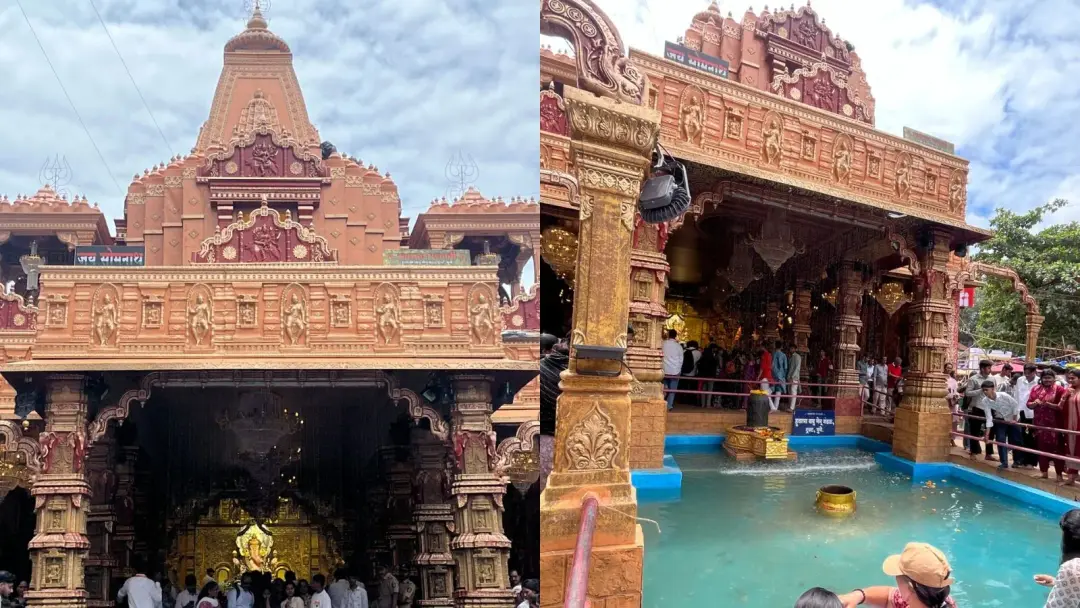
Pune Ganesh mandal recreates Somnath Temple as pandal
The Hutatma Babu Genu Mandal Trust, known as Navsacha Ganpati, has recreated Gujarat's Somnath Temple as its Ganeshotsav pandal in Pune. The set, crafted by art director Nitin Desai's team and led by Hemant and Roshan, took 30 to 40 artisans 25 days to complete, including shikharas, pillars and carvings. Established in 1970, the mandal is marking its 53rd year. Inspired by the temple tanks, a north-facing well has been built where devotees toss a coin and make a wish.
Source
Indian Express — Cities · read the original report ↗
Desk check · compared with the source
What the desk checked (5)
- Hutatma Babu Genu Mandal Trust, known as Navsacha Ganpati, has recreated Somnath Temple as its Ganeshotsav pandal — Stated in source as reporting; mandal office-bearers quoted in support.
- The mandal was established in 1970 and is celebrating its 53rd year — Figures appear in source; the year of establishment and the 53rd-year count are not reconciled in the text.
- A team of 30 to 40 artisans led by Hemant and Roshan worked 25 days on the set crafted by art director Nitin Desai's team — Figures and names appear in source; no independent verification offered.
- Somnath Temple dates back to 649 BC, though many historians believe it to be older — Asserted in source without citation of specific historians.
- Talks are underway with Pune Municipal Corporation to make the well a permanent feature — Attributed to volunteer Ketan Pawar; no civic official quoted.
Analysts’ view opinion
Pune's Ganeshotsav pandals have long been more than art installations — they are public stages where cultural symbolism finds a mass audience. Choosing a replica of Somnath, a nationally resonant shrine in Gujarat, brings a pan-Indian pilgrimage symbol to Maharashtra's devotees, a framing that sits comfortably with a broader Hindu cultural-unity narrative. The story names no party, leader or visit, so this cannot be read as a political statement; but marquee pandals of this scale typically become magnets for leaders' visits and public outreach during the festival season.
- A mandal in its 53rd year, established in 1970, represents decades of local organisational muscle — the kind of civic platform that carries weight in city politics.
- Picking Somnath, described in the story as first among the 12 jyotirlingas, shows the pull of cultural symbols that travel beyond regional boundaries.
- The scale — 30 to 40 artisans working 25 days — points to sponsorship, fundraising and volunteer networks, all indicators of a mandal's reach.
- The story notes talks with the Pune Municipal Corporation to make the wish-well permanent, placing faith, urban governance and permissions politics at the same table.
- The mention of devotees arriving from Thailand and other countries opens the door to framing the festival as a cultural-tourism asset.
What to watch — Watch how the Pune Municipal Corporation responds to the proposal to make the well a permanent feature, and which political figures turn up at the pandal during the festival.
The story establishes no party involvement, no funding source, no leader visits and no political intent behind the choice of theme — none of that is on the record here.
Deep dive
Research brief · 8 facts · 5 dates · exam-readyThe brief
Context
Ganeshotsav in Pune is known for elaborate pandals, many of which replicate famous temples and monuments. This year the Hutatma Babu Genu Mandal Trust, popularly called Navsacha Ganpati, has recreated Gujarat's Somnath Temple — regarded as the first among the 12 jyotirlingas of Lord Shiva — as its pandal. The replica set, built by art director Nitin Desai's team, includes shikharas, pillars, carvings and a north-facing wish well inspired by Somnath's sacred temple tanks.
Key facts
- Hutatma Babu Genu Mandal Trust, known as Navsacha Ganpati, was established in 1970 and is celebrating its 53rd year.
- The pandal recreates the Somnath Temple, considered the first among the 12 jyotirlingas of Lord Shiva.
- The source states Somnath Temple dates back to 649 BC, though many historians believe it to be older.
- The set was crafted by the team of art director Nitin Desai, led by Hemant and Roshan.
- A team of 30 to 40 artisans worked for 25 days on the carvings, shikharas and pillars mirroring the original temple.
- A north-facing well has been recreated, inspired by Somnath's sacred temple tanks, where devotees toss a coin and make a wish.
- A fountain and pond have been built around the well so that water offered during prayers flows towards the Kalash and the well.
- Talks are underway with the Pune Municipal Corporation to make the well a permanent feature of the temple.
Timeline
- 649 BC (as stated in the source)Somnath Temple dates back to this period, though many historians believe it to be older.
- 1970Hutatma Babu Genu Mandal Trust established.
- This Ganeshotsav (53rd year of the mandal)Somnath Temple replica pandal unveiled; 30-40 artisans complete the set in 25 days.
- Since the start of this GaneshotsavDevotees from across Pune and from Thailand and other countries visit to make wishes at the well.
- OngoingDiscussions with the Pune Municipal Corporation to make the well permanent.
Who has a stake
- Hutatma Babu Genu Mandal Trust (Navsacha Ganpati) — Its reputation as a wish-fulfilling shrine and 53-year tradition rests on the scale and authenticity of the pandal.
- Kishor Dabare, president of the mandal — Frames the decoration as an experience combining architecture, faith and tradition for devotees.
- Milap Marne, secretary of the mandal — Notes devotees from Pune and abroad, including Thailand, come to make wishes at the pandal.
- Nitin Desai's art team, led by Hemant and Roshan — 30-40 artisans' livelihood and craftsmanship tested by 25 days of intricate replica work.
- Ketan Pawar, third-generation volunteer — Continuity of the 'Ichha Purti Kalash' ritual and the plan to retain the well permanently.
- Pune Municipal Corporation — Must decide on the mandal's request to make the wish well a permanent feature.
Why it matters
Pune's Ganeshotsav pandals have become large-scale public art and cultural spectacles that bring distant pilgrimage sites within reach of ordinary devotees, sustaining livelihoods for artisans and set designers. The mandal's request to make the wish well permanent shows how temporary festival structures can turn into lasting urban religious spaces, raising questions for the municipal body about public space and permissions.
UPSC angle
Prelims pointers
- Somnath Temple, Gujarat, is considered the first among the 12 jyotirlingas of Lord Shiva.
- Hutatma Babu Genu Mandal Trust, Pune, popularly called Navsacha Ganpati, was established in 1970.
- Ganeshotsav pandal replica of Somnath Temple built by art director Nitin Desai's team in 25 days by 30-40 artisans.
- 'Ichha Purti Kalash' — the vessel devotees whisper wishes to at the Navsacha Ganpati mandal.
- The recreated well faces north, a direction the mandal associates with progress and prosperity.
- Pune Municipal Corporation is the civic body approached to make the well permanent.
Mains framing
Pune's Ganeshotsav has evolved from a neighbourhood religious observance into a large cultural economy in which mandals compete through architectural replicas of pilgrimage sites — here, the Somnath Temple recreated by art director Nitin Desai's team with 30 to 40 artisans working 25 days. Such pandals democratise pilgrimage by bringing a distant sacred site to local devotees, sustain skilled craft livelihoods, and attract international visitors, as the mandal notes of devotees from Thailand. They also blend ritual innovation with tradition: the north-facing wish well inspired by Somnath's temple tanks now supplements the older 'Ichha Purti Kalash' practice, deepening the mandal's identity as a wish-fulfilling shrine in its 53rd year since 1970. The proposal to make the well a permanent feature, now under discussion with the Pune Municipal Corporation, points to the governance dimension — temporary festival installations seeking permanence require civic sanction and raise issues of urban space, safety and upkeep. A balanced way forward would preserve the artistic and devotional value the mandal's office-bearers emphasise while ensuring civic clearance and transparent decision-making on any permanent structure.
Key terms
- Jyotirlinga
- Shrine of Lord Shiva; Somnath is considered the first among the 12 jyotirlingas.
- Navsacha Ganpati
- Popular name of the Hutatma Babu Genu Mandal Trust in Pune, associated with wish fulfilment.
- Shikhara
- Temple spire or tower; recreated in the pandal to mirror the original Somnath Temple.
- Ichha Purti Kalash
- Vessel at the mandal to which devotees whisper their wishes for Ganpati.
- Ganeshotsav
- The public Ganesh festival, marked in Pune by elaborate mandal pandals and decorations.
- Pune Municipal Corporation
- City civic body with which the mandal is in talks to make the wish well permanent.
Practice questions
- How do large-scale replica pandals in Pune's Ganeshotsav shape public religiosity, artisan livelihoods and the city's cultural economy? Discuss with reference to the Somnath Temple recreation.
- Temporary festival structures increasingly seek permanence in urban spaces. What civic and regulatory considerations should municipal bodies weigh in such cases?
- Somnath Temple is regarded as the first among the 12 jyotirlingas. Discuss the significance of jyotirlinga shrines in India's pilgrimage geography.
Grounded only in the source report — figures and dates are the source's, not inferred.