
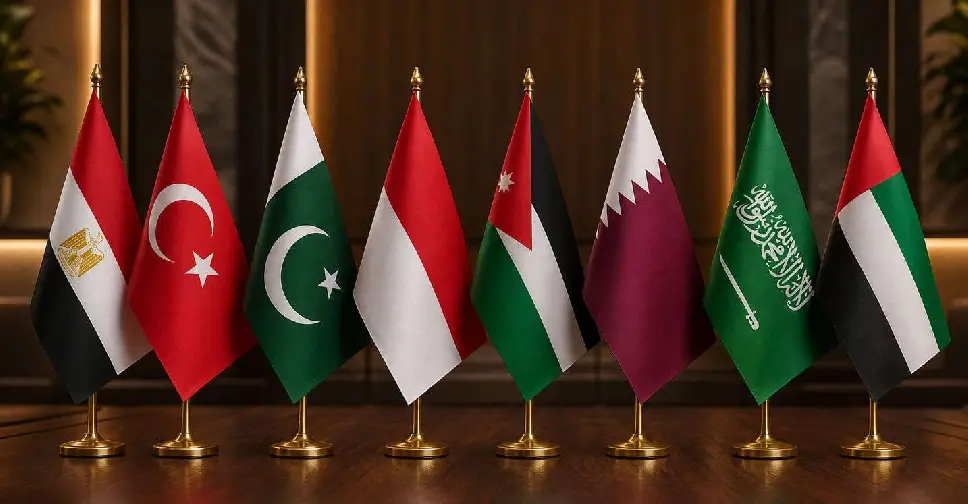
Eight nations urge immediate halt to Israel's E1 settlement plan
Foreign ministers of the UAE, Saudi Arabia, Qatar, Jordan, Indonesia, Pakistan, Turkey and Egypt condemned Israel's settlement expansion in occupied Palestinian territories. A joint statement rejected the 'E1' plan east of occupied East Jerusalem, warning it would undermine territorial connection with the West Bank and threaten prospects of an independent Palestinian state on 1967 borders with East Jerusalem as capital. They condemned settler violence, sought sanctions and urgent UN action, and reaffirmed a two-state solution as the only viable path to peace.
Source
Gulf / Middle East · read the original report ↗
Desk check · compared with the source
What the desk checked (5)
- Foreign ministers of the UAE, Saudi Arabia, Qatar, Jordan, Indonesia, Pakistan, Turkey and Egypt condemned Israel's settlement expansion. — Attributed to a joint statement reported by WAM and linked to the UAE MoFA account; sourcing is official.
- The 'E1' plan lies east of occupied East Jerusalem and could undermine territorial connection between the West Bank and East Jerusalem. — Stated as the ministers' warning in the source, not as independent finding.
- The plan threatens an independent Palestinian state based on 1967 borders with East Jerusalem as capital. — Presented as the ministers' assessment; appears in source text.
- Ministers called for international measures and sanctions against those involved in illegal settlement activities. — Attributed to the joint statement; no specific measures named in source.
- Ministers reaffirmed a two-state solution as the only viable path to peace. — Direct paraphrase of the joint statement in the source.
Analysts’ view opinion
The striking thing about this joint statement is not its wording but its signatory list. The UAE, Jordan and Egypt, which have diplomatic ties with Israel; Saudi Arabia and Pakistan, which do not; Qatar, which plays a mediating role; Türkiye, a NATO member; and Indonesia, the world's largest Muslim-majority country — all standing behind one text suggests these capitals see 'E1' not as a land dispute but as a regional strategic red line. The core argument is geographic rather than merely moral: if territorial contiguity between the West Bank and East Jerusalem is severed, a two-state outcome becomes physically harder to draw. Notably, the statement calls for sanctions rather than announcing any of its own.
- Countries with and without normalised ties to Israel signing the same text is a rare piece of diplomatic alignment.
- The phrase 'territorial connection' is the key: this is framed as a strategic question of whether a future Palestinian state remains geographically viable.
- By demanding accountability and sanctions, the signatories are trying to move the issue from regional protest into UN and Western policy arenas.
- Reaffirming the 1967 borders and East Jerusalem as capital is also a pre-emptive rejection of alternative formulas.
- Singling out settler violence points to individual-level measures — a lower-cost lever than state-level action.
What to watch — Watch whether these eight move towards a formal resolution at the UN Security Council or General Assembly, or stop at the level of statements — that will reveal the bloc's real political weight.
The story does not establish Israel's response, how far the E1 plan has actually advanced, or whether any signatory will take concrete steps affecting its own ties with Israel.
Deep dive
Research brief · 8 facts · 1 dates · exam-readyThe brief
Context
Israel's plan for settlement construction in the area designated "E1", east of occupied East Jerusalem, has drawn a joint diplomatic protest from eight Muslim-majority countries. Critics say building in E1 would physically separate the northern and southern West Bank from East Jerusalem, undercutting the contiguity of any future Palestinian state. In a joint statement carried by UAE state news agency WAM and posted by the UAE foreign ministry on 21 August 2026, the foreign ministers of the UAE, Saudi Arabia, Qatar, Jordan, Indonesia, Pakistan, Türkiye and Egypt demanded an immediate halt to the plan and to all settlement expansion. They also called for UN and international action to protect Palestinians and reaffirmed the two-state solution.
Key facts
- Foreign ministers of eight countries - UAE, Saudi Arabia, Qatar, Jordan, Indonesia, Pakistan, Türkiye and Egypt - issued a joint statement condemning Israel's settlement expansion in the occupied Palestinian territories.
- The statement specifically rejects Israel's 'E1' settlement plan located east of occupied East Jerusalem.
- The ministers warned E1 could expand settlements further and undermine the territorial connection between the West Bank and East Jerusalem.
- They said the plan threatens the prospects of an independent Palestinian state based on the 1967 borders with East Jerusalem as its capital.
- The statement condemned violence by Israeli settlers against Palestinians and their property and called for accountability.
- The ministers sought international measures and sanctions against those involved in illegal settlement activities.
- They urged the United Nations and the international community to take urgent action to protect Palestinians and support their right to self-determination.
- The joint statement was posted by the UAE Ministry of Foreign Affairs (@mofauae) on 21 August 2026.
Timeline
- 21 August 2026The UAE Ministry of Foreign Affairs posts the joint statement by the foreign ministers of the UAE, Saudi Arabia, Qatar, Jordan, Indonesia, Pakistan, Türkiye and Egypt.
Who has a stake
- Palestinians in the West Bank and East Jerusalem — Territorial contiguity, protection from settler violence and the right to self-determination and statehood.
- Israel — Its settlement expansion policy, including the E1 plan, faces condemnation and calls for international sanctions.
- The eight signatory states (UAE, Saudi Arabia, Qatar, Jordan, Indonesia, Pakistan, Türkiye, Egypt) — Regional stability and their collective diplomatic push for a two-state solution.
- United Nations and the international community — Asked to take urgent action to protect Palestinians and act against illegal settlement activity.
- Israeli settlers — Named in the statement for violence against Palestinians and property; face demands for accountability and sanctions.
Why it matters
The E1 area sits between East Jerusalem and the West Bank, so construction there is seen as capable of severing the geographic link on which a viable Palestinian state depends. The joint statement shows Arab, Gulf and wider Muslim-majority powers, including some with ties to Israel, converging on a single demand for a halt and for sanctions. It also renews pressure on the UN to act, keeping the two-state framework at the centre of the diplomatic agenda.
UPSC angle
Prelims pointers
- 'E1' is a settlement plan area east of occupied East Jerusalem, opposed for cutting West Bank-East Jerusalem territorial connection.
- Eight signatories to the joint statement: UAE, Saudi Arabia, Qatar, Jordan, Indonesia, Pakistan, Türkiye, Egypt.
- The demanded Palestinian state is based on the 1967 borders with East Jerusalem as its capital.
- WAM is the UAE's state news agency; the statement was posted by @mofauae on 21 August 2026.
- The ministers reaffirmed the two-state solution as the only viable path to just and lasting peace.
- Statement sought international measures and sanctions against those involved in illegal settlement activities.
Mains framing
The joint statement by eight foreign ministers against Israel's E1 settlement plan illustrates how settlement geography, rather than rhetoric alone, is now the operative issue in the Israeli-Palestinian question. The objection is spatial: building east of occupied East Jerusalem would, in the ministers' assessment, break the territorial connection between the West Bank and East Jerusalem, thereby hollowing out the possibility of a contiguous independent Palestinian state on the 1967 borders with East Jerusalem as capital. Layered onto this is settler violence against Palestinians and their property, for which the statement demands accountability and targeted international measures and sanctions - a shift from declaratory diplomacy towards instruments of pressure. The signatories span Gulf, Levantine, North African and South and Southeast Asian states, signalling a broad convergence that survives differing bilateral relations with Israel. The way forward they propose is threefold: an immediate halt to E1 and all settlement expansion, urgent United Nations and international action to protect Palestinians and uphold their right to self-determination, and recommitment to the two-state solution as the only viable path to a just and lasting peace. The statement's limits are equally clear - it identifies demands but, as the source records, no enforcement mechanism.
Key terms
- E1 plan
- Israeli settlement plan for the area east of occupied East Jerusalem, opposed as severing West Bank-East Jerusalem territorial links.
- Two-state solution
- Framework of an independent Palestinian state alongside Israel; reaffirmed by the ministers as the only viable path to lasting peace.
- 1967 borders
- The lines cited as the basis for a Palestinian state, with East Jerusalem as its capital.
- Right to self-determination
- The Palestinian entitlement the ministers asked the UN and international community to support.
- WAM
- The UAE's state news agency, which carried the joint statement.
Practice questions
- Why is the E1 area considered critical to the viability of a contiguous Palestinian state, and what do the eight foreign ministers demand in their joint statement?
- Examine the effectiveness of collective diplomatic statements and calls for sanctions in restraining settlement expansion in the occupied Palestinian territories.
- Discuss the significance of Gulf, Arab and wider Muslim-majority states converging on a common position on the two-state solution.
Grounded only in the source report — figures and dates are the source's, not inferred.