
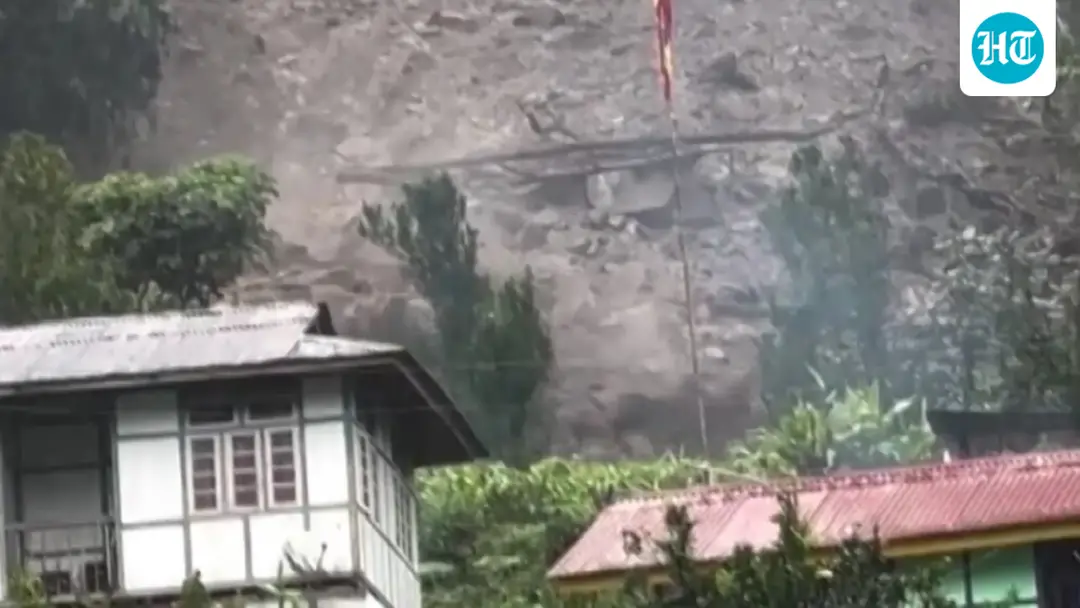
Landslide hits Sikkim's Rimbi village after heavy rain
A landslide struck in Sikkim late on Thursday following heavy rainfall, with a video showing rocks, mud and debris crashing downhill. Parts of Rimbi village, under the Yuksom-Tashiding constituency of West Sikkim, were affected, ANI reported. The Sikkim State Disaster Management Authority said on September 17 that 128 people living in 28 houses in vulnerable parts of Rimbi, Gyalshing district, were moved to safer locations. Debris built up along the NiK Kholsa stream washed away an RCC bridge.
Source
Hindustan Times — India · read the original report ↗
Desk check · some claims need care
What the desk checked (5)
- A landslide struck late on Thursday after heavy rainfall, affecting parts of Rimbi village under Yuksom-Tashiding constituency in West Sikkim. — Attributed to ANI news agency; source text confusingly also places the same landslide at Tadong in Gangtok, an internal inconsistency.
- 128 people living in 28 houses in vulnerable parts of Rimbi, Gyalshing district, were moved to safer locations. — Figures appear in source, attributed to the Sikkim State Disaster Management Authority on September 17.
- An RCC bridge in Rimbi was washed away as water and debris flow increased along the NiK Kholsa stream. — Figure/detail appears in source; no specific official named as source.
- A landslide last week in Lingding, Tadong damaged part of a house and three water pipelines; no injuries or deaths reported. — Attributed to earlier ANI reporting in the source.
- Nepal's August 26 flash floods killed 1,404 people with more than 6,000 missing. — Attributed in source to earlier HT reporting; unrelated to the Sikkim event and not independently verifiable here.
Analysts’ view opinion
The Sikkim landslide currently reads as a disaster without reported casualties, but politically it sets up two tests: preparedness and the speed of evacuation. Moving 128 people from 28 houses pre-emptively is a credit line for the administration; the washing away of an RCC bridge, however, will inevitably pull construction quality and clearances in vulnerable zones into the political conversation. Attention will settle on local representatives of the Yuksom-Tashiding constituency and on the state disaster management authority.
- Because evacuation happened before loss of life was reported, the government has a ready argument that it responded in time.
- The washed-away RCC bridge is a natural focal point for opposition questions on connectivity, build quality and contract accountability.
- Local political credit will hinge less on the rescue and more on how fast rehabilitation and compensation reach the displaced.
- Coordination between the state and the Centre on hill-state disaster funding will be quietly tested.
- Repeated landslide incidents risk being framed not as a one-off event but as a policy failure.
What to watch — Watch how quickly shelter arrangements, any compensation announcement and a bridge-rebuilding commitment follow for the 128 evacuees — that will decide whether this stays administrative or turns political.
The story does not establish any political reaction, compensation decision or official finding on construction lapses; these are analytical readings, not reported facts.
Deep dive
Research brief · 8 facts · 5 dates · exam-readyThe brief
Context
Heavy overnight rainfall in Sikkim triggered a series of landslides, including one at Tadong in Gangtok late on Thursday and mudslides affecting parts of Rimbi village under the Yuksom-Tashiding constituency of West Sikkim. The Sikkim State Disaster Management Authority ordered evacuations from vulnerable pockets of Rimbi in Gyalshing district after fresh landslide activity, while debris accumulation along a stream washed away a bridge. The episode comes weeks after far deadlier floods and landslides in neighbouring Nepal, where fresh heavy rain warnings have been issued.
Key facts
- A landslide struck Tadong in Sikkim's Gangtok late at night on Thursday after heavy rainfall; a video showed rocks, mud and debris crashing down.
- Parts of Rimbi village under the Yuksom-Tashiding constituency of West Sikkim were affected, according to ANI.
- The Sikkim State Disaster Management Authority said on September 17 that 128 people living in 28 houses in vulnerable parts of Rimbi, Gyalshing district, were moved to safer locations.
- Debris built up along the NiK Kholsa stream in Rimbi, and an RCC bridge was washed away as water and debris flow increased.
- Relief and restoration operations were carried out in Rimbi and Singlitam, with debris cleared and assistance given to affected residents.
- In an earlier landslide at Lingding, Tadong, mud and rainwater entered first-floor rooms of a house and three water pipelines were damaged, affecting local water supply.
- The road near Lingding Jhora was inaccessible from around 3 am to 9 am before debris clearance restored traffic; no injuries or deaths were reported.
- Nepal's Ministry of Home Affairs activated disaster-response mechanisms after heavy rainfall was forecast between September 24 and 27; flash floods of August 26 had killed 1,404 people with over 6,000 missing at the time of the HT report.
Timeline
- August 26Devastating flash floods struck parts of Nepal; HT reported 1,404 killed and more than 6,000 missing at the time of that report.
- September 17Sikkim State Disaster Management Authority said 128 people from 28 houses in vulnerable parts of Rimbi, Gyalshing district, were moved to safer locations.
- Week before the reported incidentA landslide in Lingding, Tadong damaged part of a house and three water pipelines; road near Lingding Jhora blocked from about 3 am to 9 am.
- Thursday late night (date not stated in the source)Landslide struck Tadong in Gangtok after heavy rain; mudslide affected parts of Rimbi village in West Sikkim.
- September 24 to 27Nepal Meteorological Department forecast heavy and very heavy rainfall in parts of Gandaki and Lumbini provinces; disaster-response mechanisms activated.
Who has a stake
- Residents of Rimbi village, Gyalshing district — 128 people from 28 houses evacuated; homes, property, the washed-away RCC bridge and connectivity at risk from continuing debris flow.
- Sikkim State Disaster Management Authority — Responsible for evacuation, relief and restoration, and issuing warnings to stay away from active landslide zones and streams.
- Residents of Tadong and Lingding, Gangtok — Faced house damage, water pipeline breakage and hours-long road blockage near Lingding Jhora.
- District administration of Gyalshing / Sikkim government — Carrying out relief and debris clearing in Rimbi and Singlitam and assisting affected residents.
- Nepal's Ministry of Home Affairs and Nepal Meteorological Department — Activating disaster-response mechanisms and forecasting heavy rain after the August 26 floods that killed 1,404 people.
Why it matters
Sikkim's steep Himalayan terrain turns short spells of intense rain into landslides that cut roads, snap water pipelines and wash away bridges, isolating villages and tourists. The evacuation of 128 people in Rimbi and the loss of an RCC bridge show how quickly debris accumulation in small streams can escalate into infrastructure failure. Read alongside Nepal's August 26 floods, it underlines the need for early warning, hazard mapping and relocation of settlements in vulnerable zones across the eastern Himalaya.
UPSC angle
Prelims pointers
- Rimbi village lies in the Yuksom-Tashiding constituency of West Sikkim, in Gyalshing district.
- Sikkim State Disaster Management Authority reported on September 17 that 128 people from 28 houses in Rimbi were shifted to safer places.
- An RCC (reinforced cement concrete) bridge in Rimbi was washed away after debris built up along the NiK Kholsa stream.
- Tadong and Lingding, where landslides occurred, are in Gangtok; the road near Lingding Jhora was blocked from about 3 am to 9 am.
- Nepal's flash floods of August 26 killed 1,404 people with over 6,000 missing at the time of the HT report.
- Nepal Meteorological Department forecast heavy to very heavy rain in Gandaki and Lumbini provinces for September 24-27.
Mains framing
Recurrent landslides in Sikkim, as seen in Tadong, Lingding and Rimbi after heavy overnight rainfall, illustrate how high-intensity precipitation on fragile, steep Himalayan slopes converts routine monsoon events into multi-hazard disasters — mudslides, debris flows in streams such as NiK Kholsa, washed-away RCC bridges, damaged water pipelines and hours-long road closures. The implications are threefold: risk to life and property in settlements built in vulnerable pockets, which forced the shifting of 128 people from 28 houses in Gyalshing district; disruption of connectivity and essential services in a state where a single road closure can strand residents and tourists; and heavy demand on state disaster machinery for evacuation, relief and debris clearance, as undertaken in Rimbi and Singlitam. The source points to a way forward centred on the measures actually being used — pre-emptive evacuation from vulnerable areas by the Sikkim State Disaster Management Authority, official advisories to avoid active landslide zones, debris-accumulation sites and streams during rainfall, rapid debris clearing to restore traffic, and continuous monitoring of vulnerable areas. Nepal's August 26 floods, which killed 1,404 people, and its activation of disaster-response mechanisms ahead of forecast rain show the value of forecast-linked preparedness across the region.
Key terms
- Sikkim State Disaster Management Authority
- State body that reported the Rimbi evacuations and relief and restoration operations after fresh landslide activity.
- RCC bridge
- Reinforced cement concrete bridge; the one in Rimbi was washed away as water and debris flow increased.
- NiK Kholsa stream
- Stream in Rimbi where debris built up, with rainwater carrying material downstream towards the village.
- Jhora
- Local term for a hill stream or gully; the road near Lingding Jhora was blocked by landslide debris.
- Yuksom-Tashiding constituency
- Assembly constituency in West Sikkim under which the affected Rimbi village falls.
- Nepal Meteorological Department
- Nepal's forecasting agency that predicted heavy and very heavy rainfall in Gandaki and Lumbini provinces for September 24-27.
Practice questions
- Discuss the factors that make Himalayan states like Sikkim prone to rain-triggered landslides, and evaluate the effectiveness of pre-emptive evacuation as a mitigation strategy.
- How do landslides affect connectivity and essential services in hill regions? Illustrate with the recent disruptions reported in Sikkim.
- Examine the role of State Disaster Management Authorities in forecast-based preparedness, relief and restoration, with reference to the Rimbi landslide.
Grounded only in the source report — figures and dates are the source's, not inferred.