
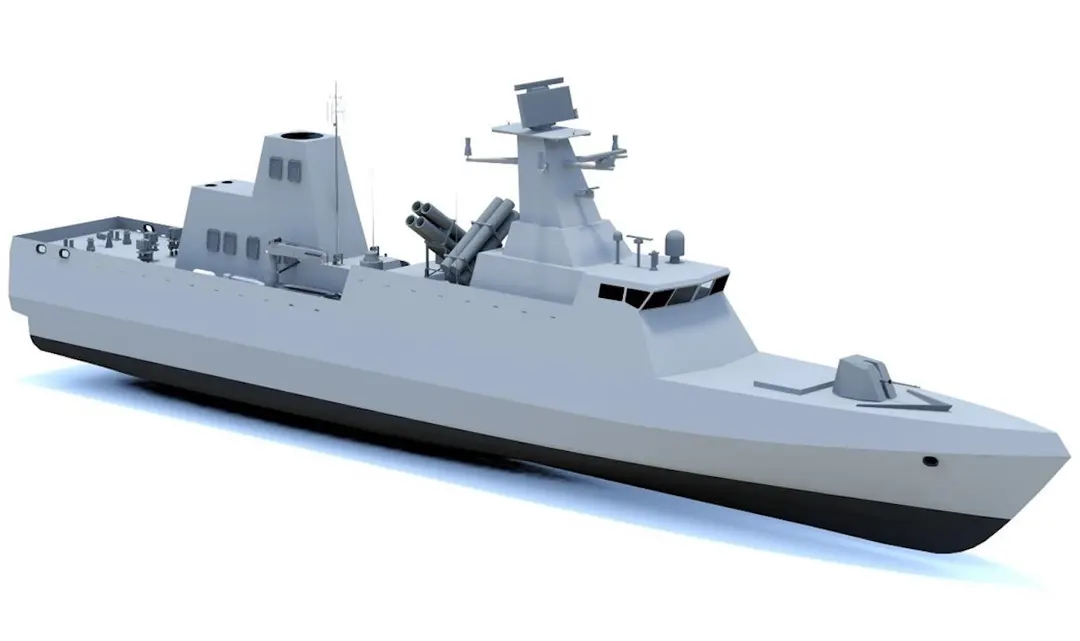
Cochin Shipyard begins construction of Navy's first NGMV
State-owned Cochin Shipyard Limited (CSL) has laid the keel for the Indian Navy's first Next Generation Missile Vessel (BY 531) in Kerala, formally starting construction of the lead ship. Steel cutting for the second hull (BY 532) took place a day earlier. Vice Admiral Sanjay Sadhu presided over the keel-laying. The vessels are being built under an approximately $1-billion contract signed in 2023 between the Defence Ministry and CSL for six corvette-type ships.
Source
Indian Navy · read the original report ↗
Desk check · compared with the source
What the desk checked (4)
- CSL laid the keel for the lead Next Generation Missile Vessel (BY 531), with steel cutting for the second hull (BY 532) a day earlier. — Attributed to Cochin Shipyard Limited, including its own social media post cited in the source.
- Vice Admiral Sanjay Sadhu, Controller of Warship Production and Acquisition, presided over the keel-laying. — Named official attributed in source and in the quoted CSL statement; internally consistent.
- An approximately $1-billion contract for six corvette-type vessels was signed in 2023 between the Ministry of Defence and CSL. — Figure appears in source; contract value given as approximate, no document cited.
- The NGMV will be 89 m long, 12 m in beam, carry over 80 sailors, exceed 35 knots and a 2,800 nautical mile range, and carry BrahMos missiles and a 76mm gun. — Specifications appear in source without explicit attribution to a named document; not externally verified.
Analysts’ view opinion
Technically this is a shipbuilding milestone; politically it is a visible, measurable proof-point for the government's "Aatmanirbhar Bharat" and "Make in India" narrative. That an roughly $1-billion order sits with a state-owned yard in Kerala also strengthens the argument that public sector units remain capable — useful at a time when the Centre faces criticism over privatisation. At the same time, expect competition over who claims credit locally for the investment and the jobs it implies.
- Keel-laying and steel-cutting are inherently photogenic milestones that let the Centre show defence modernisation is moving, not stalled.
- The defence ministry's framing that "all major role-defining equipment" is indigenous is a pre-emptive answer to opposition criticism about import dependence.
- CSL's first entry into heavily armed surface combatants can be presented as evidence that public sector shipyards are being empowered, not hollowed out.
- Because the investment and employment land in Kerala, credit-sharing between state and central leaders is a natural political flashpoint.
- As the lead ship of a six-vessel series, any future slippage in cost or schedule gives the opposition a ready line of attack.
What to watch — Watch how delivery timelines and build progress are officially communicated — visible delay would quickly revive the political debate over the pace of defence procurement.
The story does not establish delivery dates, employment numbers, or any political reaction; it confirms only the formal start of construction.
Deep dive
Research brief · 8 facts · 3 dates · exam-readyThe brief
Context
Cochin Shipyard Limited (CSL), a state-owned defence shipbuilder in Kerala, has laid the keel of the Indian Navy's first Next Generation Missile Vessel (NGMV), designated BY 531, formally beginning construction of the lead ship of the class. A steel-cutting ceremony for the second hull (BY 532) was held a day earlier. The vessels flow from an approximately $1-billion contract signed in 2023 between the Ministry of Defence and CSL for six corvette-type ships. The project is CSL's first venture into building heavily armed, high-speed surface combatants for the Navy.
Key facts
- CSL laid the keel for the Indian Navy's first Next Generation Missile Vessel (NGMV), the lead ship BY 531, in Kerala.
- A steel-cutting ceremony for the second hull of the series, BY 532, was held a day before the keel laying.
- Vice Admiral Sanjay Sadhu, AVSM, NM, Controller of Warship Production and Acquisition (CWP&A), presided over the keel-laying; CSL CMD Jose VJ was present.
- The programme stems from an approximately $1-billion contract signed in 2023 between the Ministry of Defence and CSL for six corvette-type vessels.
- Each NGMV will be 89 metres (292 feet) long with a 12-metre (39-foot) beam, accommodating over 80 sailors plus a rigid-hull inflatable boat.
- Armament includes Kavach anti-missile decoys, a 76mm naval autocannon, 30mm close-in weapon systems, 12.7mm remote weapon stations, BrahMos supersonic cruise missiles, VL-SRSAM, VSHORADS and loitering munitions.
- Performance: endurance beyond 10 days, top speed 35 knots (65 km/h) and range of 2,800 nautical miles (5,186 km).
- Propulsion: one General Electric LM2500 gas turbine, twin Pielstick 12PA 6 STC6 diesel engines and three Kongsberg Kamewa waterjets.
Timeline
- 2023Ministry of Defence signs an approximately $1-billion contract with CSL for six corvette-type Next Generation Missile Vessels.
- A day before the keel layingSteel-cutting ceremony held for the second hull of the series, BY 532.
- September 18, 2026 (CSL post date)Keel laid for the lead NGMV (BY 531) at CSL, presided over by Vice Admiral Sanjay Sadhu.
Who has a stake
- Cochin Shipyard Limited (CSL) — State-owned builder executing its first heavily armed, high-speed surface combatant programme; the milestone tests its complex warship-building capability.
- Indian Navy — Gains six missile vessels for surface warfare, precision strikes, offshore infrastructure security and choke-point interdiction in the Indian Ocean.
- Ministry of Defence — Contracting authority for the approximately $1-billion deal; links the project to Aatmanirbhar Bharat, Make in India and Make for the World.
- Indian defence industry / indigenous vendors — All major role-defining equipment is to be indigenously developed and manufactured, expanding domestic industrial participation.
- Vice Admiral Sanjay Sadhu, CWP&A — Oversees warship production and acquisition; presided over the keel-laying of the lead platform.
Why it matters
The NGMV gives the Navy fast, heavily armed platforms for surface strike and choke-point interdiction in the Indian Ocean, an increasingly contested maritime space. It also broadens India's warship-building base beyond established yards, since CSL is entering high-speed missile combatant construction for the first time with all major role-defining equipment indigenously developed.
UPSC angle
Prelims pointers
- Next Generation Missile Vessel (NGMV): corvette-type warship being built by Cochin Shipyard Limited for the Indian Navy; lead ship BY 531, second hull BY 532.
- Contract: approximately $1 billion, signed in 2023 between the Ministry of Defence and CSL for six vessels.
- Key specifications: 89 m length, 12 m beam, over 80 crew, 35 knots top speed, 2,800 nautical miles range, endurance over 10 days.
- Weapons fit includes BrahMos supersonic cruise missiles, VL-SRSAM, VSHORADS, Kavach decoys, 76mm gun and 30mm CIWS.
- Vice Admiral Sanjay Sadhu is the Controller of Warship Production and Acquisition (CWP&A); Jose VJ is CMD, CSL.
- Roles: surface warfare, precision strikes on surface and ground targets, offshore infrastructure security and choke-point interdiction.
Mains framing
The keel laying of the first Next Generation Missile Vessel at Cochin Shipyard reflects two converging drivers of Indian naval policy: the need for fast, missile-heavy platforms to dominate Indian Ocean choke points and protect offshore infrastructure, and the push to widen the domestic warship-building industrial base. The approximately $1-billion 2023 contract for six corvette-type ships places CSL, historically not a builder of high-speed heavily armed combatants, at the centre of this effort, with the Ministry of Defence stressing that all major role-defining equipment is indigenously developed and manufactured in line with Aatmanirbhar Bharat, Make in India and Make for the World. The armament mix, centred on BrahMos supersonic cruise missiles with layered air defence through VL-SRSAM, VSHORADS and Kavach decoys, indicates a design optimised for offensive surface strike rather than long-endurance patrol, given the stated endurance of over 10 days and a range of 2,800 nautical miles. The way forward lies in holding to construction timelines across the six-ship series, deepening indigenous content in propulsion and sensors where imported systems such as the LM2500 gas turbine and Kamewa waterjets remain in use, and integrating these vessels into a coherent littoral and choke-point strategy.
Key terms
- Keel laying
- Ceremonial and technical milestone marking the formal start of a ship's hull construction.
- NGMV (Next Generation Missile Vessel)
- Corvette-type, fast, heavily armed surface combatant for surface warfare, precision strikes and choke-point interdiction.
- Cochin Shipyard Limited (CSL)
- State-owned shipyard in Kerala, building the NGMV series; this is its first high-speed heavily armed combatant programme.
- BrahMos
- Supersonic cruise missile that forms the principal strike armament of the NGMV.
- VL-SRSAM / VSHORADS
- Vertical Launch Short Range Surface-to-Air Missile and Very Short Range Air Defence System; the vessel's layered air-defence weapons.
- Aatmanirbhar Bharat / Make in India
- Government initiatives for self-reliance and domestic manufacturing, cited by the Defence Ministry as the framework for the NGMV project.
Practice questions
- Discuss how indigenous warship construction programmes such as the Next Generation Missile Vessel advance India's maritime security and self-reliance objectives.
- What roles are the NGMVs intended to perform in the Indian Ocean, and why are fast missile-armed corvettes suited to choke-point interdiction?
- Examine the challenges of achieving full indigenisation in naval platforms, with reference to the imported propulsion systems used in the NGMV.
Grounded only in the source report — figures and dates are the source's, not inferred.