
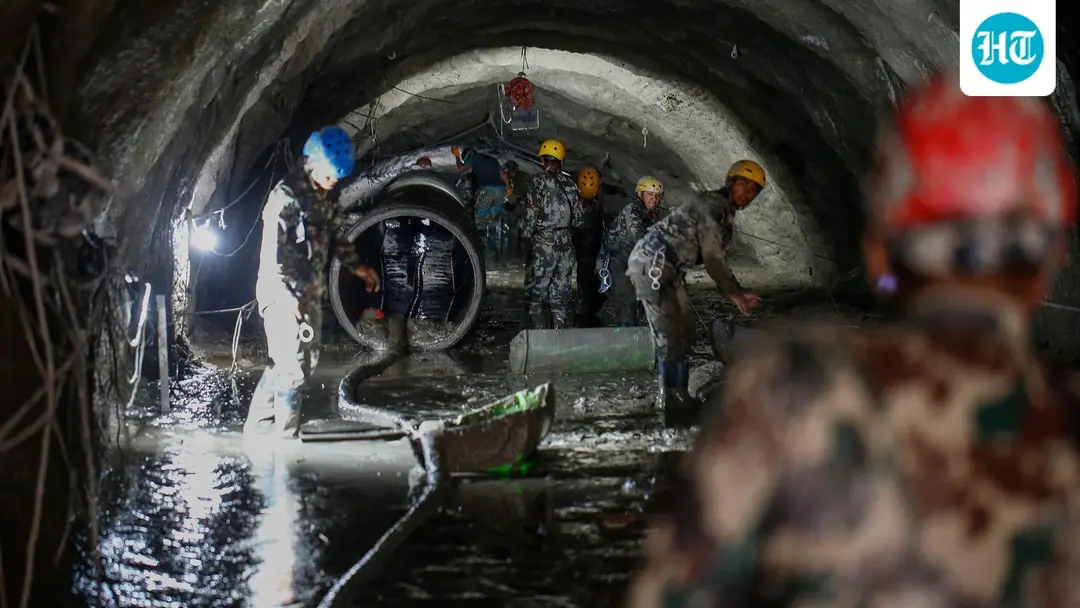
Rat-hole mining used to reach six trapped workers in Nepal
Rescuers at Nepal's Chilime 22 MW hydropower project are using rat-hole mining, the technique adopted in the 2024 Silkyara tunnel rescue in Uttarakhand, to reach six workers trapped since the August 26 floods. Twenty tunnel experts from the Indian Army and NDRF and 37 Nepalese Army personnel are involved. About 90 metres of debris was cleared and rescuers dug 35 metres further to a depth of 125 metres, deputy manager Bimal Khadka said. Contact with the workers is yet to be established. Hydropower company data showed 909 people missing at 11 sites.
Source
Hindustan Times — India · read the original report ↗
Desk check · compared with the source
What the desk checked (5)
- Six workers have been trapped at Nepal's Chilime 22 MW hydropower project since the August 26 floods. — Stated in source and attributed to officials monitoring the rescue.
- Rescuers have dug about 35 metres through debris using rat-hole mining, reaching a total depth of 125 metres after clearing about 90 metres of debris. — Attributed to Bimal Khadka, deputy manager, Chilime Hydropower Company Ltd; the Nepal Army separately cites about 100 metres cleared, a minor internal discrepancy.
- Twenty tunnel experts from the Indian Army and NDRF and 37 Nepalese Army personnel are carrying out the rescue. — Figures appear in the source, attributed to officials.
- 909 people went missing at 11 sites after the floods. — Attributed to data maintained by hydropower companies; no independent confirmation in source.
- Clearing work is expected to continue on September 15 to reach the powerhouse. — Attributed to Indian envoy to Nepal Naveen Srivastava in a post on X.
Deep dive
Research brief · 8 facts · 4 dates · exam-readyThe brief
Context
Devastating floods in Nepal on August 26 struck several hydropower sites, trapping workers underground. At the Chilime 22 MW hydropower project, six workers have been missing since the floods, last seen at the underground power station. Rescuers, including Indian Army and NDRF tunnel experts alongside Nepalese Army personnel, have turned to rat-hole mining — the narrow-tunnel technique used in the 2024 Silkyara tunnel rescue in Uttarakhand — to dig through debris and water-logged passages. Contact with the trapped workers has still not been established.
Key facts
- Six workers have been trapped at Nepal's Chilime 22 MW hydropower project since the floods of August 26.
- Twenty tunnel experts from the Indian Army and the NDRF, along with 37 Nepalese Army personnel, are carrying out the rescue.
- About 90 metres of debris, including large boulders, was cleared using excavators; rescuers then dug a rat hole 35 metres further to a total depth of 125 metres.
- The Nepal Army said approximately 100 metres of debris has been cleared by a joint team using an excavator and a loader, and a search and rescue team is trying to enter using ropes.
- Data maintained by hydropower companies showed 909 people went missing at 11 sites after the floods.
- Deputy manager Bimal Khadka said teams hope water has created a void in the next 100 metres or so leading to the underground power station.
- Information officer Shree Raj Bajracharya said rescuers on Monday morning found oil mixed with water, suggesting they are near the power station.
- In the 2024 Silkyara rescue in Uttarakhand, which spanned nearly 17 days, all 41 trapped workers could communicate with rescuers and were sent food and medicine through a roughly 100-metre drilled pipe.
Timeline
- 2024Silkyara tunnel rescue in Uttarakhand: all 41 trapped workers rescued after nearly 17 days, with rat-hole mining used in the final stage.
- August 26Devastating floods in Nepal trap six workers at the Chilime 22 MW hydropower project; hydropower company data later showed 909 missing at 11 sites.
- Monday (as reported)Rescuers report digging 35 metres via rat hole to a total depth of 125 metres; oil mixed with water found, indicating proximity to the power station.
- Tuesday, September 15Indian envoy Naveen Srivastava said clearing work was expected to continue to reach the powerhouse.
Who has a stake
- Six trapped workers at Chilime — Survival; last spotted at the underground power station where stored drinking water was kept, but no contact yet established.
- Indian Army and NDRF tunnel experts (20 personnel) — Deploying Silkyara-tested rat-hole mining expertise in a cross-border rescue.
- Nepalese Army (37 personnel) — Leading debris clearing, dewatering and rope-based entry into the tunnel.
- Chilime Hydropower Company Ltd — Its underground power station is the rescue target; officials Bimal Khadka and Shree Raj Bajracharya are briefing on progress.
- Indian Embassy in Nepal / Ambassador Naveen Srivastava — Coordinating and publicly updating on Indian assistance to the Nepal rescue effort.
- Families of the 909 people missing at 11 sites — Awaiting news as flood damage spans multiple hydropower project sites.
Why it matters
The Chilime operation shows how disaster-response knowledge crosses borders: a high-risk, largely illegal coal-mining technique used at Silkyara is now Nepal's best hope for reaching six workers. Unlike Uttarakhand, where communication and a supply pipe kept 41 workers alive, rescuers at Chilime are working blind through boulders and water. With 909 people reported missing at 11 hydropower sites, the episode raises hard questions about the vulnerability of Himalayan hydropower infrastructure to extreme floods.
UPSC angle
Prelims pointers
- Rat-hole mining: narrow, unventilated tunnels sized for a single miner, normally used to extract coal from thin seams, often illegally.
- Silkyara tunnel rescue (Uttarakhand, 2024): 41 workers rescued after nearly 17 days; supplies sent via a roughly 100-metre drilled pipe.
- NDRF (National Disaster Response Force) tunnel experts, with the Indian Army, deployed at Nepal's Chilime 22 MW hydropower project.
- Chilime Hydropower Company Ltd operates the 22 MW project where six workers have been trapped since the August 26 floods.
- Naveen Srivastava is the Indian envoy in Nepal, providing updates on the rescue.
- Hydropower company data: 909 people missing at 11 sites after the Nepal floods.
Mains framing
The Chilime rescue illustrates the collision between fragile Himalayan hydropower infrastructure and extreme hydro-meteorological events: the August 26 floods left six workers trapped in an underground power station and, per company data, 909 people missing at 11 sites. With debris, large boulders and inflowing water blocking access, rescuers resorted to rat-hole mining — a technique of narrow, unventilated single-miner tunnels normally associated with illegal coal extraction — after clearing roughly 90-100 metres of debris and digging 35 metres more to a depth of 125 metres. The contrast with Silkyara is instructive: there, communication with all 41 workers and a roughly 100-metre supply pipe sustained them for nearly 17 days, whereas at Chilime no contact has been made and hope rests on stored drinking water and a possible void ahead. The episode underscores three imperatives: institutionalising tunnel-rescue capability (Indian Army and NDRF expertise being shared with the Nepalese Army, 20 and 37 personnel respectively), building escape routes, communication lines and dewatering capacity into underground hydropower design, and strengthening India-Nepal disaster cooperation. Sustained monitoring of the risk to run-of-river Himalayan projects, rather than ad hoc post-disaster improvisation, is the way forward.
Key terms
- Rat-hole mining
- Digging narrow, unventilated tunnels wide enough for one miner to directly access a thin coal seam; hazardous and often carried out illegally.
- Silkyara tunnel rescue
- The 2024 Uttarakhand operation lasting nearly 17 days in which all 41 trapped workers were brought out, with rat-hole mining adopted in the final push.
- NDRF
- National Disaster Response Force; India's specialised disaster response force, 20 of whose experts with the Indian Army are aiding the Chilime rescue.
- Chilime 22 MW hydropower project
- Nepalese hydropower project run by Chilime Hydropower Company Ltd, where six workers have been trapped in the underground power station since August 26.
- Dewatering
- Pumping out accumulated water — here using mud pumps — to allow rescuers to advance through the flooded tunnel.
Practice questions
- Compare the Silkyara (2024) and Chilime rescue operations. What factors explain the differing prospects of success, and what do they reveal about preparedness for underground tunnel emergencies?
- Rat-hole mining is hazardous and often illegal, yet has twice become a rescue tool of last resort. Critically examine the ethical and safety dilemmas this poses for disaster response agencies.
- Discuss the vulnerability of Himalayan hydropower projects to extreme flood events, using the August 26 Nepal floods in which 909 people went missing at 11 sites.
Grounded only in the source report — figures and dates are the source's, not inferred.