
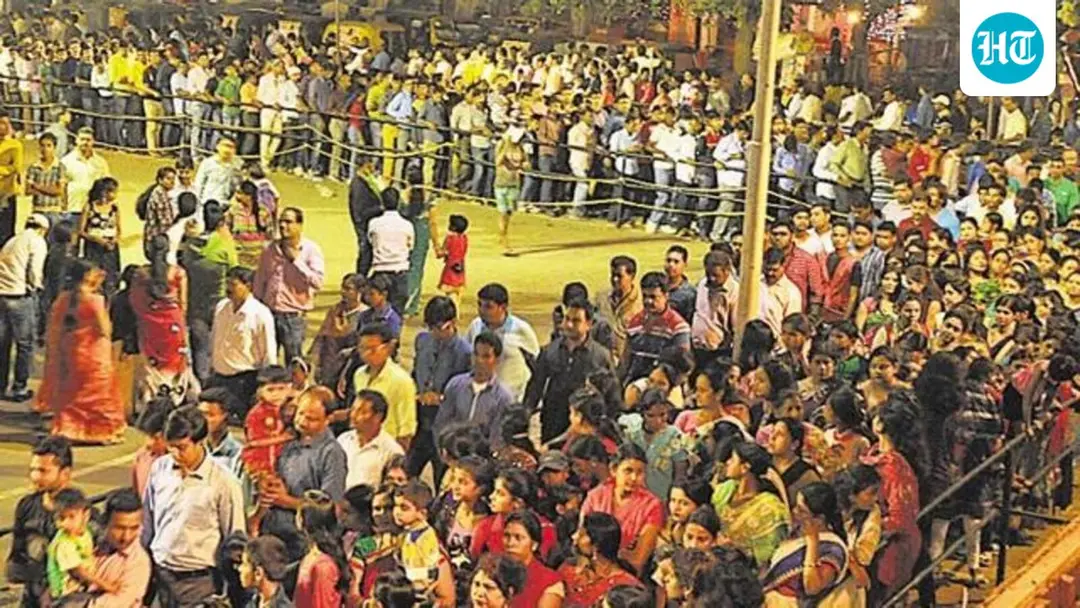
Row over Kolkata Police orange T-shirt tender for Puja volunteers
A political row erupted in West Bengal after Kolkata Police floated an e-tender to procure orange full-sleeve T-shirts and peak caps for temporary Durga Puja volunteers. A senior officer said the estimated cost is ₹89 lakh. Another officer said the colour was being changed from blue and white to orange to make volunteers easily identifiable in crowds. About 20,000 volunteers are deployed for 10 days annually. TMC and Congress alleged 'saffronisation'; BJP rejected the charge.
Source
Hindustan Times — India · read the original report ↗
Desk check · compared with the source
What the desk checked (5)
- Kolkata Police floated an e-tender for orange full-sleeve T-shirts and peak caps for Durga Puja volunteers at an estimated cost of ₹89 lakh. — Attributed to a senior Kolkata Police officer; figure appears in source.
- Around 20,000 temporary volunteers are deployed for a 10-day period during Durga Puja. — Figure appears in source, attributed to police officers; not independently verifiable here.
- The volunteer dress colour is being changed this year from blue and white to orange for easier identification in crowds. — Attributed to an unnamed second police officer.
- TMC and Congress allege the move is an attempt to 'saffronise' the police force. — Attributed to named leaders Kunal Ghosh (TMC) and Soumya Aich Roy (Congress) as direct quotes.
- BJP says saffron is the first colour of the national flag and symbolises courage and sacrifice. — Attributed to BJP leader Rahul Sinha as a direct quote; opinion, not fact.
Analysts’ view opinion
The ₹89-lakh T-shirt tender is no longer a procurement matter — it has become a fight over colour symbolism staged at Bengal's most emotionally charged moment, Durga Puja. For the BJP it opens a cultural-nationalist argument it is comfortable making; for the TMC and Congress it keeps alive the charge that the police are being politicised. The story records only an operational explanation from police officers — easier identification in crowds — but that explanation is unlikely to settle the politics.
- This is a row both sides can profit from: the BJP frames saffron as the flag's own colour signifying courage and sacrifice, while the opposition frames it as mixing administration with religion.
- With around 20,000 temporary volunteers deployed for 10 days at major intersections, the colour change becomes one of the most publicly visible signals in the city.
- Allegations that the police behave like a party's cadre are an old fixture of Bengal politics; this tender gives the opposition a simple, visual peg for that argument.
- The cost figure adds a second layer to the criticism — an ideological objection plus a 'wasteful expenditure' objection.
- TMC and Congress speaking in similar terms is notable, though the story does not establish whether this is coordination or two parties independently seizing the same opening.
What to watch — Watch whether the tender proceeds unchanged or draws a clarification or review under pressure, and whether images of these volunteers during the Puja days get absorbed into campaign messaging.
The story does not establish who decided the colour change or whether any political direction was involved — beyond the officers' stated operational reason, no other rationale is on record here.
Deep dive
Research brief · 8 facts · 3 dates · exam-readyThe brief
Context
Kolkata Police every year recruits temporary volunteers for a 10-day period during Durga Puja to help regular personnel with crowd management at major intersections and arterial roads. This year the force floated an e-tender to buy orange full-sleeve T-shirts and peak caps for these volunteers, replacing the earlier blue and white kit. The change of colour has become a political flashpoint in West Bengal, with the Trinamool Congress and Congress alleging "saffronisation" of the police and the ruling BJP rejecting the charge. The source indicates the BJP is the ruling party in the state.
Key facts
- Kolkata Police floated an e-tender to procure orange-coloured full-sleeve T-shirts and peak caps for temporary Durga Puja volunteers.
- A senior Kolkata Police officer put the total estimated cost of the procurement at ₹89 lakh.
- Around 20,000 temporary volunteers are deployed each year for a 10-day period during Durga Puja.
- The volunteer kit colour is being changed this year from blue and white to orange.
- An officer said the new colour will make volunteers 'conspicuous and easily identifiable in the crowd'.
- NCC cadets, scouts, students and NGOs also serve as Puja volunteers, but they come in their own uniforms; the T-shirts and caps go only to temporarily recruited volunteers.
- TMC spokesperson Kunal Ghosh alleged the move amounts to complete 'saffronisation' and that police are behaving like BJP cadres.
- BJP leader Rahul Sinha said saffron is the first colour of the National flag and symbolises courage and sacrifice.
Timeline
- Every year (practice)Kolkata Police recruits temporary volunteers for 10 days during Durga Puja for crowd management; earlier kit was blue and white.
- This yearE-tender invited for orange full-sleeve T-shirts and peak caps, estimated cost ₹89 lakh; colour changed from blue and white to orange.
- After the tender became knownTMC and Congress allege 'saffronisation'; BJP refutes the charge.
Who has a stake
- Kolkata Police — Must procure kit for about 20,000 temporary volunteers and justify the colour change on grounds of visibility in crowds.
- Temporary Puja volunteers — Around 20,000 people engaged for 10 days who will wear the new orange T-shirts and peak caps.
- Trinamool Congress — Alleges saffronisation of the police force and questions the expenditure on new uniforms.
- Congress — Alleges mixing of administration and religion and 'divisive politics' by the BJP.
- Bharatiya Janata Party (ruling party per source) — Defends the colour as the first colour of the National flag symbolising courage and sacrifice.
- NCC cadets, scouts, students, NGOs — Serve as Puja volunteers in their own uniforms and are outside the new procurement.
Why it matters
A routine procurement decision on volunteer clothing has become a test of whether state policing symbols are seen as politically neutral. The dispute shows how colour, uniform and festival administration can be read as markers of party or religious identity, affecting public trust in the police during a mass-gathering event involving about 20,000 volunteers.
UPSC angle
Prelims pointers
- Kolkata Police e-tender: orange full-sleeve T-shirts and peak caps for Durga Puja volunteers; estimated cost ₹89 lakh.
- About 20,000 temporary volunteers are deployed for a 10-day period during Durga Puja.
- Volunteer kit colour changed from blue and white to orange this year.
- NCC (National Cadet Corps) cadets, scouts and students volunteer in their own uniforms.
- TMC spokesperson quoted: Kunal Ghosh; Congress leader: Soumya Aich Roy; BJP leader: Rahul Sinha.
- BJP's defence: saffron is the topmost colour of the National flag, symbolising courage and sacrifice.
Mains framing
The row over Kolkata Police's ₹89-lakh e-tender for orange T-shirts and peak caps for roughly 20,000 temporary Durga Puja volunteers illustrates how administrative decisions acquire political meaning in a polarised polity. The police justification is functional — orange makes volunteers conspicuous and easily identifiable in dense festival crowds at major intersections and arterial roads, replacing the earlier blue and white. Opponents read the same choice symbolically: the TMC argues that introducing saffron in police-linked attire completes the 'saffronisation' of a force it claims already behaves like party cadre, while the Congress frames it as mixing administration with religion and identifying the government with one religious community. The BJP counters that saffron belongs to the National flag and denotes courage and sacrifice, and that the allegations are baseless. The unresolved question is institutional rather than aesthetic: how do police forces preserve the perception of neutrality when uniforms, colours and festival deployments are contested? The way forward suggested by the facts available is transparency about the operational rationale and procurement, clear distinction between temporary volunteers and uniformed cadres such as NCC and scouts, and restraint by political actors in reading party identity into policing symbols. Beyond that, the source does not state any policy response.
Key terms
- E-tender
- An electronic public procurement notice inviting bids; here for orange T-shirts and peak caps at an estimated ₹89 lakh.
- Temporary Puja volunteers
- Persons recruited by Kolkata Police for a 10-day Durga Puja period to assist with crowd management.
- National Cadet Corps (NCC)
- Youth cadet organisation whose cadets volunteer during the Puja in their own uniforms.
- 'Saffronisation'
- Allegation that state institutions are being imbued with a party's or a religion's colour and symbolism; the TMC and Congress charge here.
- Crowd management
- Regulating movement of large festival crowds at major intersections and arterial roads, the volunteers' stated task.
Practice questions
- Examine how the choice of colours and symbols in policing can affect public perception of institutional neutrality, with reference to the Kolkata Police volunteer uniform row.
- Discuss the role of temporary volunteers in managing mass religious gatherings in Indian cities, and the accountability questions such deployment raises.
- 'Administrative decisions in a polarised polity are rarely read as purely administrative.' Critically analyse with recent examples.
Grounded only in the source report — figures and dates are the source's, not inferred.