
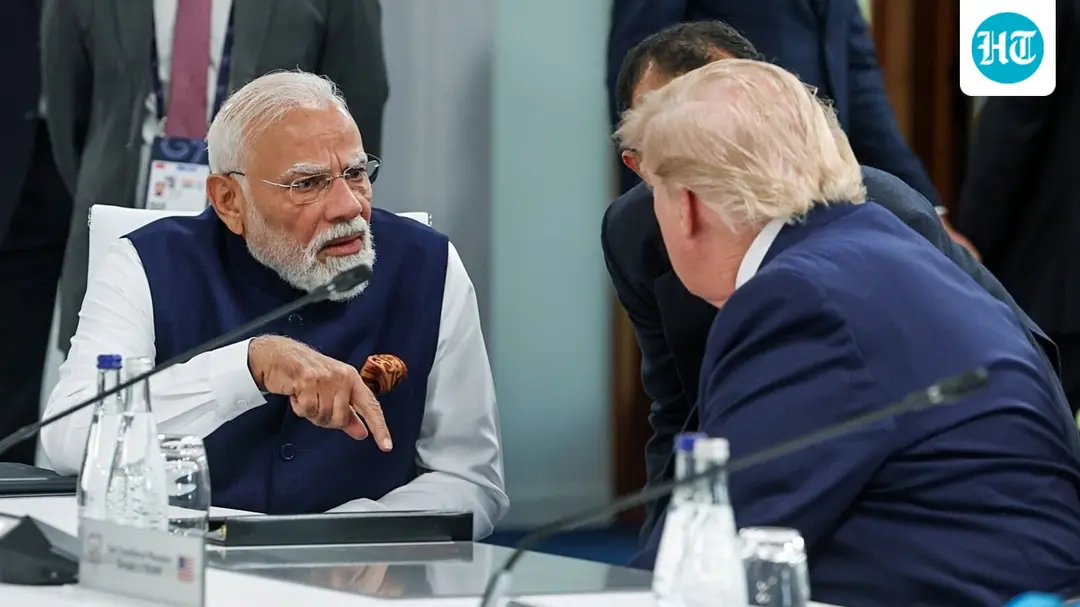
India warns US bill on 100% tariffs may affect ties, energy market
India's external affairs ministry warned on Thursday that a US bill authorising tariffs of up to 100% on the five largest buyers of Russian oil and gas could affect bilateral relations and the international energy market. The US House passed the legislation 262-159, after Senate approval 86-11. By current import volumes the list covers China, India, Slovakia, Hungary and Azerbaijan. The ministry said India remains committed to energy security for its 1.4 billion people and will protect its trade interests.
Source
Hindustan Times — India · read the original report ↗
Desk check · compared with the source
What the desk checked (5)
- US House passed the Lindsey O Graham Sanctioning Russia and Iran Act of 2026 by 262-159, after Senate approval 86-11 on August 7. — Specific vote figures appear in source; attributed to legislative proceedings, no external verification possible.
- Bill allows tariffs up to 100% on the five largest buyers of Russian crude and gas, currently China, India, Slovakia, Hungary, Azerbaijan. — Stated in source as based on current import volumes; no single named official attribution.
- Russia supplied 51.1% of India's crude imports in July. — Figure attributed in source to Global Trade Research Initiative.
- India's Russian crude imports rose 34% month-on-month to record levels in June 2026, valued at €4.5 billion. — Attributed to Centre for Research on Energy and Clean Air; date is forward-looking and should be checked by the desk.
- MEA said India will take all necessary measures to protect trade and economic interests. — Directly attributed to India's external affairs ministry statement.
Analysts’ view opinion
The bill does not order tariffs — it hands Trump a durable, congressionally sanctioned bargaining weapon, and that is the real political problem for India. After the Supreme Court struck down executive tariff powers in February, Washington now has a legally sturdier pressure tool sitting on the president's desk. India's foreign ministry response was deliberately measured — not confrontational, but leaning hard on the domestic political language of "energy security for 1.4 billion people".
- Because tariffs are discretionary and waivers rest with the president, this functions more as leverage than punishment — and it falls directly across the still-unsigned bilateral trade deal.
- The vocabulary of "national interest" and "energy security" signals Delhi's domestic imperative: appearing to buckle under US pressure carries a political cost no government wants.
- The 262-159 House vote and 86-11 Senate vote show bipartisan hostility to Moscow, yet the story notes both parties were divided over handing Trump expanded tariff authority.
- The 15% gas exemption that shields several European nations while covering neither India nor China strengthens Delhi's long-standing argument about selective targeting.
- Arriving before November's midterms, the law ties America's internal electoral clock to India's trade negotiations.
What to watch — Watch when Trump signs, and whether he actually imposes tariffs or holds them as leverage to close the pending trade deal built on the 18% tariff understanding.
The story does not establish whether, when or at what rate tariffs will actually be applied, what India's "necessary measures" would involve, or how large the White House's role in passage really was.
Deep dive
Research brief · 8 facts · 10 dates · exam-readyThe brief
Context
The US Congress has passed the Lindsey O Graham Sanctioning Russia and Iran Act of 2026, which authorises the US President to impose tariffs of up to 100% on goods from the five largest buyers of Russian crude oil and natural gas. By current import volumes that list includes China, India, Slovakia, Hungary and Azerbaijan. India, whose largest source of crude remains Russia, said the legislation could have implications for the India-US bilateral relationship and the international energy market. The development comes as the two countries are still working towards a bilateral trade agreement after Trump's 50% tariffs on Indian exports last year pushed ties to their lowest point in over two decades.
Key facts
- The US House of Representatives passed the Lindsey O Graham Sanctioning Russia and Iran Act of 2026 by 262-159 on Wednesday; the Senate had passed it 86-11 on August 7.
- The bill authorises tariffs of up to 100% on goods from the five largest purchasers of Russian crude oil and natural gas, and up to 500% on goods imported directly from Russia.
- By current import volumes the top-five list covers China, India, Slovakia, Hungary and Azerbaijan; the bill names no country, using a formula instead.
- The US Trade Representative, with the Secretary of State and Secretary of Energy, will identify the top five importers by volume over the preceding 12 months, reassessed every 180 days.
- Russia supplied 51.1% of India's crude imports in July, more than the UAE, Saudi Arabia, Venezuela, Brazil, Oman and the US combined, per the Global Trade Research Initiative.
- India's Russian crude imports surged 34% month-on-month to record levels in June 2026, valued at EUR 4.5 billion, making India the second-largest buyer behind China (Centre for Research on Energy and Clean Air).
- An exemption shields countries whose Russian gas imports are under 15% of Russia's total gas exports and that are taking significant steps to cut them; it does not cover oil, nor India or China.
- India's MEA said the country is 'firmly committed to ensuring energy security for its 1.4 billion people' and will take all necessary measures to protect trade and economic interests.
Timeline
- Last yearTrump imposed 50% tariffs on Indian exports; India-US ties fell to their lowest point in more than two decades.
- August 7The US Senate passed the sanctions bill by 86-11.
- FebruaryUS Supreme Court struck down the use of the International Emergency Economic Powers Act for trade duties; India and US also reached an understanding to cut tariffs to 18%.
- Through much of 2025India scaled back Russian oil imports under US pressure.
- June 2026India's Russian crude imports surged 34% month-on-month to record levels worth EUR 4.5 billion.
- JulyRussia supplied 51.1% of India's crude oil imports, per GTRI.
- Last monthUS Ambassador Sergio Gor said Trump's support for the bill had been muted.
- MondayHouse Rules Committee allowed the bill to progress.
- TuesdayHouse voted 214-211 to schedule the final vote, after two Democrats crossed the aisle.
- WednesdayHouse passed the bill 262-159, sending it to President Trump's desk.
Who has a stake
- Government of India / Ministry of External Affairs — Must protect energy security for 1.4 billion people and trade and economic interests while pursuing a bilateral trade agreement with the US.
- US President Donald Trump — Gains a durable, congressionally authorised tariff tool; a White House official said he plans to sign the bill, with no timeline specified.
- US Congress — Divided in both parties over handing Trump expanded tariff authority ahead of November's midterm elections.
- China, Slovakia, Hungary, Azerbaijan — Also on the current top-five list of Russian energy buyers and thus exposed to tariffs of up to 100%.
- Indian exporters and trade/industry bodies — The MEA said it will work closely with them to deal with the fallout of possible tariffs of up to 100%.
- Russia — Faces loss of energy buyers; a separate provision authorises tariffs of up to 500% on goods imported directly from Russia.
- European nations — Several would be shielded by the natural gas exemption, which does not extend to oil purchases.
Why it matters
Russia supplied 51.1% of India's crude imports in July, so any US tariff action on Russian energy buyers strikes at both India's energy security and its export competitiveness. Because the authority now comes from Congress rather than executive emergency powers struck down by the US Supreme Court in February, it is legally more durable. It also lands while the India-US bilateral trade agreement remains unsigned, giving Washington added leverage.
UPSC angle
Prelims pointers
- The Lindsey O Graham Sanctioning Russia and Iran Act of 2026: House 262-159; Senate 86-11 on August 7.
- Tariff ceiling: up to 100% on the five largest buyers of Russian crude and gas; up to 500% on goods imported directly from Russia.
- Top-five list to be identified by the US Trade Representative with the Secretaries of State and Energy, over a 12-month lookback, reassessed every 180 days.
- Russia's share of India's crude imports in July: 51.1% (Global Trade Research Initiative).
- India was the second-largest buyer of Russian crude behind China in June 2026, with imports worth EUR 4.5 billion (Centre for Research on Energy and Clean Air).
- US Supreme Court in February struck down use of the International Emergency Economic Powers Act (IEEPA) for trade duties.
Mains framing
The US sanctions bill illustrates how energy trade has become an instrument of geopolitical coercion, and how India's strategic autonomy is tested when a partner legislates penalties for its sourcing choices. The causes are layered: Trump's frustration at his inability to end the war in Ukraine, the search for a legally durable tariff tool after the US Supreme Court struck down IEEPA-based duties in February, and India's record Russian crude purchases in June 2026 following the effective closure of the Strait of Hormuz, for which Washington itself had granted general licences. The implications are significant: with Russia supplying 51.1% of India's crude in July, tariffs of up to 100% would hit exporters, while the exemption sparing European gas buyers but not oil buyers feeds India's long-standing charge, voiced by Ambassador Vinay Kumar, that such measures are "unfair, unreasonable and unjustified." The way forward, as articulated by the MEA, lies in diversified sourcing based on evolving market dynamics, including increased purchases from the US and Venezuela, sustained engagement with US interlocutors, close coordination with trade and industry bodies, and concluding the bilateral trade agreement without accepting, as GTRI's Ajay Srivastava cautions, an unequal deal.
Key terms
- Lindsey O Graham Sanctioning Russia and Iran Act of 2026
- US law authorising tariffs of up to 100% on the five largest buyers of Russian crude and gas, and up to 500% on direct imports from Russia.
- International Emergency Economic Powers Act (IEEPA)
- US statute previously used for executive trade duties; its use for tariffs was struck down by the US Supreme Court in February.
- US Trade Representative (USTR)
- US agency that, with the Secretaries of State and Energy, will identify the five largest importers of Russian crude and gas.
- Global Trade Research Initiative (GTRI)
- Indian trade research body, headed by Ajay Srivastava, which reported Russia's 51.1% share of India's July crude imports.
- Centre for Research on Energy and Clean Air (CREA)
- Research body that recorded India's 34% month-on-month surge in Russian crude imports to EUR 4.5 billion in June 2026.
- Presidential waiver
- Trump may waive tariffs by certifying to Congress it serves US national interests; permanent removal requires certified halt to Russian energy purchases.
Practice questions
- Examine how the use of secondary tariffs on buyers of Russian energy challenges India's pursuit of strategic autonomy and energy security.
- Discuss the implications of the US Lindsey O Graham Sanctioning Russia and Iran Act of 2026 for India-US trade negotiations and for the global energy market.
- 'Energy security for 1.4 billion people must be guided by national interest.' Critically evaluate India's diversification strategy in light of Russia supplying over half its crude imports.
Grounded only in the source report — figures and dates are the source's, not inferred.