
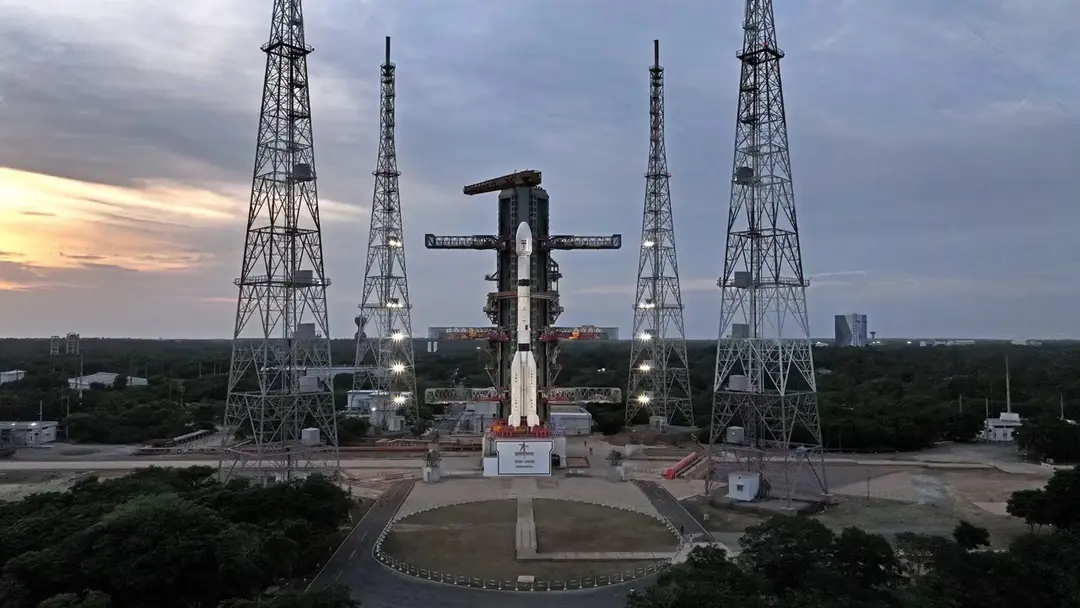
ISRO employee groups warn against technology transfer at 'throwaway prices'
The Joint Action Council of ISRO employee associations has warned that India's push for greater private participation in space must not weaken the agency or transfer taxpayer-funded technology at "throwaway prices". It wants the LVM3 rocket and the under-development NGLV to remain entirely with ISRO. The Indian Express reported that the four-page statement, circulated among employees on Thursday, sought transparency and accountability. Chairman V Narayanan has said there is no proposal to privatise ISRO.
Source
ISRO · read the original report ↗
Desk check · some claims need care
What the desk checked (5)
- ISRO employee groups' Joint Action Council warned private participation must not weaken ISRO or transfer taxpayer-funded technology at 'throwaway prices'. — Attributed to a JAC statement reported by The Indian Express; the quoted phrase appears in the source.
- The four-page statement was undated and circulated among ISRO employees on Thursday. — Attributed to The Indian Express, which says it obtained a copy and confirmed authenticity with two serving employees.
- JAC wants LVM3 and the under-development NGLV to remain fully with ISRO. — Figure/detail appears in source as the JAC's stated position; not independently confirmed.
- Employee associations wrote to ISRO Chairman V Narayanan on September 4, a day after the successful GSLV-F17 mission. — Date and mission name appear in the source; no supporting document cited.
- Narayanan said there is no proposal to privatise ISRO; IN-SPACe Chairman Pawan Goenka said ISRO would remain the foundation of India's space programme. — Attributed to named officials in the source; ISRO did not respond to the newspaper's request for comment.
Analysts’ view opinion
This is more than a staff grievance — the JAC has framed the debate in the most politically potent terms available: taxpayer money versus private profit, around an institution that is a symbol of national pride. Crucially, it does not oppose private participation outright but demands transparency, accountability and no transfer of technology at "throwaway prices" — a framing that is hard to brand as anti-reform. The speed with which the ISRO chairman and the IN-SPACe chief offered reassurances suggests the government is keen not to let this narrative slip away.
- Because ISRO ranks among India's most trusted public institutions, any perception that it is being weakened carries a political charge that few other PSUs generate.
- The fact that a four-page statement has surfaced after the September 4 letter suggests the chairman's assurances have not settled employee anxieties.
- By backing industry participation while ring-fencing LVM3 and NGLV, the JAC has shifted the argument from "whether" to "how much and at what price" — a harder position for the government to dismiss.
- For opposition parties this is a ready-made line of attack, lending employee-voice credibility to their existing critique of privatising public assets.
- With most ISRO centres located in southern states, staff discontent could also acquire a regional political colour.
What to watch — Watch for whether written clarity emerges from the government or the space department on technology-transfer pricing and NGLV ownership, or whether the issue migrates into parliamentary questions and opposition statements.
The story does not establish that any technology has actually been transferred cheaply or that a proposal to shrink ISRO's role exists — these are the employee bodies' concerns, and ISRO did not respond to a request for comment on the statement.
Deep dive
Research brief · 8 facts · 5 dates · exam-readyThe brief
Context
India has been opening its space sector to private companies, with ISRO expected to work alongside industry, start-ups and PSUs while IN-SPACe acts as the promoter-regulator. Reports that ISRO could focus on a smaller set of strategic missions and hand other activities to private firms prompted concern among its employees. The Joint Action Council (JAC), representing ISRO employee associations, has now circulated a four-page statement warning that publicly funded technology must not be transferred at "throwaway prices" and that ISRO must retain end-to-end control of key launch vehicles such as LVM3 and the under-development NGLV. ISRO Chairman V Narayanan has said there is no proposal to privatise the agency.
Key facts
- The Joint Action Council of ISRO employee associations warned that private participation must not weaken ISRO or transfer taxpayer-funded technology at "throwaway prices".
- The undated four-page JAC statement was circulated among ISRO employees on Thursday, as reported by The Indian Express on Friday.
- The Indian Express said it obtained a copy of the statement and confirmed its authenticity with two serving employees; ISRO did not respond to its request for comment.
- The JAC named the LVM3 heavy-lift rocket and the Next Generation Launch Vehicle (NGLV), under development, as systems that should remain with ISRO.
- The JAC said ISRO must retain the entire chain of capability: research, development, production, integration, testing and launch.
- Employee associations wrote to ISRO Chairman V Narayanan on September 4, a day after the successful GSLV-F17 mission.
- Narayanan told employees there is no proposal to privatise ISRO, and also addressed them through a video conference.
- IN-SPACe Chairman Pawan Goenka said ISRO would remain the foundation of India's space programme.
Timeline
- September 3 (a day before the letter)GSLV-F17 mission is launched successfully.
- September 4ISRO employee associations write to Chairman V Narayanan seeking clarity on the agency's future role.
- After the letterNarayanan tells employees there is no proposal to privatise ISRO and addresses them via video conference; ISRO and IN-SPACe issue reassurances.
- Thursday (undated statement)JAC's four-page statement is circulated among ISRO employees.
- FridayThe Indian Express reports the contents of the statement; report dated September 18, 2026 in the source.
Who has a stake
- Joint Action Council (JAC) of ISRO employee associations — Wants ISRO to retain core R&D and launch capability, and safeguards on transfer of publicly funded technology.
- ISRO — Its future mandate, capabilities and institutional primacy in India's space programme are in question.
- ISRO Chairman V Narayanan — Must reassure employees while pursuing industry partnerships to expand the space economy.
- IN-SPACe (Chairman Pawan Goenka) — Promotes private participation; has said ISRO will remain the foundation of India's space programme.
- Private companies, start-ups and PSUs — Stand to gain access to ISRO-developed technologies and facilities, and a larger role in launches.
- Taxpayers — Publicly funded assets should not become private profit without adequate return to the country, per the JAC.
Why it matters
The dispute goes to the heart of how a state-built strategic capability is shared with private industry: on what terms, at what price and with what accountability. If mature launch technologies built with public money are transferred cheaply, the state may lose both revenue and strategic control; if industry is kept out, India may not scale up its launch numbers or space economy.
UPSC angle
Prelims pointers
- Joint Action Council (JAC) is a grouping of employee associations at ISRO.
- LVM3 is ISRO's heavy-lift launch vehicle; NGLV (Next Generation Launch Vehicle) is under development.
- V Narayanan is the ISRO Chairman referred to in the story.
- Pawan Goenka is the Chairman of IN-SPACe.
- GSLV-F17 mission was successful, a day before the September 4 employee letter.
- JAC demands: transparency, accountability and a level playing field in technology transfer.
Mains framing
The controversy over technology transfer at ISRO reflects the tension inherent in liberalising a strategic, state-built sector. India's expanding space ambitions require more launches than ISRO alone can deliver, which is why industry, PSUs and start-ups are being brought in; the JAC itself accepts this. Its objection is narrower and sharper: that mature technologies and facilities created with taxpayer money should not be handed over at "throwaway prices" or without adequate return to the country, and that ISRO must not lose the full chain of capability from research and development to production, integration, testing and launch, especially for the LVM3 and NGLV. The implications are threefold: fiscal (recovering public investment), strategic (retaining sovereign launch capability for strategic missions), and institutional (whether ISRO's role narrows to a few missions). The way forward suggested in the source is procedural rather than restrictive: transparency, accountability and a level playing field in how public assets are opened up, alongside official assurances from the Chairman and IN-SPACe that ISRO will remain the foundation of the programme and the principal institution for advanced research, strategic missions and space science.
Key terms
- Joint Action Council (JAC)
- A body representing employee associations at ISRO, which issued the four-page statement on technology transfer.
- LVM3
- ISRO's heavy-lift launch vehicle, which the JAC says should remain entirely with the agency.
- NGLV
- Next Generation Launch Vehicle, an ISRO launcher under development, also flagged for retention by the JAC.
- IN-SPACe
- The body, chaired by Pawan Goenka, associated with promoting private participation in India's space sector.
- GSLV-F17
- An ISRO mission described as successful, launched a day before the employee associations' September 4 letter.
- Throwaway prices
- The JAC's phrase for transferring publicly funded technology to private entities without adequate return.
Practice questions
- Examine the arguments for and against transferring mature ISRO-developed launch technologies to private industry. What safeguards should govern such transfers?
- "Publicly funded assets should not become a source of private profit without adequate return to the country." Discuss in the context of India's space sector reforms.
- Discuss the evolving division of roles between ISRO, IN-SPACe and private players in India's space programme.
Grounded only in the source report — figures and dates are the source's, not inferred.