
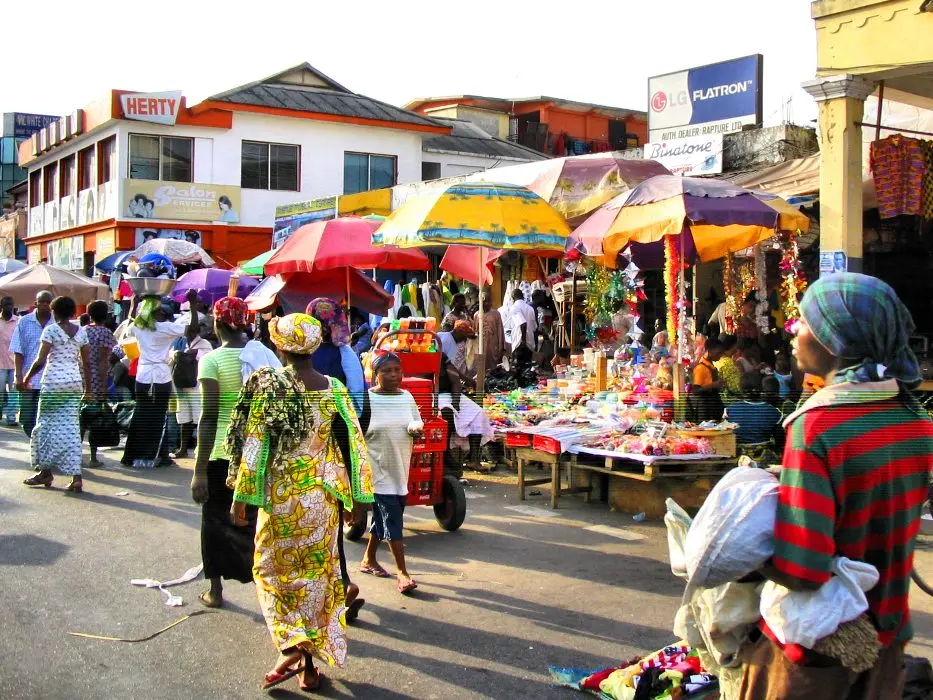
Report documents Indian perspectives on China's role in Ghana
A report by Veda Vaidyanathan and Arhin Acheampong, published by the Atlantic Council on December 16, 2022, examines China's expanding footprint in Africa from an Indian vantage point. It notes China-Africa two-way trade of $254 billion and India-Africa trade of $55 billion in 2020-21. Researchers interviewed 12 of 23 Indian businesses in Ghana and 33 of 261 Chinese firms listed by the Ghana Investment Promotion Centre.
Source
Atlantic Council · read the original report ↗
Desk check · compared with the source
What the desk checked (5)
- Africa accounts for almost 25% of global revenues of Chinese construction companies, while US and European firms held over 85% of continental construction contracts in 1990. — Attributed in the report to the China Africa Research Initiative dataset and cited media analyses; figures appear in the source.
- China-Africa two-way trade stood at $254 billion, with investments exceeding $2.07 billion in the first seven months of 2021. — Figure appears in source, attributed to the International Institute for Sustainable Development.
- India's total trade with Africa in 2020-21 was $55 billion and India is the fifth-largest investor with $54 billion cumulative investments. — Figures appear in source; no specific citation given for these two numbers in the text provided.
- Ghana's imports from China rose from $71.3 million to $6.75 billion and exports to China from $4.23 million to $1.52 billion between 1995 and 2020. — Attributed to the Observatory of Economic Complexity 2020 data in the source.
- Researchers interviewed 12 of 23 Indian businesses listed by the Indian High Commission in Accra, and 33 of 261 Chinese firms registered with the Ghana Investment Promotion Centre. — Methodology stated by the report authors; self-reported and internally consistent.
Analysts’ view opinion
Though packaged as a business survey, the real substance of this report is strategic: India can no longer read China's economic grip in Africa as mere commercial competition. The figures cited — $254 billion in China-Africa trade against $55 billion in India-Africa trade in 2020-21 — capture a difference not of degree but of scale. That Ghana's investment promotion centre list carries 261 Chinese firms against 23 prominent Indian businesses shows how that imbalance looks at ground level.
- The report's account of Chinese dominance in African construction — where Western firms held over 85 percent of contracts in 1990 — illustrates the familiar pathway by which economic presence converts into political influence.
- By recalling that African votes were decisive in the PRC's admission to the UN, the report underlines the enduring strategic value of African support in multilateral forums.
- With India-China ties described as being at their lowest point amid border clashes, a steep trade deficit and the China-Pakistan Economic Corridor, the report argues this rivalry now extends well beyond the Indian Ocean region into Africa.
- Unable to match Chinese capital volumes, India's more realistic route is leverage through triangular cooperation with Japan and the United States, Quad-linked initiatives, skills transfer and diaspora links rather than sheer scale.
- The counterpoint deserves weight: with Africa's infrastructure financing gap running into tens of billions annually, Chinese investment is a necessity rather than a choice for countries like Ghana, and African states are not passive spectators in this contest.
What to watch — Watch whether New Delhi shifts from competing alone in Africa towards joint or triangular projects with partners such as Japan and the United States, and whether it widens its diplomatic and commercial footprint in West Africa.
This is a think-tank study based on a limited interview sample; it establishes no government policy decision in India or Ghana, and no military or security development.
Deep dive
Research brief · 8 facts · 9 dates · exam-readyThe brief
Context
A report published by the Atlantic Council on December 16, 2022, by Veda Vaidyanathan and Arhin Acheampong, studies China's deepening economic and political footprint in Africa from an Indian vantage point, using Ghana as a case study. Ghana, one of West Africa's fastest-growing economies, hosts both a significant Indian diaspora and a rapidly growing Chinese migrant and business community. The study argues that with India-China relations at their lowest point since the 1962 war, and with Indian ties to developing countries said to have "atrophied," New Delhi needs a granular, ground-level understanding of Chinese instruments and approaches in Africa. Fieldwork combined desktop research with interviews of Indian, Chinese and Ghanaian businesses, academics, tribal chiefs and trade unions.
Key facts
- China-Africa two-way trade stood at $254 billion, with Chinese investments exceeding $2.07 billion in the first seven months of 2021 alone.
- Africa's infrastructure financing need is estimated at $130-170 billion a year, with a current financing gap of $68-108 billion.
- Africa accounts for almost 25 percent of global revenues of Chinese construction companies; Chinese market shares in African construction range from 31 to 62 percent.
- In 1990, American and European companies held over 85 percent of construction contracts in Africa; Chinese firms now control 85 percent of Kenya National Highways Authority road projects.
- Researchers interviewed 12 of 23 prominent Indian businesses in Ghana (Accra and Tema) in August 2022, from a list given by the High Commission of India in Accra.
- Of 261 Chinese companies listed by the Ghana Investment Promotion Centre (2014-2021 data), contact was established with 83 and 33 agreed to telephonic interviews.
- The 1971 pro-Beijing UN resolution passed with 76 votes for, 35 against, 17 abstentions; over a third of the favourable votes were African, and 11 of 23 co-sponsors of the 'important question' were African.
- The 2022 African Youth Survey (Ichikowitz Family Foundation, 15 countries, 4,507 interviews) found 54 percent of African youth say China has a lot of influence, against 41 percent for the United States.
Timeline
- Early Han dynastyEarliest recorded Chinese contacts with Africa; relations peaked with Admiral Zheng He's sea ventures during the Ming dynasty.
- 1949The People's Republic of China is established; Ethiopia, Egypt, Liberia and apartheid South Africa were among the few independent African countries then.
- 1962Sino-Indian War, cited as the benchmark low point against which current India-China relations are measured.
- 1990American and European companies held over 85 percent of construction contracts in Africa.
- 2000-2014Period covered by Tsinghua professor Xiaoyang Tang's analysis of Chinese investment in Ghana's manufacturing sector, which this study builds on.
- September 24, 2021Quad Leaders' Summit fact sheet issued by the White House, cited as a platform for practical cooperation extending to Africa.
- October 2021Report 'India's Path to Power' argues India's relations with developing countries have 'atrophied' and calls for a new outreach.
- August 2022Field interviews conducted with Indian company representatives in Accra and Tema, plus Ghanaian businesses, academics, tribal chiefs and trade unions.
- December 16, 2022Atlantic Council publishes the report by Veda Vaidyanathan and Arhin Acheampong.
Who has a stake
- India (New Delhi) — Needs to reimagine engagement with traditional African partners as Beijing's geopolitical and economic sway grows; India-Africa trade is far smaller than China's.
- China (Beijing) — Largest trading partner, biggest investor and creditor for most African countries; gains African political support in multilateral forums.
- Ghana — Fast-growing West African economy hosting both a significant Indian diaspora and a growing Chinese migrant community; case study for evaluating perceptions.
- Ghana Investment Promotion Centre (GIPC) — Custodian of data on Chinese investments in Ghana (261 companies listed for 2014-2021) used as the study's sampling frame.
- Indian businesses in Ghana — Coexisting and competing with Chinese firms; 12 of 23 listed companies shared their experiences of backward and forward linkages.
- Chinese construction and tech firms — Enjoy advantages of speed, scale, easy financing and low costs; dominate African infrastructure and telecom projects.
- African youth and local workers — Value cheap Chinese goods, infrastructure and jobs, but cite resource exports without fair compensation, job displacement and disrespect for local traditions.
- Quad (US, Australia, India, Japan) — Potential vehicle for triangular and practical cooperation by democracies in Africa, including in the Indo-Pacific frame.
Why it matters
Africa is emerging as a theatre where India-China competition plays out economically rather than militarily, and the gap in scale is stark: China-Africa trade of $254 billion against India-Africa trade of $55 billion. With African states holding decisive weight in multilateral forums, as the 1971 UN vote showed, Beijing's grassroots footprint translates into diplomatic leverage. For India, understanding how Chinese firms actually operate on the ground in countries like Ghana is a precondition for any credible "new outreach" to its traditional partners in the developing world.
UPSC angle
Prelims pointers
- China-Africa two-way trade: $254 billion; India-Africa trade: $55 billion in 2020-21.
- Africa contributes nearly 25 percent of global revenues of Chinese construction companies.
- Four Chinese lenders active in African debt restructuring: Export-Import Bank of China, China Development Bank, ICBC, and China International Development Cooperation Agency.
- FOCAC (Forum on China-Africa Cooperation) runs debt cancellation programmes; G20's Debt Service Suspension Initiative and IMF's Catastrophe Containment Relief Trust are also leveraged.
- Quad = United States, Australia, India, Japan; works on Indo-Pacific issues including countries in Africa.
- 'Feed the Future India Africa Innovation Transfer Platform': USAID and NGO Technoserve transfer Indian Khadin and Taanka soil-water techniques to Kenya and Malawi.
Mains framing
China's footprint in Africa is no longer only state-to-state: it spans artisanal miners, contractors, industrial parks, telecom networks and venture funds, built on advantages of speed, scale, cheap financing and low cost that have flipped a construction market once dominated (over 85 percent in 1990) by Western firms. This grassroots presence, in a continent facing a $68-108 billion annual infrastructure financing gap and with few alternative partners, converts into diplomatic capital, as the 1971 UN vote and African youth perceptions (54 percent seeing China as highly influential) illustrate. For India, whose Africa trade of $55 billion is a fraction of China's $254 billion, and whose ties with developing countries are described as having "atrophied," the challenge is compounded by an India-China relationship at its lowest since 1962. The report's Ghana fieldwork suggests the way forward lies less in matching Chinese capital than in granular understanding of Chinese operating models, leveraging the Indian diaspora and existing business linkages, and pursuing triangular and Quad-based cooperation with Japan and the United States, along with technology-transfer models such as the Feed the Future India Africa Innovation Transfer Platform.
Key terms
- Belt and Road Initiative (BRI)
- China's global connectivity and infrastructure programme, whose China-Pakistan Economic Corridor component is a source of India-China friction.
- FOCAC
- Forum on China-Africa Cooperation, the platform through which China runs Africa policy commitments including debt cancellation programmes.
- Ghana Investment Promotion Centre (GIPC)
- Ghanaian agency whose dataset listed 261 Chinese companies investing in the country between 2014 and 2021.
- Quad
- Quadrilateral Security Dialogue of the US, Australia, India and Japan, working on Indo-Pacific issues that extend to Africa.
- Debt Service Suspension Initiative
- G20 mechanism, alongside the IMF's Catastrophe Containment Relief Trust, used in restructuring African debt involving Chinese lenders.
- Khadins and Taankas
- Traditional Indian soil and water management techniques being transferred to Kenya and Malawi under a USAID-Technoserve platform.
Practice questions
- Africa has become a key arena of India-China economic competition. Examine the drivers of China's dominance in African infrastructure and assess the options available to India to strengthen its own engagement.
- How does China's grassroots economic presence in African countries translate into influence in multilateral institutions? Illustrate with examples.
- Critically evaluate the potential and limitations of triangular and Quad-based cooperation as an instrument of India's Africa policy.
Grounded only in the source report — figures and dates are the source's, not inferred.