
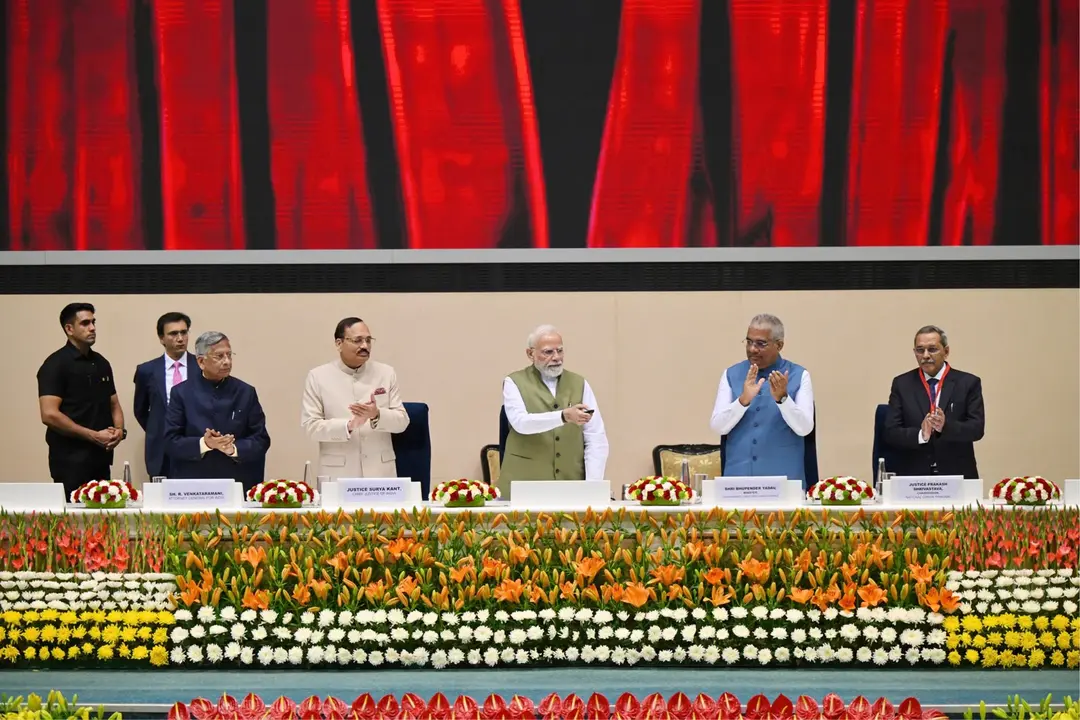
PM Modi opens NGT international conference on environment, climate
Prime Minister Narendra Modi inaugurated the National Green Tribunal's two-day International Conference on 'The Future of Environment and Climate Dynamics' in New Delhi and launched the NGT mobile application. He said India fulfilled its Paris COP21 commitments ahead of schedule. Union Minister Bhupender Yadav said non-fossil sources form 54.18 per cent of installed electricity capacity, surpassing the 2030 target of 50 per cent nine years early. Delegates from 17 countries are attending.
Source
Environment — Bhupender Yadav · read the original report ↗
Desk check · compared with the source
What the desk checked (5)
- Non-fossil sources account for 54.18% of India's installed electricity capacity, surpassing the 2030 target of 50% nine years early. — Attributed in source to Union Minister Bhupender Yadav; figure appears in source text.
- India's forest and tree cover has reached 8.27 lakh square kilometres. — Attributed to Bhupender Yadav, citing UN FAO Global Forest Resources Assessment 2025 for India's third rank in annual net forest-area gain.
- India fulfilled its Paris COP21 commitments ahead of schedule. — Attributed to Prime Minister Narendra Modi in his address; no independent data given in source.
- Conference brings together participants from 17 countries plus UNEP and ADB. — Stated in source without a named source; consistent with the event description.
- Chief Justice of India named as Justice Surya Kant. — Name as given in source; desk cannot verify spelling or designation externally.
Analysts’ view opinion
This was more than the opening of a judicial-environmental conference; it was a carefully built political message positioning India as a country that has delivered on its climate promises. The Prime Minister's claim that India met its Paris COP21 commitments ahead of schedule, paired with Union Minister Bhupender Yadav's figure of non-fossil sources at 54.18 per cent of installed capacity — beating the 2030 target nine years early — is the government's ready answer to the 'development versus environment' critique. The presence of delegates from 17 countries, along with UNEP and the ADB, lends that message an international stamp of approval.
- The launch of the NGT mobile app extends the government's familiar narrative of technology-enabled, more accessible governance, here applied to environmental justice.
- The Prime Minister, the Chief Justice of India, the Attorney General and the NGT Chairperson sharing one platform signals broad institutional alignment on the environmental agenda.
- Flagging 'equity, implementation and the needs of vulnerable countries' ahead of UNFCCC COP31 in Antalya continues India's diplomatic positioning as a voice for the Global South.
- The minister's framing — the choice is between sustainable development and development that cannot be sustained — works as pre-emptive political cover against domestic criticism over clearances and forest-land projects.
- Because the headline numbers relate to installed capacity, opposition parties and environmental groups could still press on actual generation, air and water pollution levels, and enforcement capacity.
What to watch — Watch how India converts this 'targets met early' narrative into diplomatic leverage in the run-up to COP31, and whether the opposition counters domestically on pollution and environmental clearances.
The story reports official statements and figures only; it does not establish independent verification, on-ground implementation outcomes, or any reaction from rival political parties.
Deep dive
Research brief · 8 facts · 4 dates · exam-readyThe brief
Context
The National Green Tribunal (NGT), India's specialised environmental adjudicatory body, hosted a two-day International Conference on 'The Future of Environment and Climate Dynamics' in New Delhi, inaugurated by Prime Minister Narendra Modi, who also launched the NGT Mobile Application. The event brought together jurists, scientists, policymakers and experts from 17 countries, along with UNEP and the Asian Development Bank, for dialogue on judicial, scientific and institutional best practices. Speakers used the platform to showcase India's climate record — including early fulfilment of its Paris COP21 commitments — and India's evolving environmental jurisprudence ahead of UNFCCC COP31 in Antalya.
Key facts
- Prime Minister Narendra Modi inaugurated the NGT's two-day International Conference on 'The Future of Environment and Climate Dynamics' in New Delhi and launched the NGT Mobile Application.
- Modi said India has fulfilled its Paris COP21 commitments ahead of schedule, citing renewable energy, clean mobility, water conservation, forest cover and circular economy.
- Union Environment Minister Bhupender Yadav said non-fossil sources account for 54.18 per cent of installed electricity capacity, surpassing the 2030 target of 50 per cent nine years early.
- Yadav said India ranks third globally in renewable energy installed capacity and is the world's second-largest solar growth market.
- India's forest and tree cover has reached 8.27 lakh square kilometres; the UN FAO's Global Forest Resources Assessment 2025 places India third globally in annual net forest-area gain.
- Delegates from 17 countries attended, along with the United Nations Environment Programme (UNEP) and the Asian Development Bank (ADB).
- The conference features four technical sessions; two were held on the inaugural day — on climate justice, equity and inclusion, and on the future of environmental law and governance.
- CJI Justice Surya Kant noted the Supreme Court has recognised the right to a pollution-free environment as a fundamental right and evolved the precautionary principle, polluter pays principle, absolute liability and public trust doctrine.
Timeline
- Day 1 of the conference (inaugural day)PM Modi inaugurates the NGT International Conference in New Delhi and launches the NGT Mobile Application; CJI Surya Kant, Attorney General R. Venkataramani, Bhupender Yadav and NGT Chairperson Justice Prakash Shrivastava address the session.
- Day 1 (same day)Technical Session-I on 'Climate Justice, Equity and Inclusion: From Principles to Action' and Technical Session-II on 'The Future of Environmental Law and Governance' held.
- Day 2Remaining two of the four technical sessions scheduled, aimed at actionable recommendations and a roadmap for future cooperation.
- Upcoming (date not stated in the source)UNFCCC COP31 at Antalya, where India will advocate climate action centred on equity, implementation and the needs of vulnerable countries.
Who has a stake
- National Green Tribunal (NGT) — Host institution; launched a mobile application and seeks to strengthen environmental adjudication and global judicial cooperation.
- Prime Minister Narendra Modi — Inaugurated the conference; projected India's civilisational environmental ethos and early fulfilment of Paris COP21 commitments.
- Ministry of Environment, Forest and Climate Change (Bhupender Yadav) — Presented India's energy transition, forest cover and wildlife conservation record and India's negotiating stance for COP31.
- Supreme Court of India / CJI Justice Surya Kant — Custodian of environmental jurisprudence recognising climate-related rights under equality, livelihood and health.
- Attorney General R. Venkataramani — Argued for a new global environmental regulatory framework and enforceable mechanisms beyond declarations.
- UNEP and Asian Development Bank — International partners in knowledge exchange, green finance and institutional best practices.
- Vulnerable countries and communities — Bear the harshest consequences of environmental degradation despite least responsibility; equity and climate justice at stake.
Why it matters
The conference positions India as both a climate performer — claiming early achievement of its non-fossil capacity and Paris goals — and a norm-setter in environmental jurisprudence, just ahead of UNFCCC COP31 at Antalya. It also signals a judicial dimension to climate governance, with courts increasingly linking climate harm to fundamental rights to equality, livelihood and health. For global negotiations, India's framing of equity, implementation and the needs of vulnerable countries shapes the diplomatic terrain.
UPSC angle
Prelims pointers
- National Green Tribunal Chairperson: Justice Prakash Shrivastava; NGT Mobile Application launched by PM Modi.
- Non-fossil sources: 54.18 per cent of India's installed electricity capacity, against a 2030 target of 50 per cent.
- India's forest and tree cover: 8.27 lakh sq km; third globally in annual net forest-area gain per FAO Global Forest Resources Assessment 2025.
- India: third in global renewable energy installed capacity; second-largest solar growth market.
- Environmental law principles cited by the CJI: precautionary principle, polluter pays, absolute liability, public trust doctrine.
- Conference partners: UNEP and Asian Development Bank; delegates from 17 countries; next climate summit referenced is UNFCCC COP31, Antalya.
Mains framing
The NGT conference reflects a shift in environmental governance from declaratory commitments to questions of enforcement, equity and institutional capacity. India's claims — non-fossil sources at 54.18 per cent of installed capacity nine years ahead of the 2030 target, third rank in renewable capacity, 8.27 lakh sq km of forest and tree cover, and early fulfilment of Paris COP21 pledges — support the argument that growth and decarbonisation can be pursued together. Simultaneously, the judiciary's role has expanded: the Supreme Court's recognition of a pollution-free environment as a fundamental right and of climate impacts implicating equality, livelihood and health has created a constitutional anchor for climate action, supplemented by the precautionary, polluter pays, absolute liability and public trust doctrines. The Attorney General's call for a new global environmental regulatory framework and stronger international institutions highlights the enforcement deficit in transboundary environmental law. The way forward, as framed at the conference, lies in the choice between sustainable development and development that cannot be sustained: strengthening institutions and enforcement, green finance and infrastructure, just energy transition, resilient cities, and cooperation that protects those least responsible for degradation but worst affected by it — the agenda India says it will carry to UNFCCC COP31 in Antalya.
Key terms
- National Green Tribunal (NGT)
- India's specialised tribunal for environmental disputes; host of the international conference, chaired by Justice Prakash Shrivastava.
- Paris COP21 commitments
- India's climate pledges made at the Paris climate conference, which the PM said India fulfilled ahead of schedule.
- Non-fossil installed capacity
- Share of electricity generation capacity from non-fossil sources; now 54.18 per cent in India against a 50 per cent 2030 target.
- Polluter pays principle
- Environmental law principle, developed by Indian courts, that the cost of pollution and remediation falls on the polluter.
- Public trust doctrine
- Principle that the State holds natural resources in trust for the public, cited by the CJI among India's environmental law principles.
- Global Forest Resources Assessment 2025 (UN FAO)
- FAO report cited as placing India third globally in annual net forest-area gain.
Practice questions
- Indian courts have been central to the evolution of environmental law. Examine how principles such as polluter pays, absolute liability and the public trust doctrine have shaped climate jurisprudence in India.
- "The choice is not between development and environment, but between sustainable development and development that cannot be sustained." Critically discuss with reference to India's energy transition record.
- Global environmental action suffers from an enforcement deficit. Evaluate the case for a new global environmental regulatory framework and stronger international institutions.
Grounded only in the source report — figures and dates are the source's, not inferred.