
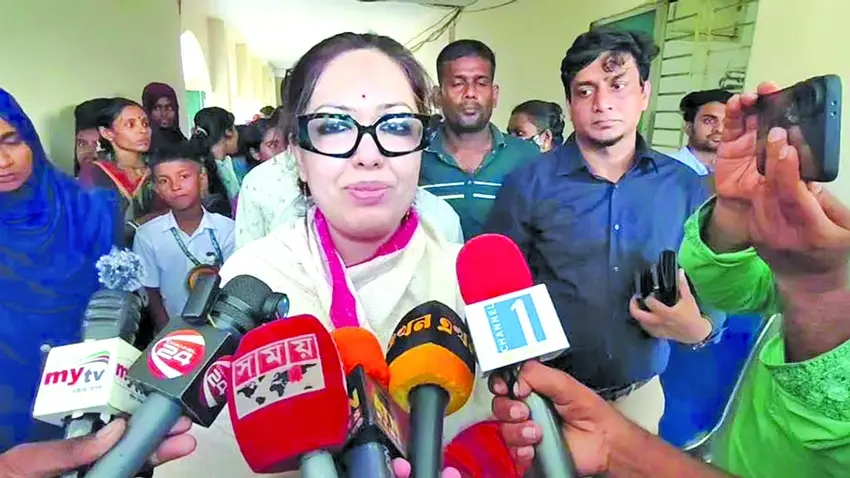
Any citizen can leave, re-enter Bangladesh, says Rumeen Farhana
Independent lawmaker Barrister Rumeen Farhana said any citizen of Bangladesh can leave the country at any time and return at any time, describing it as a right clearly stated in the Constitution. The Brahmanbaria-2 MP and former BNP leader was responding to reporters' questions on Friday about ousted Sheikh Hasina's potential return. She spoke after an event organised by the Abdul Kadir Shah Library in Ashuganj upazila. What steps are taken after someone enters the country is up to the government, she added.
Source
Bangladesh — govt & media · read the original report ↗
Desk check · compared with the source
What the desk checked (4)
- Rumeen Farhana said any Bangladeshi citizen can leave and re-enter the country at any time as a constitutional right. — Directly quoted and attributed to the named MP in the source.
- The remarks were made on Friday after an event in Ashuganj upazila, Brahmanbaria, organised by the Abdul Kadir Shah Library. — Details appear in the source; no independent confirmation possible.
- Rumeen Farhana is an independent lawmaker from Brahmanbaria-2 and a former BNP leader. — Stated in the source; source spells her name both as Farhana and Farhan.
- She was responding to questions on ousted Sheikh Hasina's potential return to Bangladesh. — Described in the source as the context of her remarks; no government statement cited.
Analysts’ view opinion
On the surface this is a plain statement of constitutional principle, but strategically it reframes one of Bangladesh's most sensitive questions — the possible return of ousted Sheikh Hasina — as a legal issue rather than a purely political one. By affirming the right to enter while adding that what happens afterwards is "up to the government", Rumeen Farhana keeps the door open to accountability without appearing to deny a citizen's rights. In a transitional political environment, such formulations tend to be read as signals well beyond Dhaka, including in regional diplomatic capitals.
- The strategic significance lies in shifting the return debate from political retribution to a constitutional right paired with governmental discretion.
- The qualifier that action after entry is the government's call is a careful balance — it neither blocks a return nor rules out legal proceedings.
- As an independent MP and former BNP leader, her words are not official state policy, but they offer a read on thinking within Bangladesh's political class.
- Questions of a former leader's return, extradition or prosecution usually carry bilateral diplomatic weight; the story mentions no such diplomatic engagement.
- Statements like this can raise domestic expectations about judicial process and security arrangements in any future scenario.
What to watch — Watch for any formal clarification from the government and major parties on this question, and whether it draws responses at the border-management or diplomatic level.
The story does not establish that any return is planned or imminent, nor that the government has taken any decision — this is one lawmaker's legal interpretation offered to reporters.
Deep dive
Research brief · 8 facts · 2 dates · exam-readyThe brief
Context
Barrister Rumeen Farhana, an independent Member of Parliament from Brahmanbaria-2 and a former BNP leader, was asked by reporters about the possible return to Bangladesh of ousted former prime minister Sheikh Hasina. Speaking after an event in Ashuganj upazila of Brahmanbaria on Friday, she said leaving and re-entering the country is a constitutional right of any Bangladeshi citizen. She added that whatever action is taken once a person enters Bangladesh is a matter for the government to decide. The source does not state any further detail on Sheikh Hasina's status, location or any legal proceedings.
Key facts
- Rumeen Farhana is the Member of Parliament for the Brahmanbaria-2 constituency and an independent lawmaker, and a former BNP leader.
- She made the remarks on Friday while responding to reporters' questions after an event in Ashuganj upazila, Brahmanbaria.
- The event she attended was organised by the Abdul Kadir Shah Library in Ashuganj; she spoke in the afternoon.
- She said: 'Any citizen of Bangladesh can leave the country at any time and can also enter the country at any time. This is clearly stated in the Constitution.'
- She said what steps the government takes after someone enters Bangladesh is up to the government.
- Her comments were a response to questions about ousted Sheikh Hasina's potential return to Bangladesh.
- The specific constitutional article she referred to is not stated in the source.
- Whether Sheikh Hasina plans to return, and any government position on it, is not stated in the source.
Timeline
- Friday afternoon (year and date not stated in the source)Rumeen Farhana attends an event organised by the Abdul Kadir Shah Library in Ashuganj upazila, Brahmanbaria.
- Same day, after the eventShe tells reporters that leaving and re-entering Bangladesh is a constitutional right of any citizen, while responding to questions on ousted Sheikh Hasina's potential return.
Who has a stake
- Rumeen Farhana, Brahmanbaria-2 MP — Her public position on a politically sensitive question of whether an ousted leader may return to the country.
- Sheikh Hasina, ousted former leader — Her possible return to Bangladesh is the subject of the question that prompted the remarks.
- Government of Bangladesh — Farhana says any steps taken after a person enters the country are the government's decision.
- BNP (Bangladesh Nationalist Party) — Farhana is a former BNP leader, so her comments carry political weight; the party's own stand is not stated in the source.
- Citizens of Bangladesh — The claimed constitutional right to leave and re-enter the country at any time.
Why it matters
The return of an ousted head of government is one of the most politically charged questions in post-transition Bangladesh, and a sitting lawmaker framing it as a matter of constitutional right rather than political permission shifts the debate to law. It also separates two issues: the right of entry, and whatever legal or administrative action the state may take once a person is inside the country. For Indian readers, statements on Sheikh Hasina's movements bear directly on Dhaka's domestic politics and its neighbourhood relations.
UPSC angle
Prelims pointers
- Rumeen Farhana: independent MP from Brahmanbaria-2, Bangladesh; former BNP leader; a barrister.
- She asserted that leaving and re-entering Bangladesh at any time is a right 'clearly stated in the Constitution' of Bangladesh.
- Brahmanbaria is a district in Bangladesh; Ashuganj is an upazila (sub-district) within it.
- The remarks were prompted by questions on ousted Sheikh Hasina's potential return to Bangladesh.
- Upazila is the administrative sub-district tier in Bangladesh, below the district (zila).
- Farhana held that post-entry action is for the government to decide — right of entry and legal consequences are distinct.
Mains framing
The statement by Brahmanbaria-2 MP Rumeen Farhana that any Bangladeshi citizen may leave and re-enter the country at any time, as a right she says is clearly stated in the Constitution, reframes the politically loaded question of ousted Sheikh Hasina's possible return as a question of constitutional entitlement rather than political discretion. The framing rests on a distinction with wide application in constitutional democracies: citizenship-based freedom of movement and entry into one's own country is treated as a right, while the state retains authority to act, administratively or through the courts, once a person is within its jurisdiction — which Farhana expressly leaves to the government. The implication is that a returning leader's entry and any subsequent legal process must be dealt with separately, insulating rights from political convenience. The way forward that such a position suggests is clarity from the executive on the procedure it would follow, and reliance on due process rather than ad hoc denial of entry. The source, however, does not specify the constitutional provision invoked, the government's stated position, or whether any return is actually planned, and an answer should not assume these.
Key terms
- Rumeen Farhana
- Barrister and independent Member of Parliament from Brahmanbaria-2 in Bangladesh; a former BNP leader.
- BNP (Bangladesh Nationalist Party)
- A major Bangladeshi political party; Farhana is described in the source as a former BNP leader.
- Upazila
- Administrative sub-district unit in Bangladesh; Ashuganj, where the event was held, is an upazila of Brahmanbaria.
- Brahmanbaria-2
- The parliamentary constituency in Bangladesh represented by Rumeen Farhana.
- Abdul Kadir Shah Library
- The Ashuganj-based organiser of the event Farhana attended before speaking to reporters.
Practice questions
- Freedom of movement and the right of a citizen to enter their own country are widely recognised constitutional guarantees. Discuss how such rights interact with a state's power to initiate legal action against a returning political leader.
- Examine the significance of a sitting lawmaker's framing of an ousted leader's return as a constitutional right rather than a political decision, in the context of Bangladesh's current politics.
- How do developments in Bangladesh's domestic politics, including questions over Sheikh Hasina's possible return, affect India's neighbourhood diplomacy?
Grounded only in the source report — figures and dates are the source's, not inferred.