
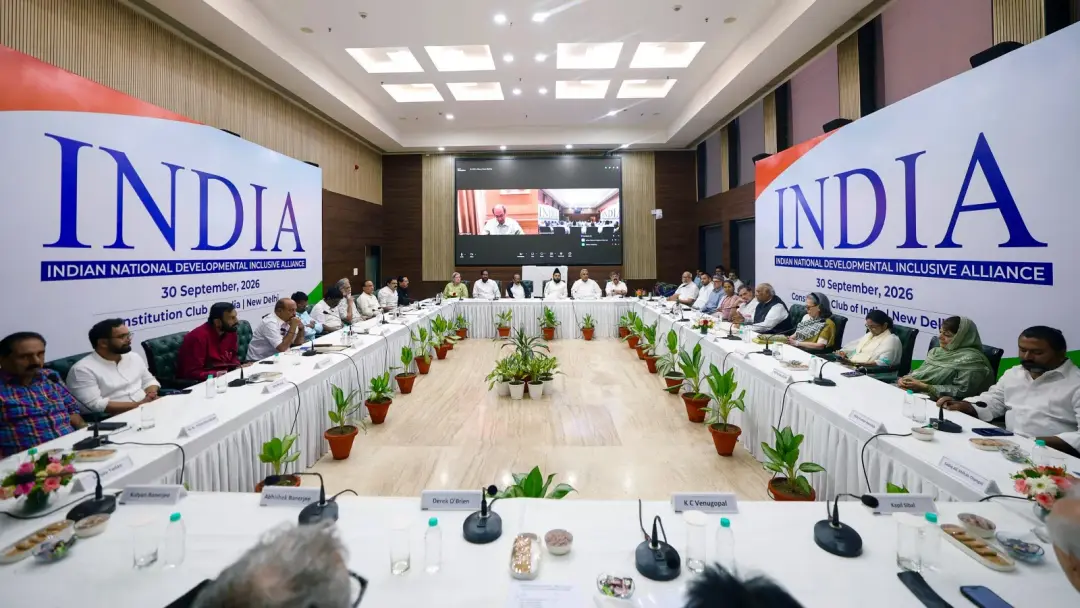
Rahul calls for unity, 'fight to finish' at INDIA bloc meeting
At the INDIA bloc meeting in Delhi on Wednesday, Lok Sabha Opposition Leader Rahul Gandhi pitched for unity, saying the system put in place by the BJP was crumbling and it was a fight to the finish, sources said. He claimed Prime Minister Narendra Modi was "psychologically broken". Mamata Banerjee said she had spoken to BJD chief Naveen Patnaik and would reach out to non-NDA parties. On Kapil Sibal's proposal, the bloc agreed to challenge the 2023 CEC appointment law in the Supreme Court.
Source
Rahul Gandhi · read the original report ↗
Desk check · some claims need care
What the desk checked (5)
- Rahul Gandhi said the Opposition faces a 'fight to the finish' and that the BJP-built system is crumbling — Attributed to unnamed sources at the INDIA bloc meeting; not a direct on-record quote.
- Rahul claimed PM Narendra Modi was 'psychologically broken' and the Opposition had won the psychological battle — Attributed to sources; strong characterisation of a named individual, flagged as a claim in source.
- Mamata Banerjee said she spoke to BJD chief Naveen Patnaik on Tuesday and would reach out to non-NDA parties outside INDIA — Attributed to sources; Patnaik's side not reported.
- Kapil Sibal said CEC Gyanesh Kumar has immunity under the 2023 Act and proposed a joint Supreme Court challenge, which the bloc accepted — Attributed to sources; the named law appears in the source text.
- Rahul claimed officers in the EC, CBI and ED have contacted him about alleged irregularities — Unverified claim reported via sources; no corroboration or response from the agencies in the source.
Analysts’ view opinion
This was less a policy meeting than a unity performance. Rahul Gandhi's framing — a "fight to the finish", a Prime Minister who is "psychologically broken" — is cadre-facing morale language, while the bloc's one concrete decision was to shift the fight against the Election Commission onto legal ground by challenging the 2023 appointments law in the Supreme Court. Mamata Banerjee's offer to court non-NDA parties, and her oblique signal to the Congress about the PM's post, show the alliance's leadership arithmetic is still unsettled.
- Rahul's appeal to set aside state-level rivalries and unite nationally is itself an admission that internal friction, not BJP strength alone, is the bloc's biggest vulnerability.
- Mamata's indirect reference to the PM's post and Kharge's "not after power" reply suggest the leadership question has been deferred rather than resolved.
- Accepting Kapil Sibal's advice to challenge the 2023 law instead of demanding the CEC's arrest marks a shift from outrage to institutional strategy.
- Mamata's outreach to parties like the BJD positions her as the bloc's bridge-builder and simultaneously rebuilds her national standing after Bengal.
- The absence of any formal discussion on a fresh impeachment motion hints at unease about launching a parliamentary fight where the numbers are not there.
What to watch — Watch when and with how many signatories the joint Supreme Court petition is filed, and whether Mamata's outreach actually brings non-INDIA parties such as the BJD onto a shared platform.
Almost every detail here is attributed to unnamed sources, so the story does not establish official positions, the leaders' exact words, or the truth of the allegations made against the EC and other agencies.
Deep dive
Research brief · 8 facts · 2 dates · exam-readyThe brief
Context
The INDIA bloc, the Opposition grouping led by the Congress, met in Delhi on Wednesday amid a sharpening confrontation with the Election Commission over alleged electoral malpractice, including claims of "vote chori" and irregularities in the West Bengal elections and the SIR exercise. Leader of Opposition in the Lok Sabha Rahul Gandhi used the meeting to press for unity against the BJP-led government, while allies pushed for both street protest and legal action. The meeting agreed, on Independent MP Kapil Sibal's proposal, to jointly challenge the Chief Election Commissioner and Other Election Commissioners (Appointment, Conditions of Service and Term of Office) Act, 2023 in the Supreme Court.
Key facts
- At the INDIA bloc meeting in Delhi on Wednesday, Rahul Gandhi said the system put in place by the ruling BJP was crumbling and it was now a "fight to the finish" for the Opposition.
- Rahul Gandhi claimed PM Narendra Modi was "psychologically broken" and that the Opposition had "already won the psychological battle".
- The bloc accepted Kapil Sibal's proposal to jointly move the Supreme Court against the Chief Election Commissioner and Other Election Commissioners (Appointment, Conditions of Service and Term of Office) Act, 2023.
- Sibal argued there was no point seeking CEC Gyanesh Kumar's arrest as he has immunity under the 2023 Act, and said the campaign against the EC must be "political and legal".
- Mamata Banerjee said she had spoken to BJD chief Naveen Patnaik on Tuesday and planned to reach out to non-NDA parties outside the INDIA alliance.
- Mamata obliquely suggested the Congress could have the PM's post if it brought everyone on board; Kharge replied the Congress was not after power and "only wants to save the nation and democracy".
- G Devarajan of the Forward Bloc proposed an immediate march to the EC office; Mamata backed it, but other leaders wanted a structured protest instead.
- The meeting did not formally deliberate the proposal to again move an impeachment motion against CEC Gyanesh Kumar in Parliament, though some leaders discussed it on the sidelines.
Timeline
- Tuesday (day before the meeting)Mamata Banerjee spoke to BJD chief Naveen Patnaik as part of outreach to non-NDA parties.
- WednesdayINDIA bloc parties met in Delhi; Rahul Gandhi pitched unity, and the bloc agreed to challenge the 2023 CEC appointment law in the Supreme Court.
Who has a stake
- Rahul Gandhi, LoP in Lok Sabha — Seeking to hold the INDIA bloc together nationally despite state-level differences and lead the anti-BJP campaign.
- Congress president Mallikarjun Kharge — Signalled the party is not chasing the PM's post, aiming to reassure allies and widen the coalition.
- Mamata Banerjee (TMC) — Called herself the "biggest sufferer"; wants broader unity including non-NDA, non-INDIA parties.
- Election Commission and CEC Gyanesh Kumar — Face Opposition allegations of irregularities, "vote theft", and a planned legal challenge to the law governing the CEC's appointment.
- Left parties (CPI(M)'s M A Baby, CPI(M)-L's Dipankar Bhattacharya, Forward Bloc's G Devarajan) — Pushing for wider mobilisation of parties, civil society and intellectuals, and flagging alleged changes to Form 6 for new voters.
- Omar Abdullah (National Conference, J&K CM) and Uddhav Thackeray (Shiv Sena UBT) — Raised alleged West Bengal poll irregularities, institutional capture, and the EC allegedly helping the BJP break Opposition parties.
Why it matters
The meeting marks a shift from rhetoric to a combined political and legal strategy by the Opposition, with the 2023 law on appointing the CEC and Election Commissioners now set to be tested in the Supreme Court. It also reopens the question of coalition arithmetic and leadership ahead of future contests, with Mamata Banerjee pushing to draw in parties outside both the NDA and the INDIA bloc.
UPSC angle
Prelims pointers
- The Chief Election Commissioner and Other Election Commissioners (Appointment, Conditions of Service and Term of Office) Act, 2023 governs the appointment and service conditions of the CEC and ECs.
- Gyanesh Kumar is the Chief Election Commissioner named in the story; Sibal said he has immunity under the 2023 Act.
- Kapil Sibal, an Independent MP, proposed the joint Supreme Court challenge to the 2023 Act.
- Rahul Gandhi is Leader of Opposition in the Lok Sabha; Mallikarjun Kharge is Congress president.
- Form 6 is the form for enrolment of new voters; CPI(M)-L leader Dipankar Bhattacharya alleged malpractice in changing it.
- Omar Abdullah, National Conference leader, is Chief Minister of Jammu and Kashmir.
Mains framing
The INDIA bloc meeting illustrates how electoral administration has become the central axis of Opposition politics, with allegations of \"vote chori\", disputed West Bengal polls, SIR-related grievances and claims of institutional capture of the EC, CBI and ED binding otherwise competing parties together. The causes lie partly in structural distrust over the appointment of election commissioners: Sibal's intervention that the CEC enjoys immunity under the 2023 Act shifted the Opposition's focus from demanding arrest or impeachment to challenging the appointment law itself in the Supreme Court. The implications are twofold — a constitutional question about whether the executive-dominated selection process for the CEC and ECs secures the EC's independence, and a political one about coalition cohesion, visible in Rahul Gandhi's plea that state-level rivalries not spill into national coordination and Mamata Banerjee's suggestion that the Congress could claim the PM's post only if it brings everyone on board, which Kharge deflected. The way forward sketched in the meeting is a dual-track approach: a structured rather than impulsive street mobilisation, legal recourse through the Supreme Court, and outreach to non-NDA parties such as the BJD that remain outside the alliance.
Key terms
- INDIA bloc
- The Opposition alliance of parties including the Congress, TMC, Left parties, National Conference and Shiv Sena (UBT) that met in Delhi.
- CEC and Other Election Commissioners Act, 2023
- Law on appointment, conditions of service and term of the CEC and Election Commissioners; the Opposition plans to challenge it in the Supreme Court.
- Leader of Opposition (LoP)
- Head of the largest Opposition party in a House; Rahul Gandhi holds the post in the Lok Sabha.
- Form 6
- Electoral form used for enrolment of new voters; alleged changes to it were flagged at the meeting.
- "Vote chori" / vote theft
- Opposition's term for alleged electoral manipulation benefiting the BJP, raised by Uddhav Thackeray and others.
- Non-NDA parties
- Parties such as the BJD that are neither in the ruling NDA nor in the INDIA bloc, whom Mamata Banerjee plans to approach.
Practice questions
- Does the appointment process under the Chief Election Commissioner and Other Election Commissioners Act, 2023 adequately protect the independence of the Election Commission? Discuss.
- Examine the challenges of coalition cohesion in the INDIA bloc, where allies compete at the state level while seeking unity nationally.
- Allegations of institutional capture have become central to Opposition politics in India. Critically analyse the implications for electoral democracy.
Grounded only in the source report — figures and dates are the source's, not inferred.