
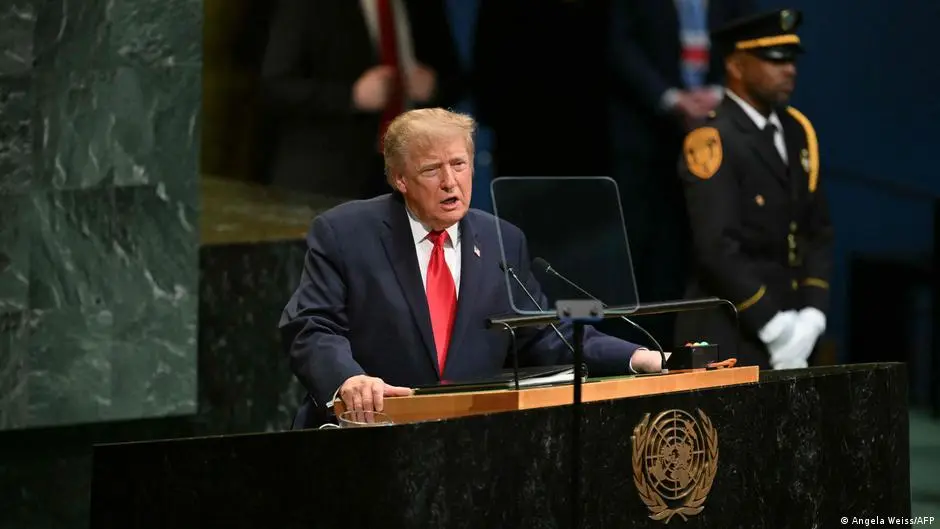
UNGA: Leaders debate Iran, Ukraine and Gaza conflicts
At the UN General Assembly debate, US President Donald Trump said he faced a choice between a deal with Iran and annihilating the Islamic Republic, later telling reporters US and Iranian officials had met for about three hours. Ukrainian President Volodymyr Zelenskyy called his 40-minute meeting with Trump positive and said both sides want the war ended before winter. French President Emmanuel Macron proposed a double moratorium on energy strikes and Black Sea grain shipments. Turkey's Erdogan criticised Israel over Gaza.
Source
DW (Deutsche Welle) · read the original report ↗
Desk check · some claims need care
What the desk checked (5)
- Trump said he faces a choice between a deal with Iran and annihilating the Islamic Republic, and later told reporters US and Iranian officials held a roughly three-hour meeting on the UNGA sidelines. — Directly quoted and attributed to Trump in the source; outcome of the meeting not independently detailed.
- Zelenskyy said his 40-minute meeting with Trump was 'positive and productive' and that both sides want the war ended before winter. — Attributed to Zelenskyy's X post and remarks to journalists, as reported in the source.
- Macron proposed a 'double moratorium' on strikes on energy infrastructure and on Black Sea grain shipments. — Quoted and attributed to Macron in his UNGA address.
- Erdogan said more than 1,500 people had been killed in Gaza since the ceasefire reached last year and accused Israel of a 'genocidal mindset'. — Figure and characterisation attributed to Erdogan only; source notes Israel denies blocking the peace plan.
- UK PM Andy Burnham said the Kremlin spends about £1.3 billion ($1.7 billion) a year on disinformation and announced a National Centre for Information Defence. — Figure attributed to Burnham's speech; no supporting documentation given in source.
Analysts’ view opinion
This UNGA session captured a world where coercion and negotiation are being run in parallel rather than in sequence. Trump's framing of a binary choice between a deal with Iran and 'annihilating' the Islamic Republic, followed within hours by a reported three-hour meeting between US and Iranian officials, is classic escalate-to-negotiate signalling — the threat is the leverage, and the talks are the payoff. On Ukraine, the emerging centre of gravity has shifted from grand settlement to partial, verifiable de-escalation: an energy ceasefire, Macron's proposed 'double moratorium' on energy-infrastructure strikes and Black Sea grain shipping, and an air-defence package to hedge if diplomacy fails.
- The gap between Trump's 'annihilate' rhetoric and the reported US-Iran meeting suggests the threat is being used as bargaining leverage, but it also raises the risk of miscalculation if either side misreads the other's red lines.
- Tehran's willingness to sit down while under that kind of public pressure signals it is keeping a diplomatic channel open, though the story gives no indication of what either side actually put on the table.
- Ukraine's strategy is visibly two-track: pursue an energy ceasefire before winter while working with Washington on Patriot interceptor production and air defence — insurance against talks collapsing.
- Macron's 'double moratorium' is strategically attractive because it is narrow and measurable, targeting energy infrastructure and Black Sea grain corridors — issues that touch global food and fuel markets far beyond the belligerents.
- Erdogan's criticism of Israel over Gaza and Macron's 'shame on all of us' framing show that recognition of Palestinian statehood has not resolved the credibility problem for Western and regional capitals, keeping Gaza a live source of diplomatic friction.
What to watch — Watch whether the next scheduled US-Iran meeting actually convenes and whether Moscow responds to the energy and Black Sea moratorium ideas — Russian buy-in, not Kyiv's willingness, is the binding constraint.
The story does not establish what was discussed or agreed in the US-Iran talks, whether Russia will accept any moratorium, or whether the 'positive' Trump-Zelenskyy meeting produced concrete commitments.
Deep dive
Research brief · 8 facts · 9 dates · exam-readyThe brief
Context
The story is a live-blog style account of the UN General Assembly general debate held in New York in September 2026, where world leaders spoke on the wars involving Iran, Ukraine and Gaza. US President Donald Trump used his address to oscillate between offering Iran a "deal" and threatening to "annihilate the Islamic Republic", against the backdrop of a US war with Iran that the source says is disrupting energy shipments through the Strait of Hormuz. Ukraine's Volodymyr Zelenskyy met Trump on the sidelines to push for an end to Russia's war before winter, while French President Emmanuel Macron, in his final UNGA address, proposed a "double moratorium" on energy strikes and Black Sea grain shipments and condemned inaction on Gaza. Other leaders — from the UK, Japan, Finland, Lithuania and Qatar — raised disinformation, nuclear disarmament, multilateralism and Gulf security.
Key facts
- Trump told the UNGA he faced a choice: a deal letting Iran rebuild, or to "annihilate the Islamic Republic and do it quickly"; hours later he said US and Iranian officials had met for roughly three hours and another meeting was scheduled.
- Zelenskyy called his 40-minute meeting with Trump on September 22, 2026 "positive and productive", saying both sides want the "senseless Russian war ended before winter".
- Zelenskyy said teams are working on launching Patriot interceptor production in Ukraine and discussed a winter air-defense package, and that Ukraine is "ready for any kind of format of energy ceasefire".
- Macron proposed a "double moratorium": on strikes on energy and civilian infrastructure, and a Black Sea moratorium to release grain shipments.
- Macron said of Gaza: "Some claim that peace has been achieved, but this has not opened up humanitarian deliveries... Shame on all of us!"
- Macron called for a pooled open-source frontier AI model with India, Brazil, Singapore, African nations and Gulf states so no country becomes "the vassal of one of the great powers".
- UK Prime Minister Andy Burnham said Russia forged the branding of 28 British organisations including universities and the BBC, alleged Russian interference in the 2019 UK general election, put Kremlin disinformation spending at about £1.3 billion ($1.7 billion) a year, and announced a National Centr
- Japanese Prime Minister Sanae Takaichi called it Japan's mission to lead towards a world without nuclear weapons, urged a stronger NPT regime, flagged North Korea's programs as a serious threat, and sought UN Security Council expansion of permanent and non-permanent members.
Timeline
- 1945US atomic bombings of Hiroshima and Nagasaki killed and maimed hundreds of thousands, with radiation illnesses among survivors for years after.
- 2014 (12 years before the debate, per Nauseda)Russia's aggression against Ukraine begins with the annexation of Crimea and a Russian-backed uprising in eastern Ukraine.
- 2018-2019Trump met North Korean leader Kim Jong Un in Singapore, Hanoi and the Korean Demilitarized Zone over a nuclear deal.
- October 2019US-North Korea talks broke down in Sweden; no final agreement materialised.
- February 2022Russia launches its full-scale invasion of Ukraine; Putin has not travelled to New York since.
- Earlier in September 2026US Special Envoy Steve Witkoff and Jared Kushner visited Moscow and Kyiv to try to restart stalled Russia-Ukraine talks.
- September 22, 2026Trump's Iran speech and the reported US-Iran meeting; Zelenskyy-Trump 40-minute meeting; addresses by Macron, Stubb, Nauseda and Qatar's emir.
- September 23, 2026Burnham's debut UNGA address, Takaichi's debut address, and North Korean Vice Foreign Minister Kim Son Gyong's departure from Pyongyang for the UNGA.
- February 2027Russia's full-scale invasion of Ukraine will hit its five-year anniversary.
Who has a stake
- United States (President Donald Trump) — Weighing a deal with Iran versus military escalation; brokering an end to the Ukraine war while blaming Ukrainian strikes on Russian refineries for record US diesel prices.
- Iran — Faces an explicit threat of annihilation alongside the prospect of a deal; its officials met US officials for about three hours on the UNGA sidelines.
- Ukraine (President Volodymyr Zelenskyy) — Seeking an energy ceasefire, a winter air-defense package and domestic Patriot interceptor production as negotiations with Russia remain stalled.
- Russia — Accused of aggression in Ukraine, drone attacks on civilian infrastructure, airspace violations and state-funded disinformation; Putin absent from New York.
- France (President Emmanuel Macron) — In his final UNGA address, pressing Palestinian statehood recognition, humanitarian access in Gaza, a double moratorium on Ukraine, and AI sovereignty.
- Israel and Palestinians — Macron argues respect for Palestinian rights is a prerequisite for Israeli security; humanitarian deliveries to Gaza remain blocked; Erdogan criticised Israel.
- United Kingdom (PM Andy Burnham) — Rebuilding stability post-Brexit, raising NATO defence spending and countering Russian-aligned online disinformation via a new National Centre for Information Defence.
- Japan (PM Sanae Takaichi) — Pushing nuclear disarmament and a stronger NPT, an AI safety summit, and UN Security Council reform through expanded membership.
Why it matters
The debate showed three simultaneous wars — Iran, Ukraine and Gaza — being negotiated in corridors rather than through UN mechanisms, with a US president publicly weighing annihilation against a deal. For India and other middle powers, Macron's call to pool resources for an open-source frontier AI model and Japan's push for Security Council expansion signal how questions of technological and institutional sovereignty are now central to global diplomacy. The repeated theme, voiced by Finland's Stubb and Lithuania's Nauseda, was that competition is increasingly being waged against the rules of the international order itself.
UPSC angle
Prelims pointers
- UNGA general debate 2026: Trump on Iran offered a choice between a "deal" and annihilating the Islamic Republic; US-Iran officials met about three hours on the sidelines.
- Macron's "double moratorium" = halt on strikes on energy/civilian infrastructure plus a Black Sea moratorium to release grain shipments.
- Strait of Hormuz features twice: energy shipment disruption from the US-Iran war, and Lithuania's offer to help defuse mines there.
- Japan's PM Sanae Takaichi urged a stronger Nuclear Non-Proliferation Treaty (NPT) regime and expansion of both permanent and non-permanent UNSC members.
- UK PM Andy Burnham announced a National Centre for Information Defence; cited Kremlin disinformation spending of about £1.3 billion a year.
- Macron named India, Brazil, Singapore, African nations and Gulf states as partners for an open-source frontier AI model; France's frontier model is Mistral AI.
Mains framing
The 2026 UNGA debate illustrates a multilateral system reduced to a stage for bilateral bargaining: the Iran question advanced not through the General Assembly but through a three-hour sideline meeting, and the Ukraine war through a 40-minute Trump-Zelenskyy conversation and earlier Witkoff-Kushner shuttle visits to Moscow and Kyiv. The causes lie in great-power unilateralism and the erosion of rules that Finland's Stubb described as nations competing "against the rules on which the international order rests", compounded by hybrid warfare — Lithuania cited drone violations of its airspace, and Britain alleged Russian forgery of 28 organisations' branding and interference in its 2019 election. The implications are threefold: humanitarian, as Macron's "shame on all of us" on blocked Gaza aid shows recognition of Palestinian statehood has not translated into relief; energy and food security, since strikes on energy infrastructure and Black Sea grain routes affect prices far beyond the belligerents; and institutional, as Japan's demand for Security Council expansion underlines the legitimacy deficit of a body unable to stop three wars. The way forward suggested by the speakers themselves is incremental and verifiable: reciprocal moratoria on energy and grain, defensive capacity-building such as Patriot interceptor production, a strengthened NPT regime, dedicated counter-disinformation institutions, and pooled investment in open-source frontier AI so that middle powers avoid technological vassalage.
Key terms
- UNGA general debate
- The annual high-level session in New York where heads of state and government address the UN General Assembly, here held in September 2026.
- Double moratorium
- Macron's proposal that Russia and Ukraine both halt strikes on energy and civilian infrastructure and allow Black Sea grain shipments.
- Nuclear Non-Proliferation Treaty (NPT)
- The global nuclear regime Japan's PM Takaichi urged be strengthened, citing Japan as the only country to have suffered wartime atomic bombings.
- National Centre for Information Defence
- New UK body announced by PM Andy Burnham to counter disinformation that harms British interests.
- Patriot interceptor
- Air-defence missile whose production in Ukraine Zelenskyy said US and Ukrainian teams are working to launch.
- Open-source frontier model
- A cutting-edge AI model Macron wants like-minded nations to build jointly so they do not depend on the US or China.
Practice questions
- "The UN General Assembly has become a venue for bilateral deal-making rather than collective security." Examine this statement with reference to the handling of the Iran, Ukraine and Gaza conflicts at the 2026 UNGA debate.
- Discuss the significance of Macron's call for a pooled open-source frontier AI model involving India and other middle powers. What would technological sovereignty require of India?
- Critically evaluate the demand for UN Security Council reform through expansion of permanent and non-permanent membership, in the light of the Assembly's inability to resolve ongoing wars.
Grounded only in the source report — figures and dates are the source's, not inferred.