
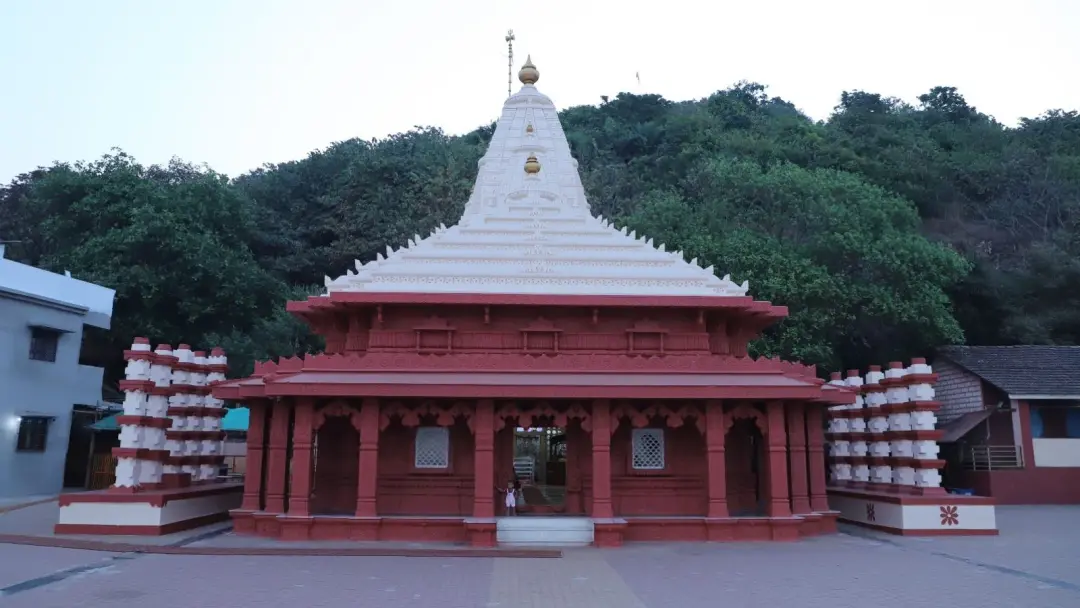
Ganpatipule temple to enforce dress code from January 1, 2027
The Lord Ganesh temple at Ganpatipule in Maharashtra's Ratnagiri district will strictly enforce a dress code from January 1, 2027, authorities said. Devotees wearing attire above the knee will not be allowed into the temple premises. The rule applies to men and women, while children below 10 are exempted. Temple trust chairman Nilesh Kolhatkar said skirts or shorts below the knee will not be stopped. The temple draws about 25 lakh devotees a year.
Source
Indian Express — Cities · read the original report ↗
Desk check · compared with the source
What the desk checked (4)
- Ganpatipule temple will strictly enforce a dress code from January 1, 2027. — Attributed to temple trust chairman Nilesh Kolhatkar, who spoke to The Indian Express on Saturday.
- Devotees in attire above the knee will be barred; rule applies to men and women, children under 10 exempted. — Stated in source and clarified by Kolhatkar; internally consistent.
- The dress code was introduced last year and awareness was created over recent months. — Attributed to Kolhatkar; no documentation cited.
- The temple attracts around 25 lakh devotees a year, over 1,000 daily, with more than five-fold rise on Chaturthi days. — Figures appear in source, attributed to Kolhatkar; not independently verifiable.
Analysts’ view opinion
On paper this is an administrative decision by a temple trust, but in Maharashtra the question of dress codes at places of worship has long been a cultural-political flashpoint. Because Ganpatipule draws around 25 lakh devotees a year, the framing of "upholding tradition" is the kind of language that sits comfortably with Hindutva-leaning constituencies, while "personal choice" is the frame liberal and progressive voices tend to use. The decision to delay strict enforcement to January 1, 2027, after months of awareness-building, suggests the trust is trying to minimise friction rather than provoke a fight.
- Stating that the rule applies equally to men and women, with an exemption for children under 10, pre-empts the most obvious criticism that such codes single out women.
- The chairman's clarification that shorts and skirts below the knee are acceptable is an attempt to present the rule as moderate rather than maximally restrictive.
- The trust's own acknowledgement that some devotees objected when the rule was first introduced shows public opinion on this is not settled.
- Giving roughly a year's notice reduces the immediate risk of viral confrontations at the gates — the kind of images that quickly turn a temple rule into a political controversy.
- As a major pilgrimage-cum-tourism site in the Konkan, Ratnagiri's local economic interests could pull against tighter entry norms, opening a second line of debate.
What to watch — Watch whether other prominent temples or devasthan boards follow with similar codes, and whether political parties choose to comment publicly rather than let the trust own the decision.
The story does not establish any political party's involvement, government backing, or any official political reaction — it is reported purely as the trust's own decision.
Deep dive
Research brief · 8 facts · 4 dates · exam-readyThe brief
Context
The Lord Ganesh temple at Ganpatipule in Maharashtra's Ratnagiri district, managed by the trust Sansthan Shreedev Ganpatipule, has decided to strictly enforce a dress code for devotees from January 1, 2027. The code bars entry to those wearing attire above the knee, with children below 10 exempted. The trust says the code was introduced last year and the past few months were spent creating awareness after some devotees objected, saying they were unaware of the rule. The shrine is a major pilgrimage destination, drawing about 25 lakh devotees a year.
Key facts
- Strict enforcement of the dress code at the Ganpatipule Ganesh temple begins January 1, 2027, authorities said.
- Devotees wearing attire above the knee will not be allowed to enter the temple premises.
- The rule applies to both men and women; children below 10 years of age are exempted.
- Trust chairman Nilesh Kolhatkar said skirts or shorts below the knee will not be stopped; the code applies only to attire above the knee.
- The dress code was introduced last year, and the trust spent the past few months creating awareness among devotees.
- The temple attracts around 25 lakh devotees every year, with more than 1,000 devotees visiting daily.
- Footfall increases more than five-fold on Chaturthi days.
- The temple trust is named Sansthan Shreedev Ganpatipule; Kolhatkar spoke to The Indian Express on Saturday.
Timeline
- Last yearDress code introduced at the Ganpatipule temple; some devotees objected, saying they had no idea about the rule.
- Past few monthsTemple trust ran awareness efforts among devotees about the dress code.
- Saturday (as reported)Trust chairman Nilesh Kolhatkar told The Indian Express that enforcement will begin from January 1 next year.
- January 1, 2027Strict enforcement of the dress code begins; those in attire above the knee to be denied entry.
Who has a stake
- Sansthan Shreedev Ganpatipule (temple trust) — Seeks to uphold age-old tradition and preserve the sanctity of the temple; responsible for enforcing the code and awareness.
- Nilesh Kolhatkar, trust chairman — Public face of the decision; clarified the scope of the rule and appealed to devotees to change attire before entry.
- Devotees (about 25 lakh a year) — Face possible denial of entry if attire is above the knee; some had earlier objected citing lack of awareness.
- Children below 10 years — Exempted from the dress code.
- Local tourism and hospitality around the temple — Daily footfall of 1,000-plus and five-fold rise on Chaturthi days; temple says it has adequate food and accommodation facilities.
Why it matters
Dress codes at major shrines sit at the intersection of religious autonomy, tradition and individual choice, and Ganpatipule's decision affects a temple visited by about 25 lakh people a year. How temple trusts frame, publicise and enforce such rules shapes whether they are accepted as reasonable practice or contested as arbitrary restriction on access.
UPSC angle
Prelims pointers
- Ganpatipule Lord Ganesh temple is in Ratnagiri district, Maharashtra; trust is Sansthan Shreedev Ganpatipule.
- Dress code enforcement date: January 1, 2027; introduced last year.
- Bar: attire above the knee; below-knee skirts or shorts allowed.
- Exemption: children below 10 years of age.
- Footfall: around 25 lakh devotees a year; over 1,000 daily; more than five-fold rise on Chaturthi days.
- Trust chairman: Nilesh Kolhatkar.
Mains framing
The Ganpatipule temple's decision to strictly enforce a dress code from January 1, 2027 illustrates how religious institutions invoke tradition and the 'sanctity' of sacred spaces to regulate conduct within their premises. The trust's stated rationale is preservation of age-old tradition, and its method has been gradual: introduce the rule, absorb initial objections that devotees were unaware, run awareness campaigns, then enforce. The design of the rule itself is narrow as described in the source - only attire above the knee is barred, below-knee shorts and skirts are permitted, and children under 10 are exempt - which limits its reach but still raises questions about uniform application to a devotee base of roughly 25 lakh a year, including tourists in a coastal district. The implications run to access, the discretion of gatekeepers, and the risk of friction at peak times such as Chaturthi, when footfall rises more than five-fold. A grounded way forward, consistent with the trust's own approach, lies in clear advance notice, visible signage, uniform and non-arbitrary checking, and facilities that let visitors change attire rather than be turned away - so that the objective of decorum does not translate into denial of darshan.
Key terms
- Ganpatipule temple
- Famous Lord Ganesh shrine in Ganpatipule, Ratnagiri district, Maharashtra, drawing about 25 lakh devotees annually.
- Sansthan Shreedev Ganpatipule
- The temple trust that manages the shrine and has framed the dress code.
- Dress code
- Rule barring entry to devotees in attire above the knee; below-knee shorts or skirts are permitted.
- Chaturthi
- Days associated with Ganesh worship when the temple's footfall rises more than five-fold, per the trust.
- Temple trust chairman
- Head of the managing body; here Nilesh Kolhatkar, who announced the enforcement date and clarified the rule.
Practice questions
- Dress codes at places of worship are increasingly being notified by temple trusts. Discuss the balance between institutional autonomy over religious spaces and individual freedom of access, using the Ganpatipule case.
- What administrative safeguards can temple trusts adopt to ensure that dress codes are applied uniformly and without arbitrary discretion at high-footfall shrines?
- Examine how awareness-building, rather than immediate penalty, shaped the rollout of the Ganpatipule temple dress code between its introduction and its enforcement from January 1, 2027.
Grounded only in the source report — figures and dates are the source's, not inferred.