
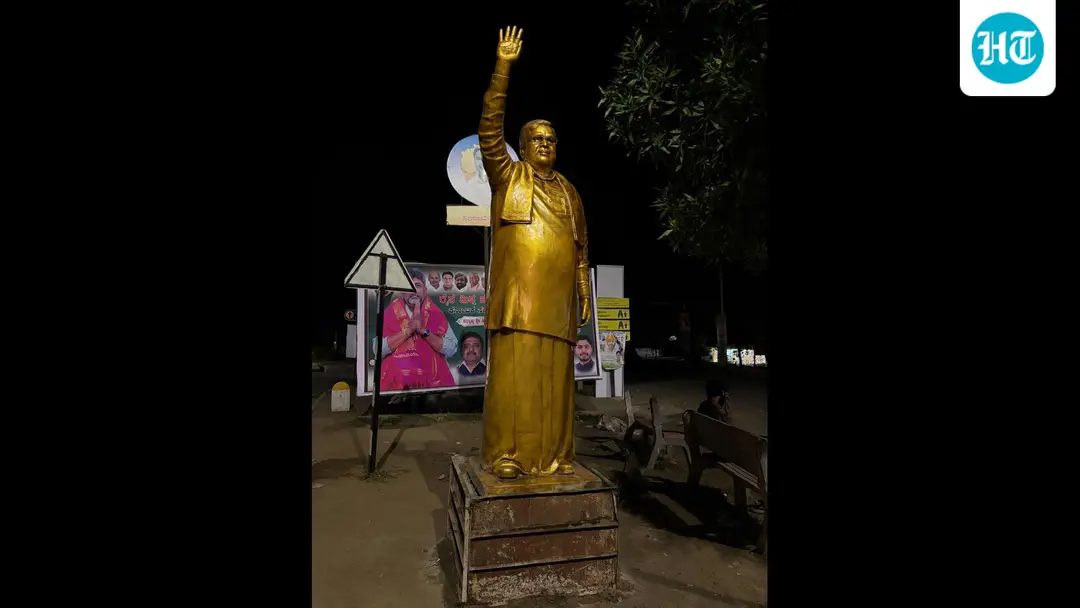
Siddaramaiah statue installed overnight, removed in Kalaburagi
The Kalaburagi City Corporation on Thursday morning removed a nine-foot statue of former Karnataka chief minister Siddaramaiah, installed without permission at High Court Circle by seven to eight people from Sharan Sirasagi village late on Wednesday. Chief Minister D K Shivakumar, in the city for Kalyana Karnataka Utsav, was to pass the junction en route to Afzalpur. Officials covered the statue and removed it with police present, an official said. Opposition leader R Ashoka called it a sign of Congress infighting.
Source
Hindustan Times — India · read the original report ↗
Desk check · compared with the source
What the desk checked (5)
- A nine-foot statue of former CM Siddaramaiah was removed by Kalaburagi City Corporation on Thursday morning after being installed without permission at High Court Circle. — Figure and sequence appear in source; removal attributed to the city corporation via an unnamed official 'in the know'.
- Seven to eight people from Sharan Sirasagi village brought and installed the statue late on Wednesday. — Stated in source without named attribution; sentence is duplicated in the original text.
- CM D K Shivakumar was in Kalaburagi for Kalyana Karnataka Utsav and was scheduled to pass the junction en route to Afzalpur. — Appears in source as reported fact; no official quoted on the schedule.
- Supporters had sought permission for a statue earlier and about three years ago tried to name the junction Siddaramaiah Circle. — Attributed to Gurunath Pujari, district president of the Kuruba Sangha.
- The episode reflects continuing Congress tensions over the chief minister's post. — Opinion attributed to Leader of Opposition R Ashoka in a post on X; source notes no indication the installers acted on instructions from either leader.
Analysts’ view opinion
A nine-foot statue put up overnight without permission, and removed within hours ahead of the chief minister's route, is a small act with outsized political signalling value. In a Congress unit still adjusting to Siddaramaiah's replacement by D K Shivakumar, the episode hands the BJP a ready-made image of an unfinished succession fight without anyone in the ruling party having to say a word. Crucially, the story does not establish that either leader directed the installation — but in factional politics, symbolism does not need instructions to do its work.
- The timing — installed the night before Shivakumar was to pass the junction during Kalyana Karnataka Utsav — is what converts a civic violation into a political statement.
- The administration's choice to cover, police and remove the statue quickly suggests officials read it as a potential flashpoint rather than a routine encroachment.
- The Kuruba Sangha district president calling the installation improper while promising protests over its removal points to a community mobilisation channel that runs parallel to, and is harder for the party to manage than, formal leadership channels.
- R Ashoka's 'succession war' framing shows the Opposition's cheapest, most repeatable line of attack is Congress's internal instability rather than governance specifics.
- The reported friction between Shivakumar and state Congress president B K Hariprasad over posts, invitations and Cabinet expansion gives the episode a wider context of contested authority within the ruling party.
What to watch — Watch whether the promised protests over the statue's removal actually materialise on the ground, and whether the party leadership responds with a formal siting decision or simply lets the matter fade.
The story does not establish who authorised or encouraged the installation, and contains no indication that Siddaramaiah or Shivakumar was involved; nor does it record any response from Siddaramaiah himself.
Deep dive
Research brief · 8 facts · 6 dates · exam-readyThe brief
Context
A nine-foot statue of former Karnataka chief minister Siddaramaiah was installed overnight without permission at High Court Circle in Kalaburagi and removed by the city corporation the next morning. The removal came as Chief Minister D K Shivakumar, who succeeded Siddaramaiah, was in Kalaburagi for Kalyana Karnataka Utsav celebrations and was scheduled to pass the junction. The episode has been read against the backdrop of unsettled leadership equations inside the Karnataka Congress after the change of chief minister, including public differences between Shivakumar and state Congress president B K Hariprasad.
Key facts
- The statue of Siddaramaiah was nine feet tall and was installed at High Court Circle, Kalaburagi, without permission.
- A group of seven to eight people from Sharan Sirasagi village brought and installed the statue late on Wednesday; the Kalaburagi City Corporation removed it on Thursday morning.
- Officials covered the statue, brought in police personnel to prevent confrontation, and moved the structure to a secure location, according to an official.
- CM D K Shivakumar was in Kalaburagi for Kalyana Karnataka Utsav and was scheduled to pass through the junction on his way to Afzalpur on Thursday.
- Gurunath Pujari, district president of the Kuruba Sangha, said supporters from Sharan Sirasagi had sought permission from the corporation several times over past years.
- About three years ago, supporters had sought to designate the junction as Siddaramaiah Circle without following the required official process.
- B K Hariprasad was appointed Karnataka Congress president after Shivakumar became CM, seen in the party as a check on power concentrating around Shivakumar.
- Hariprasad was reportedly unhappy at not being invited to an event marking 100 days of the Shivakumar government on September 10.
Timeline
- About three years agoSupporters sought to name the High Court Circle junction as Siddaramaiah Circle without following the official process.
- Past few yearsSupporters from Sharan Sirasagi approached the Kalaburagi City Corporation several times seeking permission for a statue at the site.
- After Shivakumar took over as CMB K Hariprasad was appointed Karnataka Congress president; he and Shivakumar later differed publicly on power and leadership.
- September 10Event marking 100 days of the Shivakumar government; Hariprasad was reportedly not invited, drawing his displeasure.
- Late WednesdaySeven to eight people from Sharan Sirasagi village installed the nine-foot statue at High Court Circle.
- Thursday morningKalaburagi City Corporation covered and removed the statue with police present, ahead of Shivakumar's movement to Afzalpur.
Who has a stake
- Kalaburagi City Corporation — Civic authority responsible for permissions in public spaces; removed the unauthorised statue and shifted it to a secure location.
- Chief Minister D K Shivakumar — Was in Kalaburagi for Kalyana Karnataka Utsav and due to pass the junction; the episode feeds narratives about his leadership.
- Siddaramaiah — Former CM whose statue was installed by supporters; source notes no indication he instructed the installation.
- Supporters from Sharan Sirasagi village and Kuruba Sangha — Sought recognition at the site for years; the community plans protests over the removal, per Gurunath Pujari.
- R Ashoka, Leader of Opposition in Karnataka Assembly — Uses the incident to argue that the Congress succession war and factional tensions continue.
- B K Hariprasad, Karnataka Congress president — His appointment was seen as a check on Shivakumar; his public remarks highlight the party's internal power contest.
Why it matters
A statue put up overnight in a public space and pulled down hours later shows how symbolic politics intersects with civic rules on unauthorised structures. Coming during the CM's visit for Kalyana Karnataka Utsav, it also became a marker of unresolved leadership tensions in the ruling Karnataka Congress, which the Opposition has seized upon.
UPSC angle
Prelims pointers
- Kalyana Karnataka Utsav celebrations were being held in Kalaburagi during the CM's visit.
- The nine-foot Siddaramaiah statue was installed at High Court Circle, Kalaburagi, without permission.
- D K Shivakumar succeeded Siddaramaiah as Karnataka Chief Minister.
- B K Hariprasad is Karnataka Congress president, appointed after Shivakumar became CM.
- R Ashoka is Leader of Opposition in the Karnataka Assembly.
- Gurunath Pujari is district president of the Kuruba Sangha in Kalaburagi.
Mains framing
The Kalaburagi statue episode illustrates three overlapping strands of Indian state politics: the use of statues and place-naming as instruments of identity assertion; the limits of civic regulation over public spaces; and factionalism within a ruling party after a leadership change. Supporters from Sharan Sirasagi had approached the corporation repeatedly over years and had earlier tried to rename the junction Siddaramaiah Circle without following official procedure, indicating that unmet symbolic demands can translate into unilateral action. The civic response — covering the statue, deploying police, removing it to a secure location before the Chief Minister's route passed the junction — reflects an administration balancing law-and-order caution with the risk of community protest, which the Kuruba Sangha has announced. Politically, the timing amplified an already visible contest in the Karnataka Congress, evident in Hariprasad's remarks on power and posts and the row over the 100-days event, allowing the Opposition to frame governance as hostage to a succession battle. The way forward lies in transparent, time-bound procedures for statue installation and naming of public places, consistent enforcement irrespective of the figure honoured, and internal party mechanisms to settle leadership questions rather than letting them play out through symbolic flashpoints. The source records no evidence that either leader directed the installation.
Key terms
- Kalyana Karnataka Utsav
- Celebrations held in the Kalyana Karnataka region, during which CM Shivakumar was staying in Kalaburagi.
- Kalaburagi City Corporation
- Urban local body that removed the unauthorised statue from High Court Circle with police assistance.
- Kuruba Sangha
- Community association whose Kalaburagi district president, Gurunath Pujari, spoke on the statue and planned protests.
- Leader of Opposition
- Head of the Opposition in the Karnataka Assembly; the post is held by R Ashoka, who commented on Congress infighting.
- Congress High Command
- The party's central leadership, which Ashoka accused of pretending Karnataka's factional situation was under control.
Practice questions
- Discuss how statues and the naming of public spaces function as instruments of political and community assertion in Indian states, using the Kalaburagi episode as an example.
- Examine the role of urban local bodies in regulating unauthorised structures in public spaces, and the law-and-order challenges such removals pose.
- How do intra-party leadership contests within a ruling party affect governance and public administration at the state level?
Grounded only in the source report — figures and dates are the source's, not inferred.