
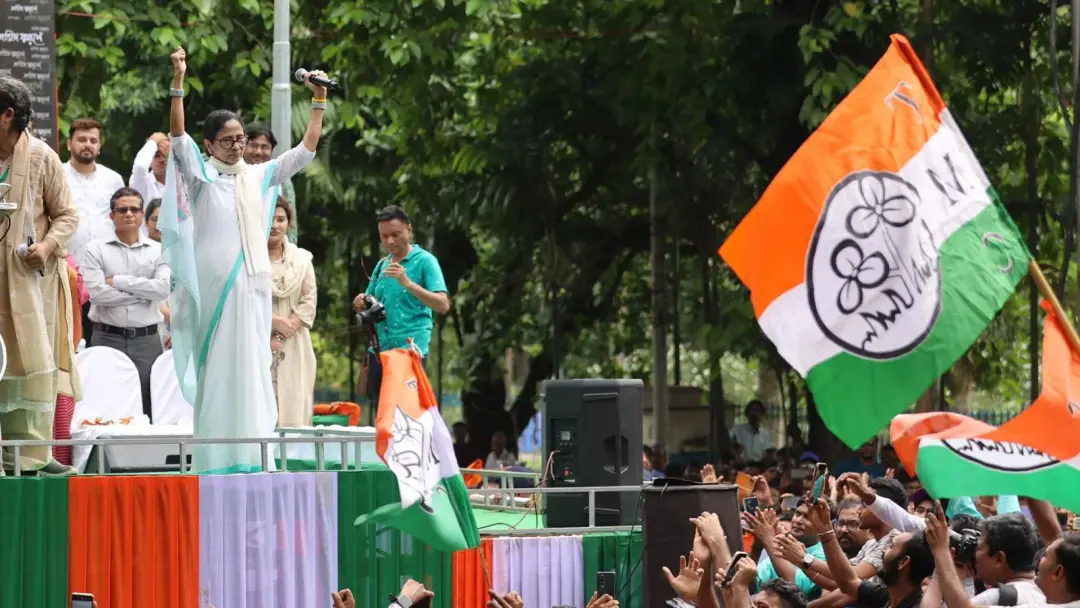
EC freezes Trinamool name, symbol in interim order
Formally recognising the dispute within the All India Trinamool Congress, the Election Commission on Thursday passed an interim order freezing the party's name and election symbol. The factions led by Mamata Banerjee and Arup Roy were asked to choose new names and symbols, and barred from using the "flowers and grass" symbol. The decision came under Para 15 of the Election Symbols Order, 1968. Preferences were sought by 11 am Friday. Bypolls to five Assembly seats and one Lok Sabha seat are on October 9.
Source
Indian Express — India · read the original report ↗
Desk check · compared with the source
What the desk checked (5)
- The EC on Thursday passed an interim order freezing the name and 'flowers and grass' symbol of the All India Trinamool Congress. — Attributed to the EC order, which is quoted at length in the source.
- The rival faction is led by Arup Roy, per the EC order; the source elsewhere refers to a Ritabrata Banerjee-led rebel faction. — Internal inconsistency within the source; editors should verify the faction leader's name before publication.
- Both groups must submit preferred names and symbols by 11 am Friday and pick from the EC's free symbols list. — Figure and deadline appear in the source, attributed to the order.
- Bye-elections to five Assembly seats, including Nandigram and Rejinagar, and one Lok Sabha seat were announced for October 9, 10 days earlier. — Stated in the source without separate attribution; dates appear as reported.
- The order was issued by CEC Gyanesh Kumar and ECs Sukhbir Singh Sandhu and Vivek Joshi. — Named in the source as signatories of the order.
Analysts’ view opinion
Freezing the name and symbol is the Election Commission's way of not picking a side, but in practice a freeze rarely lands evenly. With the bypolls days away, the faction that depends most on an established, instantly recognisable symbol has the most to lose, while the group led by Arup Roy gains something it did not have before — official recognition as an equal claimant rather than a breakaway. The substantive question of who is the real party remains undecided; this is only an interim arrangement.
- A freeze is procedurally neutral but politically asymmetric, since the side with the stronger brand equity in the old symbol carries the bigger cost of re-educating voters.
- Because both groups may link their new names to the parent party, the campaign is likely to turn into a contest over who is the 'authentic' Trinamool.
- With both factions having already fielded candidates, a split in the traditional vote base looks hard to avoid, which can benefit rival parties.
- The presence of a politically symbolic seat like Nandigram gives these results signalling value well beyond their arithmetic.
- The EC's own admission that there was no time to settle the dispute before polling suggests a prolonged organisational and possibly legal battle ahead.
What to watch — Watch the names and symbols each side submits by Friday 11 am, how aggressively each claims the parent party's legacy, and whether the interim order is challenged.
This story does not establish which faction holds organisational majority, who will finally get the name and symbol, or how voters will actually respond.
Deep dive
Research brief · 8 facts · 5 dates · exam-readyThe brief
Context
The All India Trinamool Congress (TMC), West Bengal's ruling party, is split into two rival groups — one led by Mamata Banerjee and the other led by Arup Roy (with a rebel faction associated with Ritabrata Banerjee). Both groups claim to be the real party and have nominated candidates for bypolls to five Assembly seats, including Nandigram and Rejinagar in West Bengal, and one Lok Sabha seat, scheduled for October 9. With the two claims unresolved, the Election Commission on Thursday passed an interim order under Para 15 of the Election Symbols (Reservation and Allotment) Order, 1968, freezing the party's name and its "flowers and grass" symbol until the dispute is decided.
Key facts
- The EC's interim order freezes the name 'All India Trinamool Congress' and the party's 'flowers and grass' election symbol for both rival groups.
- The EC held there are two rival groups in the AITC — one led by Mamata Banerjee, the other by Arup Roy — each claiming to be the party.
- The order was passed under Para 15 of the Election Symbols (Reservation & Allotment) Order, 1968, under which the EC decides disputes within registered parties.
- The order was issued by Chief Election Commissioner Gyanesh Kumar and Election Commissioners Sukhbir Singh Sandhu and Vivek Joshi.
- Both factions must choose new names — which may include a linkage with parent party 'All India Trinamool Congress' — and pick symbols from the EC's list of free symbols.
- Both groups were asked to submit their preferences for names and symbols by 11 am Friday.
- Bypolls are due on October 9 for five Assembly constituencies, including Nandigram and Rejinagar in West Bengal, and one Lok Sabha seat; both factions have nominated candidates.
- The EC order came 10 days after it announced the bye-elections; the Commission said there was not enough time to complete the dispute case before the bypolls.
Timeline
- 10 days before the EC orderEC announces bye-elections to five Assembly constituencies, including Nandigram and Rejinagar, and one Lok Sabha seat, for October 9.
- Last weekEC meets both TMC factions and seeks more documents from the rebel Ritabrata Banerjee-led faction; Mamata's side represented by Rajya Sabha MP Derek O'Brien and four others.
- ThursdayEC passes interim order freezing the AITC name and 'flowers and grass' symbol, directing both groups to choose new names and free symbols.
- 11 am FridayDeadline for both factions to submit their preferences for names and symbols.
- October 9Bypolls to five Assembly seats and one Lok Sabha seat.
Who has a stake
- Mamata Banerjee-led faction — Loses interim use of the AITC name and 'flowers and grass' symbol; must fight bypolls under a new name and free symbol.
- Arup Roy-led faction (rebel group linked to Ritabrata Banerjee) — Gains parity with the Mamata group in the interim, but also cannot use the party name or symbol.
- Election Commission of India — Must make a substantive determination under Para 15 on which group is the real party, while ensuring a level playing field in the bypolls.
- Voters in the five Assembly seats and one Lok Sabha seat — Face ballots without the familiar TMC name and symbol, with two rival groups contesting under new identities.
- Derek O'Brien, Rajya Sabha MP — Represented the Mamata Banerjee faction before the EC along with four others.
Why it matters
Freezing a major party's name and symbol just weeks before a multi-seat bypoll strips both factions of their most recognisable electoral identity, which matters greatly in a country where symbols anchor voter recognition. It also puts the EC's quasi-judicial power under Para 15 of the Symbols Order at the centre of an intra-party power struggle in West Bengal. The eventual determination will decide who inherits the AITC name, symbol and organisational claim.
UPSC angle
Prelims pointers
- Para 15 of the Election Symbols (Reservation and Allotment) Order, 1968 empowers the EC to decide disputes between rival groups of a recognised/registered party.
- Interim freezing of name and symbol, with both groups given new names and free symbols, is the EC's standard interim device in such disputes.
- Current EC bench in the order: CEC Gyanesh Kumar with ECs Sukhbir Singh Sandhu and Vivek Joshi.
- Bypolls on October 9 cover five Assembly seats — including Nandigram and Rejinagar in West Bengal — and one Lok Sabha seat.
- 'Flowers and grass' is the reserved election symbol of the All India Trinamool Congress.
- Free symbols are those notified by the EC and available for allotment to candidates/groups without reserved symbols.
Mains framing
The EC's interim freeze on the All India Trinamool Congress name and 'flowers and grass' symbol illustrates how intra-party splits become constitutional and administrative questions in India's electoral system. Once two groups each claim to be the party, the Commission's only route is a substantive determination under Para 15 of the Symbols Order, 1968 — a fact-intensive exercise requiring documentary evidence of organisational and legislative support, which the EC said could not be completed before the October 9 bypolls. The interim device of freezing the symbol and directing both factions to adopt new names (optionally linked to the parent party) and free symbols is justified by the EC as placing rivals "on even keel" and following past precedence, but it also imposes an immediate electoral cost on both, since symbol recognition drives voter identification, especially among first-time and less-literate voters. Implications include compressed campaign timelines, possible voter confusion in seats like Nandigram and Rejinagar, and renewed debate on whether symbol disputes should be resolved by tests of internal party democracy rather than only numerical support. The way forward lies in time-bound adjudication with clear evidentiary standards, stronger internal party democracy and transparency in registered parties, and voter-awareness measures where familiar symbols are withdrawn mid-election.
Key terms
- Election Symbols (Reservation and Allotment) Order, 1968
- EC order governing reservation and allotment of election symbols to parties and candidates; its Para 15 covers rival-group disputes.
- Para 15
- The provision under which the EC decides disputes within registered parties and determines which rival group is the party.
- Interim order
- A temporary EC direction, here freezing the party name and symbol, pending substantive determination of the dispute.
- Free symbols
- Symbols notified by the EC that are not reserved for any party and can be allotted for a particular election.
- All India Trinamool Congress (AITC)
- The West Bengal-based party whose name and 'flowers and grass' symbol have been frozen amid a factional dispute.
- Bye-election
- Poll held to fill a vacancy in a specific Assembly or Lok Sabha seat; here for five Assembly seats and one Lok Sabha seat on October 9.
Practice questions
- Examine the Election Commission's powers under Para 15 of the Election Symbols (Reservation and Allotment) Order, 1968 in resolving disputes between rival factions of a political party.
- Freezing a party's name and symbol on the eve of elections protects fairness between factions but may disadvantage voters. Critically discuss.
- How do recurring intra-party splits and symbol disputes reflect on the state of internal democracy in Indian political parties? Suggest reforms.
Grounded only in the source report — figures and dates are the source's, not inferred.