
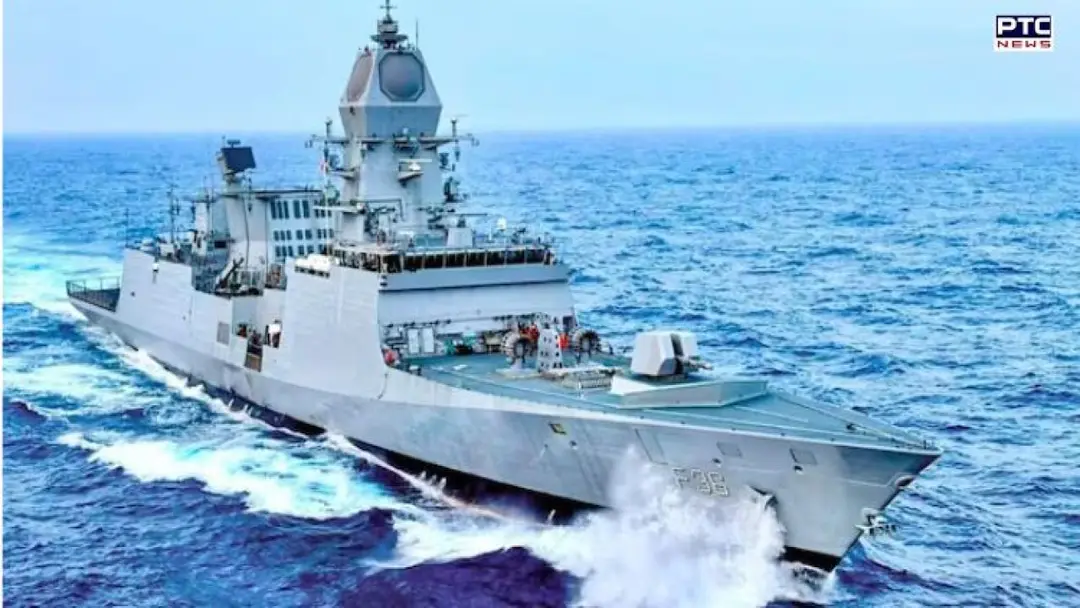
India protests after Pakistani naval ship collides with Navy vessel
India summoned Pakistan's senior diplomat to lodge a strong protest after a Pakistani naval ship collided with an Indian Navy vessel in international waters. According to sources, the incident occurred on the evening of September 15 in the North Arabian Sea, when the Pakistani vessel sped toward an Indian ship on routine surveillance patrol. The warship escaped without damage. The Ministry of External Affairs called the conduct "unacceptable and unprofessional" and said it breached Article 10 of a 1991 agreement requiring advance notice of military exercises at sea.
Source
Indian Navy · read the original report ↗
Desk check · some claims need care
What the desk checked (5)
- A Pakistani naval ship collided with an Indian Navy vessel in international waters in the North Arabian Sea on the evening of September 15. — Attributed only to unnamed 'sources' in the source text; no official confirmation cited for the date or location.
- The Indian warship escaped without damage. — Stated in the source without attribution to a named official.
- MEA called the Pakistani naval unit's actions 'unacceptable and unprofessional'. — Attributed to an official Ministry of External Affairs statement; quote appears in source.
- Pakistan's conduct breached Article 10 of a 1991 India-Pakistan agreement requiring advance notice of military exercises, manoeuvres or troop movements at sea. — Attributed to the MEA in the source; treaty article description appears as given, not independently verified.
- Relations worsened after 'Operation Sindoor' last year. — Background context in the source with no source given; timeline wording is vague and should be checked.
Analysts’ view opinion
Though the incident is naval, India's response is written entirely in political-diplomatic grammar — summoning the envoy and naming a specific breach of Article 10 of the 1991 agreement lets Delhi claim both the moral high ground and a rules-based case. The fact that the warship suffered no damage gives the government valuable political room: it can speak firmly without being pushed into escalation. With ties already at a low point after Operation Sindoor, such episodes tend to raise domestic political pressure on both sides.
- By invoking a written agreement, India shifts the argument from a contested claim to a documented violation, which is a stronger position internationally.
- The absence of damage is politically decisive — it lets the government settle at the diplomatic level without facing loud demands for retaliation.
- Summons, strong statement, simmering tension: this follows a long-established pattern in which both capitals are largely performing firmness for domestic audiences.
- The story carries no Pakistani version or rebuttal; in such cases the other side typically offers a competing account.
- Because maritime incidents are less visible than border firing, watch whether this grows into a major political talking point or stays confined to the diplomatic file.
What to watch — Watch for Islamabad's official response, whether India raises the matter in international forums, and whether Parliament or the opposition presses the government for detail.
The story does not establish whether the collision was deliberate or accidental, or at what level of command it was authorised, and the account rests largely on Indian sources and the MEA statement.
Deep dive
Research brief · 8 facts · 5 dates · exam-readyThe brief
Context
India has lodged a formal diplomatic protest with Pakistan after a Pakistani naval ship collided with an Indian Navy vessel in international waters in the North Arabian Sea on the evening of September 15. The Indian ship was on a routine surveillance patrol and escaped without damage. The Ministry of External Affairs summoned Pakistan's senior diplomat in New Delhi, terming the Pakistani naval unit's conduct "unacceptable and unprofessional" and a breach of Article 10 of a 1991 India-Pakistan agreement that requires advance notice of military exercises, manoeuvres or troop movements at sea. The episode adds to an already strained relationship that worsened after Operation Sindoor last year.
Key facts
- The collision occurred on the evening of September 15 in the North Arabian Sea, in international waters, according to sources.
- The Indian Navy ship was on a routine surveillance patrol when a Pakistani naval vessel sped toward it and crashed into it.
- The Indian warship escaped without any damage.
- India summoned Pakistan's senior diplomat to lodge a strong protest over the incident.
- The Ministry of External Affairs called the Pakistani naval unit's actions "unacceptable and unprofessional".
- India said Pakistan's conduct breached a 1991 bilateral agreement whose Article 10 requires advance notice before military exercises, manoeuvres or troop movements at sea.
- The Pakistani diplomat was told to convey that all military units must act with caution and adhere to existing bilateral agreements.
- India-Pakistan ties have been especially tense since last year's Operation Sindoor, described as pushing relations to one of their lowest points in recent memory.
Timeline
- 1947India and Pakistan become independent; start of a hostile history shaped by wars, border disputes and mutual suspicion.
- 1991India and Pakistan sign an agreement whose Article 10 mandates advance notice of military exercises, manoeuvres and troop movements at sea.
- Last yearOperation Sindoor becomes a major flashpoint, pushing bilateral relations to one of their lowest points in recent memory.
- Evening of September 15A Pakistani naval vessel speeds toward and collides with an Indian Navy ship on routine surveillance patrol in the North Arabian Sea; Indian ship undamaged.
- After the incidentIndia summons Pakistan's senior diplomat; MEA calls the conduct unacceptable and unprofessional and cites the 1991 agreement breach.
Who has a stake
- Ministry of External Affairs, India — Lodged the protest and framed the incident as a violation of a bilateral agreement, setting the diplomatic response.
- Indian Navy — Its surveillance patrol vessel was rammed at sea; operational safety and freedom of navigation are at stake.
- Pakistan's senior diplomat in India — Summoned and asked to convey India's demand that Pakistani military units follow bilateral protocols.
- Government of Pakistan — Accused of unprofessional naval conduct and of breaching Article 10 of the 1991 agreement.
- Both nuclear-armed neighbours — Repeated incidents at sea and along the border test a fragile peace with no diplomatic breakthrough in sight.
- Fishermen straying across maritime borders — Cited as a recurring irritant in India-Pakistan relations alongside cross-border firing and naval encounters.
Why it matters
A deliberate high-speed approach and collision between warships of two nuclear-armed neighbours in international waters carries a real risk of unintended escalation at sea. It also exposes how confidence-building measures such as the 1991 agreement on prior notification of naval movements are being tested at a time when diplomatic channels between New Delhi and Islamabad are largely reduced to protests and statements.
UPSC angle
Prelims pointers
- Incident site: North Arabian Sea, in international waters, on the evening of September 15.
- Article 10 of the 1991 India-Pakistan agreement: advance notice required for military exercises, manoeuvres and troop movements at sea.
- India's protest was lodged by the Ministry of External Affairs by summoning Pakistan's senior diplomat.
- MEA description of Pakistani naval conduct: "unacceptable and unprofessional".
- Operation Sindoor (last year) is cited as the flashpoint that pushed India-Pakistan ties to a recent low.
- The Indian Navy vessel was on routine surveillance patrol and suffered no damage.
Mains framing
The North Arabian Sea collision illustrates how India-Pakistan hostility has migrated from the land border to the maritime domain, where confidence-building measures are thinnest in practice. The immediate cause, per India's account, was a Pakistani naval vessel speeding toward and ramming an Indian ship on routine surveillance patrol in international waters, in violation of Article 10 of the 1991 bilateral agreement requiring prior notification of naval exercises and movements. The implications are threefold: risk of accidental escalation between two nuclear-armed states; erosion of the credibility of existing agreements when breaches draw only protests; and further narrowing of diplomatic space already constricted since Operation Sindoor, with exchanges following a predictable cycle of incident, summons, statement and stalemate. The story also situates naval encounters alongside older irritants such as straying fishermen and cross-border firing, and the unresolved Kashmir dispute. A grounded way forward, as reflected in India's own demarche, is insistence that military units act with caution and adhere strictly to existing bilateral agreements and established protocols at sea, so that tactical incidents do not become strategic crises.
Key terms
- 1991 India-Pakistan agreement (Article 10)
- Bilateral pact requiring both countries to give advance notice before military exercises, manoeuvres or troop movements at sea.
- North Arabian Sea
- The maritime area where the September 15 collision between the Pakistani naval ship and the Indian Navy vessel occurred.
- Ministry of External Affairs (MEA)
- India's foreign ministry, which summoned Pakistan's senior diplomat and issued the official protest statement.
- Operation Sindoor
- A major flashpoint of last year that, per the source, pushed India-Pakistan relations to one of their lowest recent points.
- Surveillance patrol
- Routine naval monitoring mission the Indian warship was on when it was struck.
Practice questions
- Maritime confidence-building measures between India and Pakistan have not kept pace with risks at sea. Discuss with reference to the September 15 North Arabian Sea incident and the 1991 agreement.
- Why do India-Pakistan diplomatic exchanges tend to follow a cycle of incident, summons and statement without breakthrough? Examine the structural reasons.
- How do naval encounters in international waters between nuclear-armed neighbours raise escalation risks, and what protocols can reduce them?
Grounded only in the source report — figures and dates are the source's, not inferred.