
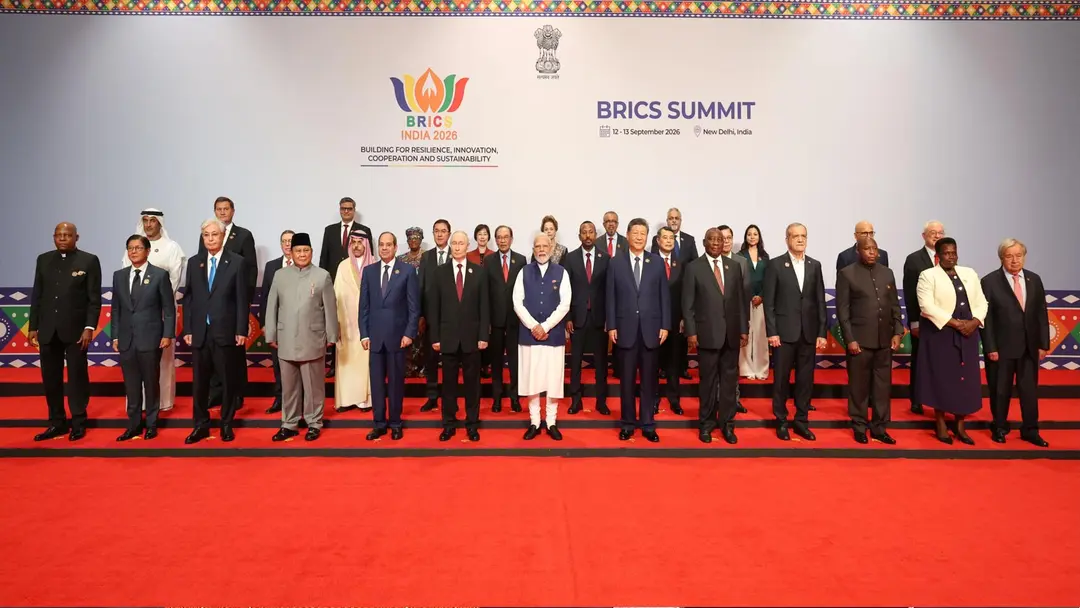
New Delhi Declaration adopted by consensus at 18th BRICS Summit
The 18th BRICS Summit, chaired by India, was held in New Delhi on September 12-13, 2026 under the theme "Building for Resilience, Innovation, Cooperation and Sustainability". The New Delhi Declaration, adopted by consensus, condemned terrorism and the April 2025 attack in Jammu and Kashmir. It voiced concern over unilateral trade measures and backed UN Security Council reform, wider use of national currencies, food security, health and AI cooperation. The analysis says India sought a bridge-building role rather than an anti-Western bloc.
Source
BRICS / G20 / SCO / Quad · read the original report ↗
Desk check · compared with the source
What the desk checked (5)
- The 18th BRICS Summit was held in New Delhi on September 12-13, 2026 under the theme 'Building for Resilience, Innovation, Cooperation and Sustainability'. — Dates and theme appear in the source; no external document cited.
- The New Delhi Declaration was adopted by consensus and condemned terrorism, including the April 2025 attack in Jammu and Kashmir. — Stated in source as summit outcome; no direct text of the Declaration quoted.
- The Declaration supports greater use of national currencies and cross-border payment interoperability, but not a common BRICS currency. — Author's characterisation of the Declaration; internally consistent.
- Russian Deputy Foreign Minister and BRICS Sherpa Sergey Ryabkov called such declarations a 'de facto roadmap for practical work'. — Direct quote attributed to Ryabkov via the Security Index Yearbook Vol. 2.
- India hosted the AI Impact Summit earlier in 2026. — Mentioned in passing without source or date detail.
Analysts’ view opinion
Getting the New Delhi Declaration adopted by consensus is the clearest political win of India's chairmanship — in an enlarged and internally divided grouping, producing a joint document at all was the real test. The condemnation of terrorism, and specifically of the April 2025 attack in Jammu and Kashmir, is politically usable for Delhi because it puts a multilateral stamp on India's long-standing argument. At the same time, by keeping BRICS from hardening into an anti-Western bloc, India protected its own strategic autonomy and multi-alignment.
- By delivering a consensus text as chair, India strengthened its claim to be the convenor and interpreter of the Global South.
- Language on terrorism, terror financing and safe havens, plus the UN comprehensive convention, gives the government a tangible outcome to point to at home as well as abroad.
- Expressing concern over unilateral trade measures without tipping into ideological confrontation is a delicate balance that keeps Western ties intact while honouring the grouping's grievances.
- Support for national currencies and payment interoperability stops short of a common BRICS currency — a limit that reads as deliberate political caution.
- Consensus gets harder as membership grows; holding open a dialogue track amid Iran–UAE tensions was the sharpest test of Delhi's approach.
What to watch — Watch whether declaratory items like the grain exchange, health and AI cooperation convert into working mechanisms, and whether the next chair sustains this balancing line.
The story establishes that the declaration was adopted, not how the negotiations went, which members pushed back, or how Western capitals have formally responded.
Deep dive
Research brief · 8 facts · 5 dates · exam-readyThe brief
Context
BRICS, marking two decades since its creation, has expanded well beyond its original five members and now includes states with sharply differing political systems and geopolitical priorities. India chaired the 18th BRICS Summit in New Delhi on September 12-13, 2026, under the theme "Building for Resilience, Innovation, Cooperation and Sustainability". The summit came amid external pressure on BRICS over tariffs, trade restrictions, sanctions, energy security and the debate on reducing dependence on the US dollar, and amid internal tensions such as those involving Iran and the UAE. Its main outcome was the New Delhi Declaration, adopted by consensus.
Key facts
- The 18th BRICS Summit was held in New Delhi on September 12-13, 2026, under India's chairmanship.
- Summit theme: "Building for Resilience, Innovation, Cooperation and Sustainability".
- The New Delhi Declaration was adopted by consensus and specifically condemned the April 2025 terrorist attack in Jammu and Kashmir.
- The Declaration called for zero tolerance towards terrorism, action against terrorist financing and safe havens, and adoption of the Comprehensive Convention on International Terrorism at the UN.
- It expressed concern over unilateral trade and economic measures and reaffirmed an open, fair and inclusive international trading system.
- It backed reform of global institutions, including the United Nations Security Council, for greater Global South participation.
- On finance, it supported greater use of national currencies in trade and investment and interoperability of cross-border payment and messaging systems - not a common BRICS currency.
- Food security initiatives included a proposed BRICS Grain Exchange, stronger food reserves, climate-adaptive seeds, the Global Forum on Farmers' Rights in Seed Systems, and networks on agroecology, regenerative and digital agriculture.
Timeline
- April 2025Terrorist attack in Jammu and Kashmir, later specifically condemned in the New Delhi Declaration.
- 2024BRICS leaders' declaration adopted at Kazan, cited by Russian Deputy Foreign Minister Sergey Ryabkov as a de facto roadmap.
- 2025BRICS leaders' declaration adopted at Rio de Janeiro.
- Earlier in 2026India hosted the AI Impact Summit, providing a foundation for the BRICS AI governance agenda.
- September 12-13, 202618th BRICS Summit in New Delhi; New Delhi Declaration adopted by consensus.
Who has a stake
- India (chair) — Sought to prove BRICS can cooperate without becoming an anti-Western bloc; secured consensus language on terrorism and a practical development agenda.
- BRICS members (expanded grouping) — Must preserve the grouping's identity and consensus as membership and diversity of interests grow.
- Russia — Views BRICS declarations as de facto roadmaps for practical work; Deputy Foreign Minister and BRICS Sherpa Sergey Ryabkov quoted in the Security Index Yearbook Vol. 2.
- Iran and the United Arab Emirates — Tensions involving them tested India's emphasis on dialogue and consultation within the enlarged BRICS.
- Global South / developing countries — Stand to gain from UNSC and global institution reform, accessible AI governance, food and health cooperation.
- Western countries — India's extensive economic, technological and strategic ties with the West shape its refusal to make BRICS an anti-Western instrument.
Why it matters
The summit shows how a rapidly enlarged BRICS can still produce a consensus document despite deep political and security disagreements among members. For India, the specific condemnation of the April 2025 Jammu and Kashmir attack is a diplomatic gain, while the pivot to food, health, energy and AI cooperation gives the grouping practical relevance. It also clarifies India's positioning: strategic autonomy and multi-alignment, engaging without aligning and strengthening the Global South without targeting the West.
UPSC angle
Prelims pointers
- 18th BRICS Summit: New Delhi, September 12-13, 2026; theme "Building for Resilience, Innovation, Cooperation and Sustainability".
- Outcome document: New Delhi Declaration, adopted by consensus.
- Previous BRICS leaders' declarations cited: Kazan (2024) and Rio de Janeiro (2025).
- Declaration pushes for adoption of the Comprehensive Convention on International Terrorism at the UN.
- BRICS backs greater use of national currencies and cross-border payment interoperability, not a common BRICS currency.
- Food security proposals include a BRICS Grain Exchange and the Global Forum on Farmers' Rights in Seed Systems.
Mains framing
The 18th BRICS Summit illustrates the central dilemma of an expanded plurilateral grouping: as membership widens, the diversity of political systems, economic interests and positions on regional conflicts makes consensus harder, yet that very diversity is the source of BRICS's claimed legitimacy as a voice of the Global South. India's chairmanship responded by de-emphasising ideological framing - stopping short of an anti-Western coalition - and instead anchoring the New Delhi Declaration in areas of tangible common interest: counter-terrorism norms including the Comprehensive Convention on International Terrorism, concern over unilateral trade and economic measures, UN Security Council and global institution reform, incremental financial resilience through national currencies and payment-system interoperability, food security via a BRICS Grain Exchange and climate-adaptive seeds, health preparedness, energy and critical minerals, and inclusive AI governance building on India's AI Impact Summit. Internal tests, such as tensions involving Iran and the UAE and the West Asia crisis, were managed through calls for restraint, dialogue and diplomacy rather than resolution. The way forward, as the source frames it, depends on whether declarations become concrete outcomes - BRICS must be neither a closed club nor an anti-Western alliance, with India's bridge-building role combining strategic autonomy and multi-alignment.
Key terms
- BRICS
- Plurilateral grouping, two decades old, now expanded well beyond its original five members; chaired by India for the 2026 summit.
- New Delhi Declaration
- Consensus outcome document of the 18th BRICS Summit covering terrorism, trade, UNSC reform, finance, food, health and AI.
- Strategic autonomy and multi-alignment
- India's foreign policy approach of engaging multiple power centres - the West, Russia, China and the Global South - without joining any bloc.
- Comprehensive Convention on International Terrorism
- Proposed UN treaty on terrorism whose adoption the Declaration urged renewed efforts towards.
- BRICS Grain Exchange
- Food-security initiative whose discussions the Declaration supported, alongside food reserves and climate-adaptive seeds.
- BRICS Sherpa
- Senior official coordinating a member state's BRICS negotiations; Russia's Sherpa is Deputy Foreign Minister Sergey Ryabkov.
Practice questions
- Examine how the expansion of BRICS has affected its ability to arrive at consensus, with reference to the outcomes of the 18th BRICS Summit in New Delhi.
- "India seeks to be a bridge-builder rather than a bloc-builder in BRICS." Discuss with reference to strategic autonomy and multi-alignment.
- Assess the practical significance of BRICS cooperation in food security, health and artificial intelligence governance for the Global South.
Grounded only in the source report — figures and dates are the source's, not inferred.