
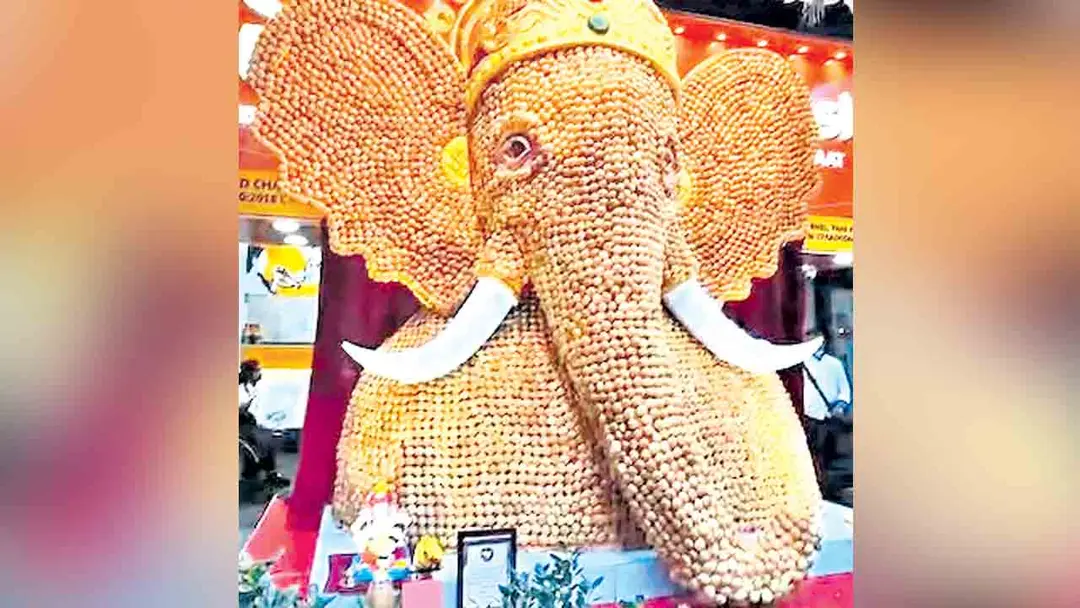
Pune shop builds 13-foot Ganesh idol with 21,000 pani puris
The operators of the 'Ganesh Bhel' chaat shop on FC Road in Pune have set up a 13-foot Ganesh idol made with 21,000 pani puris for the Ganesh festival, and images of it have gone viral on social media. Two artists, Rupesh and Dinesh, reportedly worked for two months on it. After the celebrations, the idol will be used to make organic fertiliser instead of being immersed in water.
Source
Namasthe Telangana · read the original report ↗
Desk check · some claims need care
What the desk checked (5)
- A 13-foot Ganesh idol was made using 21,000 pani puris in Pune — Figure appears in source; no named spokesperson or independent verification cited
- The idol was set up by the operators of 'Ganesh Bhel' on FC Road, Pune — Stated in source as fact; location and shop name specified but not directly quoted
- Artists Rupesh and Dinesh worked for two months on the idol — Reported in source in hearsay register ('reportedly'); names given without further detail
- Instead of water immersion, the idol will be used to make organic fertiliser after the festival — Reported as a stated intention in the source, unattributed and about a future action
- The idol went viral on social media — Claim in source; no platform, account or engagement figures given
Analysts’ view opinion
This is at heart a small-business creativity story, but in Maharashtra the Ganesh festival has always doubled as a stage for public visibility, and Pune's pandals are among the most watched. A 13-foot idol built from 21,000 panipuris going viral — combined with the plan to turn it into organic manure instead of immersing it — fits neatly into the eco-friendly festival messaging that civic bodies and political leaders have been pushing for years. No politician features in this story, yet examples like this are exactly the kind that get adopted into official campaign talking points.
- In Maharashtra the Ganesh festival is not only a cultural event but a platform for local prestige and public outreach, which is why viral idols acquire political utility.
- Choosing organic manure over water immersion offers a soft answer to the long-running pollution debate — a way to advance environmental norms without appearing to dilute devotion.
- Because the display comes from a chaat shop, there is an obvious commercial-publicity motive; reading it purely as a political signal would be over-interpretation.
- Conversely, using food to build a deity's image could draw objections on grounds of religious propriety or food wastage — no such criticism is recorded in this story.
- During festival season, feel-good items like this also give administrations relief from the more contentious arguments over pandal permissions, noise and traffic restrictions.
What to watch — Watch whether the idol is in fact converted into organic manure after the festival, and whether civic bodies or leaders cite it as a showcase example in eco-friendly immersion messaging.
The story establishes no involvement of any party, leader or government agency; the political reading here rests on general festival-politics context, not on reported claims.
Deep dive
Research brief · 7 facts · 3 dates · exam-readyThe brief
Context
During the annual Ganesh festival, devotees across Maharashtra create idols out of unusual materials, including food items. This year, the operators of the 'Ganesh Bhel' chaat shop on FC Road in Pune installed a 13-foot Ganesh idol made from 21,000 pani puris, and photographs of it went viral on social media. Two artists, Rupesh and Dinesh, are reported to have worked on it for two months. The organisers say that instead of being immersed in water after the festivities, the idol will be used to make organic fertiliser.
Key facts
- The Ganesh idol installed in Pune is 13 feet tall and made of 21,000 pani puris.
- It was set up by the operators of the 'Ganesh Bhel' chaat shop on FC Road, Pune.
- Two artists named Rupesh and Dinesh worked on the idol for two months, according to the report.
- Images of the pani puri idol went viral on social media.
- After the celebrations, the idol will not be immersed in water; it will be used to make organic fertiliser.
- The report is datelined Pune, September 15, with a timestamp of September 16, 2026 / 03:50 AM IST.
- The source notes that many such innovative idols appear in various parts of Maharashtra each year, but the pani puri idol drew particular attention.
Timeline
- About two months before the festivalArtists Rupesh and Dinesh begin work on the pani puri Ganesh idol.
- September 15 (Pune dateline)The 13-foot idol made of 21,000 pani puris at 'Ganesh Bhel' on FC Road goes viral on social media.
- After the celebrations concludeThe idol is to be used for making organic fertiliser instead of water immersion.
Who has a stake
- Operators of 'Ganesh Bhel' chaat shop, FC Road, Pune — Installed the idol; gain public attention and visibility from the viral display.
- Artists Rupesh and Dinesh — Spent two months building the idol; their craftsmanship is the centrepiece of the story.
- Devotees and festival-goers in Pune — Audience for the innovative idol and for the eco-friendly disposal message.
- Maharashtra's wider Ganeshotsav community — Part of a trend of unusual, material-based idols across the state each year.
- Environment and water bodies — Avoiding immersion and converting the idol into organic fertiliser reduces festival waste in water.
Why it matters
The pani puri idol shows how Ganeshotsav creativity in Maharashtra is increasingly paired with eco-friendly practice, with organisers choosing composting into organic fertiliser over water immersion. Such visible, viral examples can shape public behaviour on festival waste far more effectively than rules alone, since immersion of idols is a recurring source of pollution concern.
UPSC angle
Prelims pointers
- A 13-foot Ganesh idol made of 21,000 pani puris was installed at 'Ganesh Bhel' on FC Road, Pune.
- Two artists, Rupesh and Dinesh, worked for two months on the idol.
- The idol is to be converted into organic fertiliser instead of being immersed in water.
- Ganeshotsav in Maharashtra regularly features idols made from unusual objects and food items.
- The report carries a Pune dateline of September 15 and a timestamp of September 16, 2026.
Mains framing
Ganeshotsav in Maharashtra has long been a stage for public creativity, and idols built from unconventional materials — this year, a 13-foot figure of 21,000 pani puris at a Pune chaat shop — draw mass attention through social media. The significant shift in this instance is at the disposal end: rather than the customary immersion in water, the organisers plan to convert the idol into organic fertiliser, an eco-friendly choice that addresses the environmental burden festivals place on water bodies. The causes of such innovation lie in commercial visibility, artistic competition among mandals and rising environmental awareness; the implication is that eco-conscious festival practice can be popularised through spectacle rather than only through regulation. A way forward suggested by the story itself is wider replication of composting and non-immersion disposal for organic and food-based idols, with community groups and local shops acting as visible demonstrators; the source does not state any government policy, so claims beyond this cannot be made.
Key terms
- Ganeshotsav
- The annual Ganesh festival, during which devotees install idols; in Maharashtra it is marked by large public displays.
- Pani puri
- A popular Indian street snack of crisp hollow puris; 21,000 of them were used to build the Pune idol.
- Ganesh Bhel
- The chaat shop on FC Road, Pune, whose operators installed the 13-foot pani puri Ganesh idol.
- Immersion (nimajjanam)
- The traditional practice of consigning Ganesh idols to water at the end of the festival, avoided in this case.
- Organic fertiliser
- Compost-type manure; the pani puri idol is to be used to make it after the festival instead of being immersed.
Practice questions
- Discuss how public festivals such as Ganeshotsav can be leveraged to promote environmentally sustainable practices, with reference to alternatives to idol immersion.
- The Pune pani puri idol was built by two artists over two months and went viral online. Examine the role of social media in shaping contemporary festival culture in India.
- What are the environmental concerns associated with idol immersion in water bodies, and how can composting or reuse of organic idol material address them?
Grounded only in the source report — figures and dates are the source's, not inferred.