
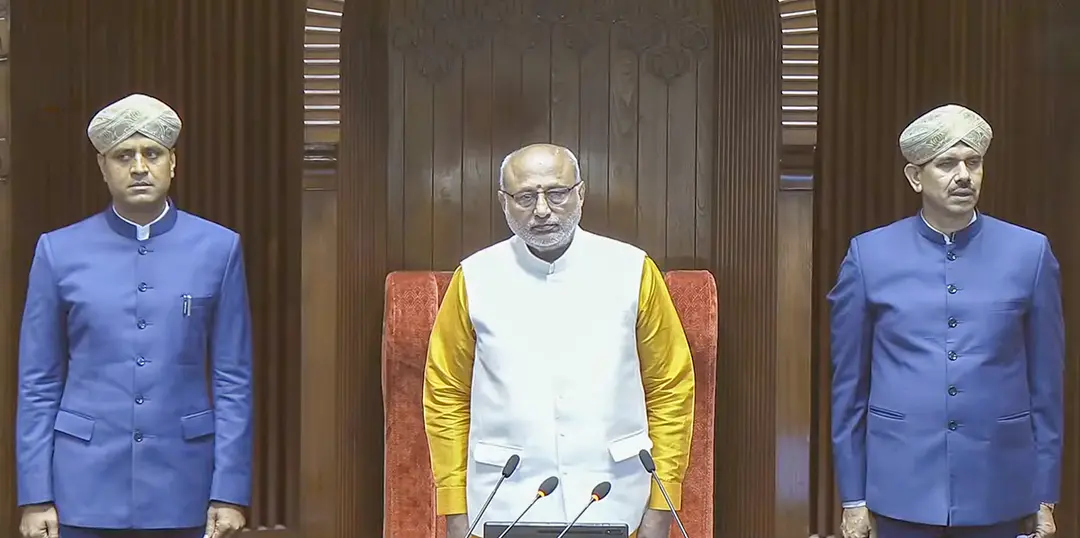
Parliament's Monsoon Session ends amid repeated disruptions
Parliament's Monsoon Session, which began on July 20, was adjourned sine die on Thursday after 19 sittings over 25 calendar days. Eleven Bills were introduced in the Lok Sabha and two in the Rajya Sabha, while both Houses passed 12 Bills. Chairman C. P. Radhakrishnan said the Rajya Sabha functioned for 37 hours 49 minutes, with 39.17 per cent productivity. Minister Kiren Rijiju put Lok Sabha productivity at 19 per cent. Demands for an Amit Shah statement on NEET protests dominated the standoff.
Source
Rajya Sabha · read the original report ↗
Desk check · compared with the source
What the desk checked (5)
- Monsoon Session concluded Thursday after 19 sittings over 25 calendar days, having begun on July 20. — Figures appear in source; no official document cited beyond the session's conclusion.
- 11 Bills introduced in Lok Sabha, two in Rajya Sabha, and 12 Bills passed by both Houses. — Figures appear in source; internally consistent with the list of named Bills.
- Rajya Sabha functioned 37 hours 49 minutes with 39.17% productivity; Lok Sabha productivity 19%. — Attributed to Rajya Sabha Chairman C. P. Radhakrishnan and Minister Kiren Rijiju respectively; Rijiju's 39% approximates the Chairman's figure.
- Foreign Contribution (Regulation) Amendment Bill, 2026 referred to a 31-member Joint Parliamentary Committee (21 LS, 10 RS). — Figures appear in source and are internally consistent; no source document cited.
- Opposition demanded a statement by Amit Shah on the July 20 NEET protest at Jantar Mantar and raised Ram Mandir donation embezzlement allegations. — Allegations reported as Opposition demands; embezzlement claim is described as alleged and unverified in source.
Analysts’ view opinion
This Monsoon Session functioned less as a legislative forum and more as a stage for political messaging. The government got its legislative agenda through with 12 Bills passed, but must now carry the criticism that much of it cleared without substantive debate; the Opposition, by stalling proceedings over its demand for a statement from Amit Shah on the NEET protests, kept the students' grievance on the national agenda. The 19 per cent and 39 per cent productivity figures are likely to become ammunition for both sides to blame each other.
- By introducing and passing the anti-paper-leak amendment against the backdrop of the NEET protests, the government attempted to claim political ownership of student anger.
- The government's repeated offers to debate, and Shah's letter to the Speaker, are strategically designed to build a narrative that it is the Opposition that is avoiding debate.
- For the Opposition, insisting on a statement by the Home Minister rather than a general discussion is a test of accountability — conceding it would mean surrendering its main pressure point.
- Referring the contested FCRA Amendment Bill to a 31-member Joint Parliamentary Committee was an accommodative move that parks a politically sensitive issue for now.
- Rajya Sabha Chairman Radhakrishnan named no party, but by placing the cost of disruption on the House as a whole he added indirect pressure on the Opposition's tactics.
What to watch — Watch the JPC report due by the end of the first week of the Winter Session, and whether the Opposition sustains its NEET demand then or finally accepts a structured debate.
The story does not establish how responsibility for the disruptions should be apportioned, nor what electoral effect the standoff may have; the Ram Mandir donation claims remain allegations.
Deep dive
Research brief · 8 facts · 4 dates · exam-readyThe brief
Context
The Monsoon Session of Parliament began on July 20 and was adjourned sine die on Thursday after 19 sittings spread over 25 calendar days. It was dominated by Opposition protests demanding a statement by Union Home Minister Amit Shah on the July 20 student protest over NEET at Jantar Mantar, along with allegations of embezzlement of donations at the Ram Mandir in Ayodhya. Despite low productivity in both Houses, 12 Bills were passed, many without substantive discussion, including an amendment to the anti-paper-leak law of 2024.
Key facts
- Session began July 20 and ended Thursday with both Houses adjourned sine die after 19 sittings over 25 calendar days.
- 11 Bills were introduced in the Lok Sabha and two in the Rajya Sabha; 12 Bills were passed by both Houses.
- Rajya Sabha functioned for only 37 hours and 49 minutes, with productivity of 39.17 per cent, per Chairman C. P. Radhakrishnan.
- Parliamentary Affairs Minister Kiren Rijiju put Lok Sabha productivity at 19 per cent and Rajya Sabha at 39 per cent.
- Of opportunities available, only 16 of 285 Starred Questions, 52 of 380 Zero Hour Submissions and 93 of 380 Special Mentions were taken up in the Rajya Sabha.
- Public Examinations (Prevention of Unfair Means) Amendment Bill, 2026 mandates investigations within two months and trials within three months, and allows Special Fast Track Courts and Special Public Prosecutors.
- Foreign Contribution (Regulation) Amendment Bill, 2026 was referred to a 31-member Joint Parliamentary Committee — 21 from Lok Sabha and 10 from Rajya Sabha — to report by the last day of the first week of the Winter Session 2026.
- Mines and Minerals (Development and Regulation) Amendment Bill, 2026 was passed by the Rajya Sabha on Thursday.
Timeline
- July 20Monsoon Session begins; students protest over NEET at Jantar Mantar in New Delhi the same day.
- Monday (of the final week)Government offers a debate on the paper leak issue with a reply by Amit Shah; Congress rejects the proposal.
- WednesdayAmit Shah writes to Lok Sabha Speaker Om Birla urging a debate on the NEET protests, saying he is ready to answer every question; Opposition declines again.
- ThursdayRajya Sabha passes the Mines and Minerals (Development and Regulation) Amendment Bill, 2026; both Houses adjourned sine die; Rijiju holds a press conference.
Who has a stake
- Rajya Sabha Chairman C. P. Radhakrishnan — Presiding officer who publicly regretted persistent disorder that derailed legislative business and cost precious working hours.
- Government / Parliamentary Affairs Minister Kiren Rijiju — Blamed Congress for "unfairly disrupting" proceedings; dissatisfied that elaborate discussions on key Bills could not take place.
- Congress and the Opposition — Demanded a statement by Amit Shah on NEET protests and raised Ram Mandir donation allegations; rejected the government's debate offers twice.
- Union Home Minister Amit Shah — At the centre of the standoff; wrote to the Speaker offering to answer every Opposition question in a debate on the students' protests.
- Students and NEET aspirants — Protests over NEET prompted the Public Examinations (Prevention of Unfair Means) Amendment Bill, 2026 to strengthen exam integrity.
- Lok Sabha Speaker Om Birla — Recipient of Shah's letter seeking a debate; responsible for House proceedings amid disruptions.
- NGOs and foreign-funded bodies — Affected by the Foreign Contribution (Regulation) Amendment Bill, 2026, now under Joint Parliamentary Committee scrutiny.
Why it matters
Productivity of 19 per cent in the Lok Sabha and 39.17 per cent in the Rajya Sabha means laws affecting examinations, mining, MSMEs, tribunals and foreign funding were cleared with little scrutiny. Question Hour, Zero Hour and Special Mentions — the main instruments for MPs to hold the executive to account — were largely squeezed out, with only 16 of 285 Starred Questions taken up in the Upper House. The session shows how deadlock over a single demand can displace the deliberative function of Parliament.
UPSC angle
Prelims pointers
- Monsoon Session: began July 20, 19 sittings over 25 calendar days, adjourned sine die on Thursday.
- Bills: 11 introduced in Lok Sabha, 2 in Rajya Sabha; 12 passed by both Houses.
- Rajya Sabha productivity 39.17 per cent in 37 hours 49 minutes; Lok Sabha 19 per cent (Rijiju).
- Public Examinations (Prevention of Unfair Means) Amendment Bill, 2026 amends the 2024 parent Act; investigation in 2 months, trial in 3 months, appeal before a High Court Division Bench.
- FCRA Amendment Bill, 2026 referred to a 31-member JPC (21 Lok Sabha + 10 Rajya Sabha), report due by the last day of the first week of Winter Session 2026.
- Other Bills passed included Kerala (Alteration of Name) Bill, Tribunals Reforms Bill, Bankers' Books Evidence Bill and MMDR Amendment Bill, 2026.
Mains framing
The Monsoon Session illustrates the growing gap between Parliament's legislative output and its deliberative quality. With 12 Bills passed but Lok Sabha productivity at 19 per cent and Rajya Sabha at 39.17 per cent — the Upper House sitting for just 37 hours 49 minutes — many laws were cleared without substantive debate, and oversight tools were sharply curtailed, with only 16 of 285 Starred Questions, 52 of 380 Zero Hour Submissions and 93 of 380 Special Mentions taken up. The immediate cause was a standoff over the Opposition's demand for a statement by the Home Minister on the July 20 NEET protest at Jantar Mantar and allegations over Ram Mandir donations; the government says it offered a debate with a reply by Amit Shah, including through his letter to the Speaker, which the Opposition twice declined. The implications are twofold: weak scrutiny of significant legislation on examinations, mining, tribunals and foreign contributions, and the erosion of the House as a forum where contentious issues are settled by argument. The partial corrective visible in this very session is committee scrutiny — the FCRA Amendment Bill's referral to a 31-member Joint Parliamentary Committee with a fixed reporting deadline — alongside the Chairman's reminder that "the floor was open" but opportunities went unused.
Key terms
- Adjourned sine die
- Termination of a sitting of Parliament without fixing a date for the next sitting, marking the end of a session.
- Productivity rate
- The proportion of scheduled working time a House actually used for business — 39.17 per cent in the Rajya Sabha this session.
- Starred Question
- A question in Parliament requiring an oral answer by the minister, followed by supplementary questions.
- Zero Hour Submission
- Matters of urgent public importance raised by MPs immediately after Question Hour, without prior notice.
- Joint Parliamentary Committee (JPC)
- A committee with members from both Houses formed to scrutinise a Bill or issue; here 31 members for the FCRA Amendment Bill, 2026.
- Public Examinations (Prevention of Unfair Means) Act
- The 2024 anti-paper-leak law, now amended in 2026 to add fast-track courts, time-bound trials, Special Task Forces and higher penalties.
Practice questions
- Low productivity in Parliament reflects a failure of both the government and the Opposition. Critically examine with reference to the Monsoon Session.
- Discuss how parliamentary committees, including Joint Parliamentary Committees, can compensate for the lack of floor debate on legislation.
- Examine the key provisions of the Public Examinations (Prevention of Unfair Means) Amendment Bill, 2026 and assess whether fast-track courts and time-bound trials can restore credibility to public examinations.
Grounded only in the source report — figures and dates are the source's, not inferred.