
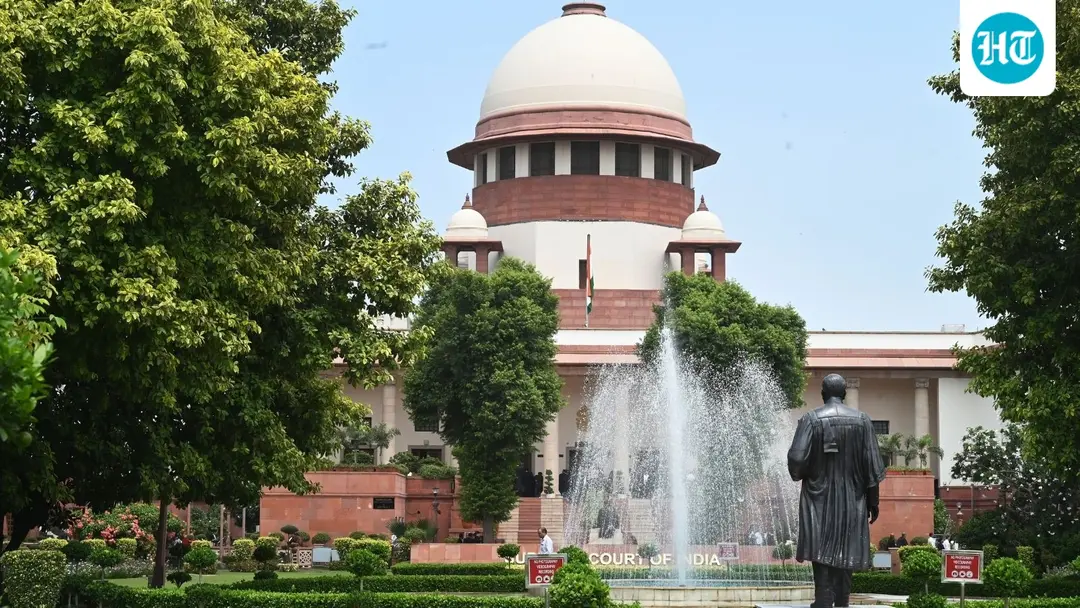
Supreme Court plans NTA office visit over exam paper leaks
The Supreme Court said on Friday it plans to visit the National Testing Agency office to assess facilities and manpower provided under reforms following repeated examination irregularities. The Centre said the high-powered task force headed by Nandan Nilekani is likely to submit its report by month-end. A bench of justices PS Narasimha and Alok Aradhe directed a DoPT joint secretary assisting the task force to file an affidavit on progress, and posted the matter after three weeks. It said lessons from the past appeared not to have been learnt.
Source
Hindustan Times — India · read the original report ↗
Desk check · compared with the source
What the desk checked (5)
- A bench of justices PS Narasimha and Alok Aradhe said it plans to visit the NTA office to inspect facilities and manpower. — Attributed in source to the bench, with direct quotes; internally consistent.
- The high-powered task force headed by Nandan Nilekani is likely to submit its report by the end of this month. — Attributed to Solicitor General Tushar Mehta appearing for the Centre.
- Permanent space was provided for NTA and senior officers at Minto Road with security by 39 CISF personnel. — Figure appears in source, attributed to Mehta; not independently verifiable here.
- The petitions followed a paper leak in the NEET-UG 2026 examination. — Stated in source as context for the hearing; no separate sourcing given.
- The court directed the DoPT joint secretary assisting the HPTF to file an affidavit on progress and posted the matter after three weeks. — Supported by a direct quote from the bench in the source.
Analysts’ view opinion
The Supreme Court's stated plan to walk into the NTA office is more than a judicial aside — it is a signal that the Centre's assurances on exam reform will be weighed on the ground, not on paper. The bench's remark that lessons from the past appear not to have been learnt, with the 2024 Radhakrishnan Committee report still the only document on the table, is a politically awkward mark for the government. That is precisely why the Centre is foregrounding the Nilekani task force report, the permanent office, CISF security and specialist recruitment.
- With court monitoring continuing, the initiative on exam reform currently looks more judicial than governmental.
- Putting a widely respected name like Nandan Nilekani in front buys the government credibility, but implementation after the report lands remains squarely the Centre's burden.
- The petitioners' point that civil servants now occupy senior posts while the Radhakrishnan panel wanted a domain expert-led board revives the familiar bureaucrats-versus-experts argument.
- NEET aspirants and their families are among the most politically sensitive constituencies nationwide, giving the opposition an obvious youth-and-accountability line of attack.
- The three-week adjournment plus the affidavit direction reads as a deliberate device to keep the government tied to dates and deliverables.
What to watch — Watch whether the Nilekani task force actually reports by month-end, what the DoPT affidavit concedes on progress, and whether the Centre commits to a timeline for shifting NEET to computer-based testing.
The story does not establish when or how the court visit will happen, what the task force will recommend, or how any political party has reacted.
Deep dive
Research brief · 8 facts · 5 dates · exam-readyThe brief
Context
The National Testing Agency (NTA), which conducts major national entrance examinations, has faced repeated allegations of irregularities, beginning with the NEET-UG controversy of 2024 that led to a reform panel headed by former ISRO chairman K Radhakrishnan. A fresh paper leak in the NEET-UG 2026 examination triggered a batch of petitions in the Supreme Court seeking structural reforms in the agency. The Centre has since constituted a high-powered task force (HPTF) headed by Infosys co-founder Nandan Nilekani. Hearing the petitions, a Supreme Court bench said it may itself visit the NTA office to verify whether the promised facilities, manpower and systems are actually in place.
Key facts
- A bench of justices PS Narasimha and Alok Aradhe said it plans to visit the NTA office to assess facilities and manpower provided under post-irregularity reforms.
- Solicitor General Tushar Mehta told the court the Nandan Nilekani-headed high-powered task force (HPTF) is likely to submit its report by the end of this month.
- The court directed the joint secretary of the Department of Personnel and Training (DoPT), assisting the HPTF secretary, to file an affidavit on the committee's progress.
- The matter was posted for hearing after three weeks.
- A permanent space has been provided for the NTA and its senior officers at Minto Road, with security by 39 CISF personnel.
- Recruitment is underway for domain specialists from the open market in technology, HR, assessment R&D, test centres, candidate experience, information security, test security and vigilance.
- The petitions arise from the paper leak in the NEET-UG 2026 examination; the court said lessons from the past appear not to have been learnt.
- Petitioners sought a fixed timeline to shift NEET from pen-and-paper to computer-based testing, noting NEET-2027 is only a few months away.
Timeline
- 2024After a similar NEET examination controversy, a panel headed by former ISRO chairman K Radhakrishnan suggests comprehensive reforms in the NTA.
- NEET-UG 2026A paper leak in the examination triggers a batch of petitions in the Supreme Court seeking NTA reforms.
- Friday (date of hearing)Supreme Court says it plans to visit the NTA office; directs DoPT joint secretary to file an affidavit on HPTF progress; posts matter after three weeks.
- End of this month (as stated by Centre)Nilekani-headed HPTF expected to submit its report.
- NEET-2027Examination due in a few months; petitioners want a fixed timeline for transition to computer-based testing before it.
Who has a stake
- National Testing Agency (NTA) — Its credibility, permanent infrastructure at Minto Road, staffing with domain specialists and data security are under judicial scrutiny.
- Supreme Court bench (justices PS Narasimha and Alok Aradhe) — Monitoring whether reform recommendations are institutionalised and implemented, not merely recommended.
- High-powered task force headed by Nandan Nilekani — Must deliver a report and recommendations that the court says it will ensure are implemented.
- Department of Personnel and Training (DoPT) — Its joint secretary assists the HPTF and must file an affidavit on progress before the court.
- Union government / Solicitor General Tushar Mehta — Defending the reform steps taken and showing institutionalisation of the Radhakrishnan committee recommendations.
- Federation of All India Medical Association and United Doctors Front (advocates Tanvi Dubey, Charu Mathur) — Petitioners pressing for a Governing Board headed by a domain expert and a timeline for computer-based NEET.
- NEET aspirants — Exam integrity, security of data and the mode of testing for NEET-2027 directly affect their careers.
Why it matters
Repeated leaks in high-stakes national entrance tests affect lakhs of aspirants and the credibility of India's examination system, which is why the Supreme Court is insisting on institutionalisation rather than one-off fixes. The court's remark that lessons from 2024 appear not to have been learnt underlines that the Radhakrishnan committee report remains largely unimplemented. The outcome will shape NTA's governance structure, staffing model, data security and the possible shift of NEET to computer-based testing.
UPSC angle
Prelims pointers
- National Testing Agency (NTA) conducts national entrance examinations including NEET-UG and JEE Main.
- K Radhakrishnan, former ISRO chairman, headed the 2024 panel that recommended comprehensive NTA reforms.
- The high-powered task force (HPTF) on examination reforms is headed by Infosys co-founder Nandan Nilekani.
- Supreme Court bench in the case: justices PS Narasimha and Alok Aradhe; Centre represented by Solicitor General Tushar Mehta.
- NTA's permanent office space is at Minto Road, secured by 39 CISF personnel.
- Radhakrishnan panel had proposed a Governing Board for NTA headed by a domain expert.
Mains framing
Recurrent paper leaks in national entrance examinations, from the NEET-UG controversy of 2024 to the NEET-UG 2026 leak, point to a governance deficit in the National Testing Agency rather than isolated lapses: the Supreme Court itself observed that lessons from the past appear not to have been learnt and that the K Radhakrishnan committee report remains, as on date, all that exists by way of reform blueprint without translation into implementation. The court's emphasis on "institutionalisation" identifies the core issue: permanency of premises and staff, recruitment of domain specialists in technology, assessment R&D, information security and vigilance, inter-departmental coordination and data security must be embedded in structures rather than left to administrative discretion. Petitioners' demand for a Governing Board headed by a domain expert, instead of civil servants in senior positions, raises the question of whether technical bodies should be led by subject expertise; their plea for a fixed timeline to shift NEET from pen-and-paper to computer-based testing before NEET-2027 raises the trade-off between speed of reform and readiness of infrastructure. The way forward, as the court frames it, lies in judicially monitored implementation: an affidavit on HPTF progress from the DoPT joint secretary, an assurance that the Nilekani panel's recommendations will be implemented, and verification on the ground of facilities and manpower.
Key terms
- National Testing Agency (NTA)
- The agency that conducts major national entrance examinations such as NEET-UG and JEE Main, now under Supreme Court scrutiny over paper leaks.
- High-powered task force (HPTF)
- Committee headed by Nandan Nilekani examining examination reforms; expected to submit its report by month-end per the Centre.
- K Radhakrishnan Committee
- Panel headed by the former ISRO chairman that suggested comprehensive NTA reforms after the 2024 examination controversy.
- Department of Personnel and Training (DoPT)
- Central department whose joint secretary is assisting the HPTF and was directed to file a progress affidavit.
- Computer-based testing (CBT)
- Mode of examination that petitioners want NEET to shift to from pen-and-paper, with a fixed transition timeline.
- CISF
- Central Industrial Security Force; 39 of its personnel provide security at NTA's permanent Minto Road premises.
Practice questions
- Repeated examination paper leaks reflect an institutional rather than an individual failure. Examine in the light of judicial monitoring of reforms in the National Testing Agency.
- Should technical regulatory and examination bodies be headed by domain experts rather than civil servants? Discuss with reference to the proposed Governing Board for the NTA.
- Evaluate the feasibility and risks of shifting high-stakes examinations like NEET from pen-and-paper to computer-based testing within a fixed timeline.
Grounded only in the source report — figures and dates are the source's, not inferred.