
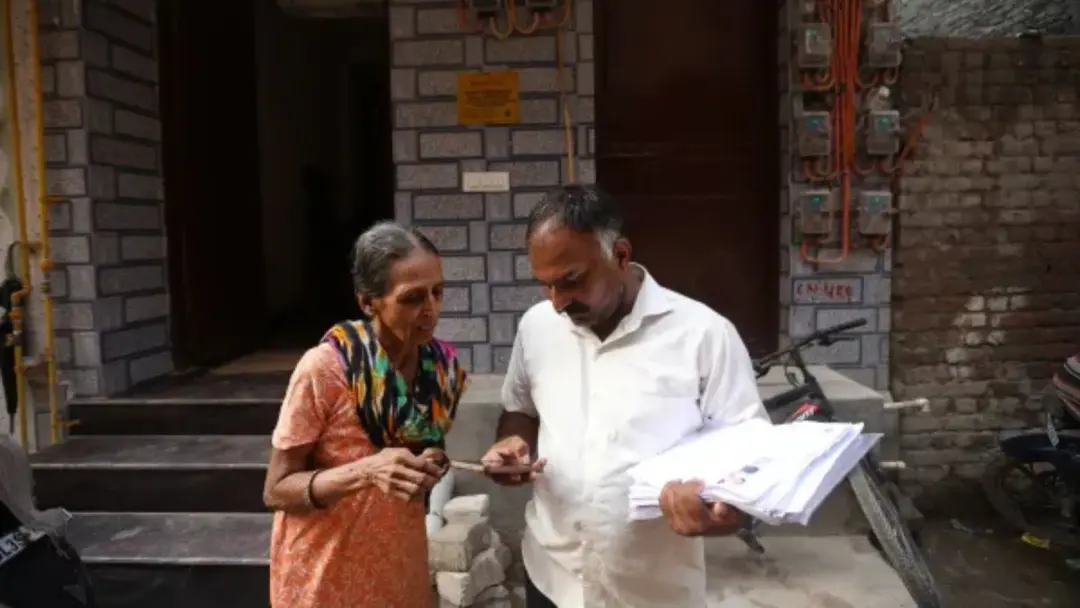
SC says Delhi SIR notices appear mechanical, seeks ECI response
The Supreme Court on Tuesday said notices to "doubtful" voters in Delhi's Special Intensive Revision (SIR) of electoral rolls appear to have been issued "mechanically" and were probably machine-generated. Justice Joymalya Bagchi asked the Election Commission to examine whether additional filters were needed. The bench, led by CJI Surya Kant, issued notice to the ECI and sought a status report. Advocate Prashant Bhushan said over 33 lakh voters got notices and over 47 lakh names were deleted from draft rolls covering more than 97 lakh voters.
Source
Indian Express — Cities · read the original report ↗
Desk check · compared with the source
What the desk checked (5)
- Supreme Court bench said notices to 'doubtful' voters appear 'mechanical' and asked ECI to examine additional filters — Attributed in source to Justice Joymalya Bagchi with direct quote; bench composition named (CJI Surya Kant, Justice V Mohana)
- Notices issued to more than 33 lakh voters, including for 'logical discrepancy' — Attributed in source to advocate Prashant Bhushan for the petitioners; not independently confirmed by ECI in text
- More than 47 lakh names deleted from draft rolls in an exercise covering over 97 lakh voters — Figures appear in source without explicit attribution to a named official
- 14,000 BLOs and 1,200 EROs deployed for Delhi SIR — Attributed in source to senior advocate D S Naidu appearing for the ECI
- ECI willing to extend the October 29 deadline if necessary — Attributed in source to ECI counsel Naidu in court
Analysts’ view opinion
The Supreme Court's remarks hand the opposition's critique of Delhi's SIR a measure of judicial validation — "mechanical notices" is the kind of phrase that travels quickly from a courtroom to a campaign platform. But the bench did not halt the exercise: it sought a status report and suggested filters, clearer wording and confidence-building steps, making this a sharp nudge to the ECI rather than a verdict on the process. The fact that notices have reached or may reach figures like Advani, Jaishankar, Dhankhar and Sisodia reframes the issue as a non-partisan systems failure, which arguably increases pressure on the poll body.
- The petitioners' figures — over 47 lakh deletions and 33 lakh notices out of more than 97 lakh voters — are large enough, if borne out, to matter politically in Delhi.
- Judicial scrutiny lets opposition voices claim vindication, though the court has not found any deliberate bias.
- Notices touching prominent figures associated with the ruling establishment also give the government a defence: this looks like a technical flaw, not targeted disenfranchisement.
- The ECI's stated willingness to extend the deadline again signals an accommodative posture in court, which may defuse immediate confrontation while leaving capacity questions open.
- Running the exercise with 14,000 BLOs and 1,200 EROs in a high-migration city puts ground-level administrative capacity at the heart of the dispute.
What to watch — Watch how the ECI's status report defines "logical discrepancy" and discloses deleted names — and whether any further deadline extension is claimed as a win by the petitioners and the opposition.
The story does not independently verify the deletion and notice figures, does not establish which party gains or loses from them, and records no court finding of intentional bias in the SIR.
Deep dive
Research brief · 8 facts · 4 dates · exam-readyThe brief
Context
The Election Commission of India is conducting a Special Intensive Revision (SIR) of electoral rolls in Delhi, during which lakhs of names have been deleted from draft rolls and lakhs of voters served notices, many for "logical discrepancy". Activists Anjali Bhardwaj and Amrita Johri petitioned the Supreme Court, arguing the ECI and the Delhi Chief Electoral Officer had not adequately disclosed which names were deleted, who was issued notices and on what grounds. A three-judge bench headed by CJI Surya Kant heard the plea on Tuesday, told the ECI the notices appeared "mechanical" and machine-generated, issued notice to the poll body and sought a status report.
Key facts
- Justice Joymalya Bagchi said notices to doubtful voters were "almost mechanical" and "in all probability... machine-generated", asking the ECI to examine whether additional filters are necessary before notices.
- The three-judge bench comprised CJI Surya Kant, Justice Joymalya Bagchi and Justice V Mohana; it issued notice to the ECI and sought a status report.
- Advocate Prashant Bhushan said notices were issued to more than 33 lakh voters, including for "logical discrepancy".
- More than 47 lakh names have already been deleted from the draft electoral rolls in Delhi, in an exercise covering more than 97 lakh voters.
- ECI counsel D S Naidu said 14,000 Booth Level Officers (BLOs) and 1,200 Electoral Registration Officers (EROs) have been deployed for the Delhi SIR.
- Naidu said the 12 documents referred to in the notices were not exhaustive, and that the ECI is willing to extend the October 29 deadline if necessary.
- Prominent voters who have received or are likely to receive notices include L K Advani, S Jaishankar, Jagdeep Dhankhar, Election Commissioner S S Sandhu, Foreign Secretary Vikram Misri, Manish Sisodia, Najeeb Jung, Arvind Panagariya, SEBI Chairman Tuhin Kanta Pandey, CBI Director Praveen Sood and Ka
- The CJI suggested the ECI prepare and circulate standard responses to the 15-20 types of queries electors raise, and provide orientation to boost electors' confidence.
Timeline
- May 2019CJI Surya Kant, citing his own case as an example, shifted to Delhi after his elevation, having earlier voted in Chandigarh.
- OngoingSIR of electoral rolls under way in Delhi; over 47 lakh names deleted from draft rolls and over 33 lakh voters issued notices.
- Tuesday (date of hearing)Supreme Court bench hears the plea by Anjali Bhardwaj and Amrita Johri, calls notices "mechanical", issues notice to ECI and seeks a status report.
- October 29Existing SIR deadline; ECI counsel says the poll body is willing to extend it if necessary.
Who has a stake
- Election Commission of India — Must defend the SIR process, clarify "logical discrepancy", refine notice-generation filters and file a status report before the Supreme Court.
- Supreme Court (CJI Surya Kant, Justices Bagchi and Mohana) — Examining whether the revision process is fair, transparent and intelligible to electors.
- Delhi electors (over 97 lakh covered) — Over 47 lakh names deleted and over 33 lakh notices issued; risk of disenfranchisement and burden of producing documents.
- Petitioners Anjali Bhardwaj and Amrita Johri — Seek disclosure of deleted names, notice recipients and the reasons for deletions and discrepancies.
- Booth Level Officers and EROs (14,000 and 1,200) — Field-level machinery responsible for verification; court noted BLOs were sometimes unavailable to electors.
- Delhi Chief Electoral Officer — Accused in the petition of inadequate disclosure of deletions and notice reasons.
Why it matters
The right to vote depends on an accurate electoral roll, and the scale in Delhi — over 47 lakh deletions and over 33 lakh notices out of more than 97 lakh voters — means errors can affect lakhs of citizens, including senior public figures. The Court's observation that notices look machine-generated and that "logical discrepancy" is not explained goes to the heart of procedural fairness: an elector cannot answer a notice she does not understand. It also tests whether field machinery like BLOs can deliver door-to-door verification in a city with a large migrant population.
UPSC angle
Prelims pointers
- Special Intensive Revision (SIR) of electoral rolls in Delhi covers more than 97 lakh voters; over 47 lakh names deleted from draft rolls.
- Over 33 lakh Delhi voters received notices, including on the ground of "logical discrepancy".
- ECI told the SC that 14,000 BLOs and 1,200 Electoral Registration Officers were deployed for Delhi's SIR.
- The SC bench hearing the plea: CJI Surya Kant, Justice Joymalya Bagchi and Justice V Mohana.
- Notices referred to 12 documents, which the ECI said were not an exhaustive list.
- The SIR deadline in question was October 29; the ECI said it was willing to extend it.
Mains framing
The Delhi SIR controversy illustrates the tension between the Election Commission's mandate to purify electoral rolls and the citizen's procedural right to a fair, intelligible process. The immediate trigger is scale and opacity: over 47 lakh deletions and 33 lakh notices in an exercise covering over 97 lakh electors, with the Supreme Court observing that notices appear "almost mechanical" and likely machine-generated, and that the ground of "logical discrepancy" is not explained to the elector. Structural causes flagged in court include Delhi's large migrant population, which creates genuine duplicate-entry risks the CJI said verification can address, alongside field-level gaps such as BLOs not being available and practical difficulties of door-to-door visits in multi-storey buildings without lifts. The implication is a double risk: wrongful deletion of genuine voters and loss of confidence in the roll, as notices reaching figures like a former deputy prime minister, a sitting Election Commissioner and the Foreign Secretary suggest algorithmic over-inclusion. The way forward suggested within the hearing itself is refinement rather than abandonment: additional filters before notices are generated, clearer specification of what the elector must clarify, a non-exhaustive but usable document list, stationing BLOs at ward offices so electors can approach them, standard responses to the 15-20 recurring queries, orientation for electors, disclosure of deletions and reasons, and extension of deadlines where needed.
Key terms
- Special Intensive Revision (SIR)
- An intensive exercise by the Election Commission to revise electoral rolls, under way in Delhi, involving enumeration forms, deletions and notices to doubtful voters.
- Logical discrepancy
- A ground cited in SIR notices to Delhi voters; the Supreme Court asked the ECI to clarify what it means and what the elector must explain.
- Booth Level Officer (BLO)
- Field-level official who verifies electors and conducts door-to-door checks; 14,000 deployed for Delhi's SIR per the ECI.
- Electoral Registration Officer (ERO)
- Officer responsible for preparation and revision of the electoral roll of a constituency; 1,200 deployed in Delhi's SIR.
- Draft electoral roll
- The provisional roll published during revision, from which over 47 lakh names were deleted in Delhi, open to claims and objections.
- Enumeration form
- Form filled by electors during the SIR with proof of age and residence; petitioners questioned why further documents are demanded after it.
Practice questions
- Critically examine the procedural safeguards required when electoral rolls are revised at scale, in light of the Supreme Court's observation that SIR notices in Delhi appeared "mechanical" and machine-generated.
- "Purity of the electoral roll and the right to vote must be balanced." Discuss with reference to the deletion of over 47 lakh names during Delhi's Special Intensive Revision.
- What role do Booth Level Officers and Electoral Registration Officers play in electoral roll revision, and what administrative reforms could reduce wrongful deletions in urban areas with high migration?
Grounded only in the source report — figures and dates are the source's, not inferred.