
Gadkari says carmakers compromise safety on India-spec models
Union Road Transport and Highways Minister Nitin Gadkari has said some carmakers compromise on safety and structural integrity in their India-spec cars while building the same models to international standards for foreign markets. He questioned why safety was not taken seriously in a country reporting the maximum road crashes and deaths. The ministry has issued a draft notification mandating six airbags from October 2022 for cars carrying up to eight occupants. Some carmakers, including Maruti, oppose the Bharat NCAP crash test.
Source
Road Transport — Nitin Gadkari · read the original report ↗
Desk check · some claims need care
What the desk checked (5)
- MoRTH issued a draft notification mandating six airbags from October 2022 for cars carrying up to eight occupants. — Attributed to the Ministry of Road Transport and Highways in the source; notification text not quoted.
- Gadkari said some companies make cars in India that are not up to international standard while making the same model to international standard for foreign markets. — Direct quote attributed to the minister in the source.
- Some carmakers, including Maruti, oppose the government's Bharat NCAP crash test. — Stated by the source without naming an official or document as the origin of the claim.
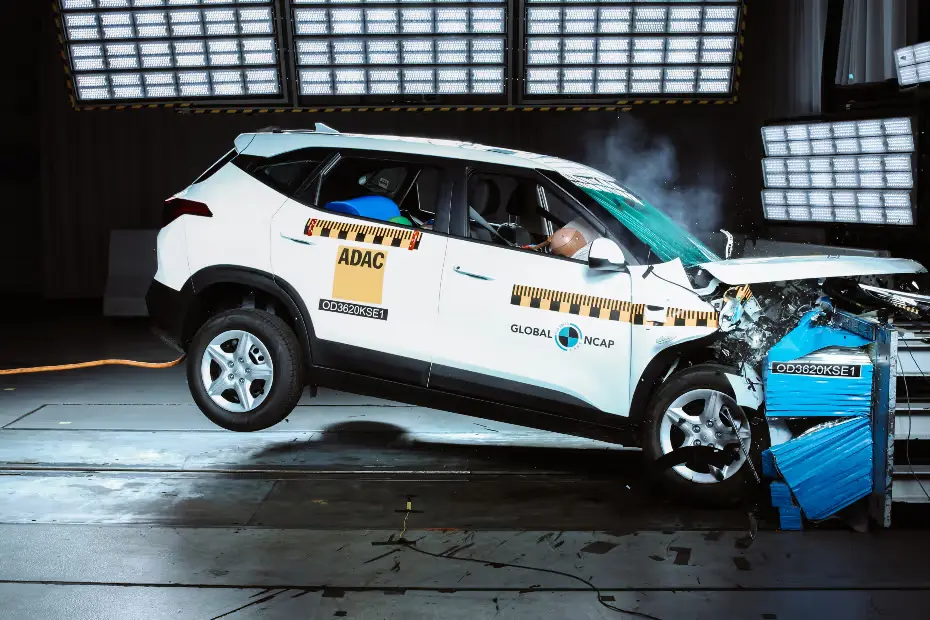
- The India-spec Kia Seltos has a 3-star Global NCAP rating while the Australian model scored 5 stars in ANCAP. — Figures appear in the source; ratings are cited to Global NCAP and ANCAP but no test dates are given.
- The Kia Carens was rated unstable for structural integrity despite having six airbags. — Presented in the source as a recent crash test result; the testing agency is not specified for this case.
Analysts’ view opinion
This is as much political positioning as it is vehicle-safety policy. By framing the issue as "why should an Indian passenger get second-class standards?", Gadkari has pushed the objecting carmakers onto the weakest possible ground in a public argument — cost. With big players including Maruti resisting Bharat NCAP, this is turning into a contest over who holds regulatory authority: the ministry or the industry.
- In a country reporting very high road crash deaths, a "safety versus price" debate hands the government the moral high ground almost by default.
- Naming and shaming brands publicly is a deliberate tactic — it layers public opinion pressure on top of regulatory pressure.
- The industry's argument that re-engineering will raise prices cannot be dismissed outright, since it lands on the most price-sensitive small-car buyers.
- Bringing crash-test ratings in-house through Bharat NCAP shifts the influence of "safety certification" from international bodies towards the government.
- Because structural integrity can still rate poorly even with six airbags, the government will have to answer the charge that the mandate is a visible fix rather than a complete one.
What to watch — Watch when and in what diluted or intact form the draft notification is finalised, and whether firms like Maruti keep up public opposition or quietly fall in line.
The story does not establish the full list of objecting companies, whether the deadline will be extended, or any credible estimate of the actual price impact.
Deep dive
Research brief · 8 facts · 5 dates · exam-readyThe brief
Context
The Ministry of Road Transport and Highways (MoRTH) issued a draft notification earlier this year mandating six airbags from October 2022 in cars carrying up to eight occupants, a move some carmakers have objected to. Union Minister Nitin Gadkari has now accused some brands of building India-spec cars that are not up to international standard while making the same models compliant with international norms for foreign markets. The comments come as the government moves to introduce a domestic crash-test programme, Bharat NCAP, which some carmakers including Maruti oppose.
Key facts
- MoRTH issued a draft notification earlier this year mandating six airbags from October 2022 for cars carrying up to eight occupants.
- Gadkari said some companies make cars in India that are not up to international standard while making the same model to international standard for foreign markets.
- Gadkari asked why safety is not taken seriously when India reports the maximum road crashes and deaths.
- The six-airbag mandate covers even 'economic models', as per Gadkari.
- Some manufacturers argued six airbags should not be mandatory as it would require re-engineering and raise prices.
- The Bharat NCAP crash test is being opposed by some carmakers, including India's largest, Maruti.
- The India-spec Kia Seltos has a 3-star Global NCAP rating; the Australian model scored a perfect 5 stars in the ANCAP crash test.
- The Kia Carens' structural integrity was rated unstable in a recent crash test despite having the requisite six airbags.
Timeline
- Earlier this year (year not stated in the source)MoRTH issues draft notification mandating six airbags for cars carrying up to eight occupants.
- Following the draft notificationA few carmakers express concern; some say the mandate would force re-engineering and raise prices.
- Around the same periodGovernment decides to introduce the Bharat NCAP crash test; some carmakers, including Maruti, oppose it.
- Recent (date not stated in the source)Kia Carens crash test rates its structural integrity unstable despite six airbags.
- October 2022Date from which the draft notification proposes six airbags to become mandatory.
Who has a stake
- Ministry of Road Transport and Highways (MoRTH) — Issued the six-airbag draft notification and is introducing Bharat NCAP to test vehicle body structure and push safer models.
- Nitin Gadkari, Union Minister for Road Transport & Highways — Publicly pressing carmakers on safety and structural integrity of India-spec cars.
- Carmakers, including Maruti — Face re-engineering costs from the airbag mandate and scrutiny under Bharat NCAP; some oppose the crash test.
- Car buyers and road users in India — Stand to get better safety in India-spec models; currently exposed to weaker equipment and body shell integrity.
- Global NCAP / ANCAP — Crash-test bodies whose divergent ratings (Seltos 3-star vs 5-star) expose the India-versus-export specification gap.
Why it matters
India reports the maximum road crashes and deaths, yet several India-spec models are sold with less safety equipment and weaker body shells than their export versions. The six-airbag mandate and Bharat NCAP together shift the debate from add-on features to structural crashworthiness, which is what determines survival in a crash. Industry resistance on cost grounds will decide how quickly Indian buyers get parity with international safety standards.
UPSC angle
Prelims pointers
- MoRTH draft notification: six airbags mandatory from October 2022 for cars carrying up to eight occupants.
- Bharat NCAP is the government's proposed domestic crash-test programme; opposed by some carmakers including Maruti.
- Global NCAP rated the India-spec Kia Seltos 3 stars; ANCAP rated the Australian model 5 stars.
- Kia Carens was rated unstable on structural integrity despite having six airbags.
- Nitin Gadkari is Union Minister of Road Transport & Highways.
- Body shell / structural integrity, not airbag count alone, determines crash performance.
Mains framing
India's road safety deficit is compounded by a two-tier manufacturing practice in which the same model is built to international standards for export markets but to weaker specifications for domestic buyers, as reflected in the India-spec Kia Seltos's 3-star Global NCAP rating against the Australian version's 5-star ANCAP score. The government's response has two legs: a draft notification mandating six airbags from October 2022 for cars carrying up to eight occupants, and the introduction of Bharat NCAP to test vehicle body structure. Industry resistance rests on cost, with some manufacturers arguing that mandatory six airbags would require re-engineering and raise prices. But the Kia Carens result, where structural integrity was rated unstable despite six airbags, shows that passive restraints cannot substitute for a stable body shell. The way forward, therefore, is to pair the airbag mandate with a credible, structure-focused Bharat NCAP rating regime so that consumer information and regulation together compel carmakers to bring India-spec body shell integrity in line with their international counterparts, in a country that Gadkari notes reports the maximum road crashes and deaths.
Key terms
- MoRTH
- Ministry of Road Transport and Highways, which issued the draft notification on six airbags.
- Bharat NCAP
- Government's proposed Indian crash-test programme that will test vehicle body structure; opposed by some carmakers.
- Global NCAP
- International crash-test assessment programme; rated the India-spec Kia Seltos 3 stars.
- ANCAP
- Australian crash-test programme; awarded the Australian Kia Seltos a perfect 5-star score.
- Body shell / structural integrity
- Strength of a car's structure in a crash; rated unstable for the Kia Carens despite six airbags.
- India-spec model
- Version of a car sold in India, sometimes with less safety equipment than its international counterpart.
Practice questions
- Critically examine the argument that mandating six airbags alone cannot improve occupant safety in India, using the evidence cited in the story.
- Discuss how a domestic crash-test rating regime such as Bharat NCAP can change carmakers' incentives in the Indian market.
- Why do India-spec models sometimes score lower on crash tests than the same models sold abroad, and what regulatory response has the government proposed?
Grounded only in the source report — figures and dates are the source's, not inferred.