
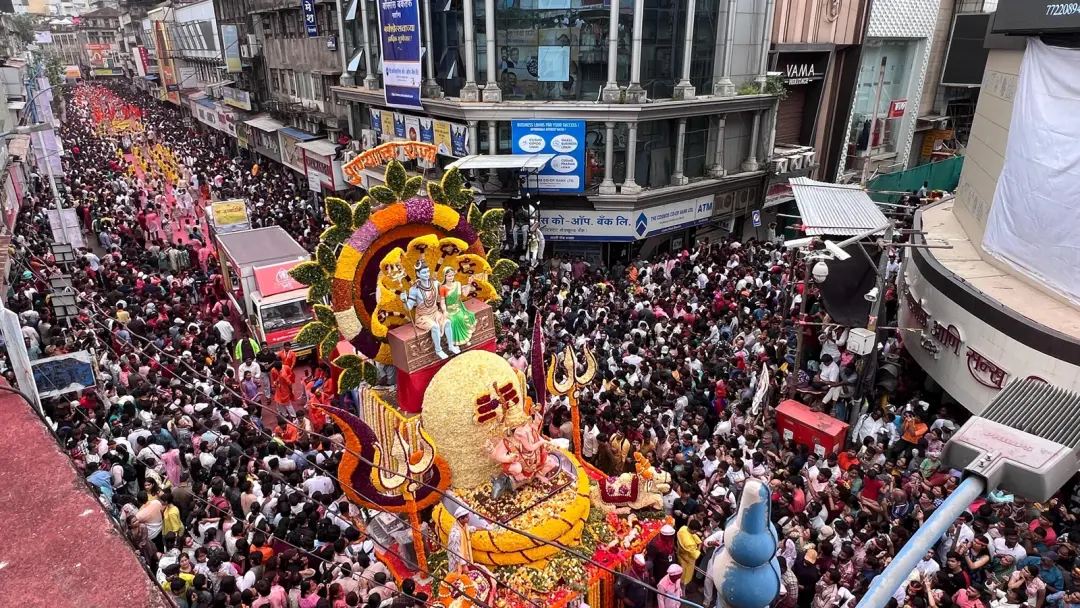
71 noise pollution cases in Pune region; high-intensity gear banned
Pune police have registered 21 cases and Pimpri-Chinchwad police 50 cases for violations of noise pollution norms during the Ganesh festival, taking the total to 71. Pune Police Commissioner Amitesh Kumar said 120 teams with decibel meters have been deployed and there is a complete ban on pressure-mid sound systems, plasma lights, high-intensity laser lights and 'tol' bells. Mandals are allowed two Dhol-Tasha troupes, each with 15 minutes per intersection.
Source
Indian Express — Cities · read the original report ↗
Desk check · compared with the source
What the desk checked (5)
- Pune and Pimpri-Chinchwad police have together registered 71 noise pollution cases during the Ganesh festival. — Figures appear in source (21 + 50) and are internally consistent; attributed to the two police commissioners.
- 120 teams with decibel meters have been deployed to monitor sound levels. — Attributed to Pune Police Commissioner Amitesh Kumar in a direct quote.
- A complete ban applies to pressure-mid sound systems, plasma lights, high-intensity laser lights and 'tol' bells. — Attributed to Commissioner Amitesh Kumar; no copy of the order cited in the source.
- Each Dhol-Tasha troupe gets a maximum 15 minutes per intersection (10 for performance, five for preparation), with mandals limited to two troupes. — Attributed to Amitesh Kumar; mandals' agreement described as an assurance, not a formal order.
- Activist Vidyanand Bapat has been seeking stricter enforcement of noise limits. — Named in source without a direct quote; no independent confirmation possible.
Analysts’ view opinion
The 71 noise-pollution cases across Pune and Pimpri-Chinchwad are not just a policing story — they are an exercise in managing one of Maharashtra's most politically delicate balances, tradition versus regulation. By holding meetings with Ganesh mandals in advance and securing their agreement on limits, bans and the 15-minute rule, the police have opted for consent-building over confrontation. With local-body politics never far away in Pune, this is an uncomfortable subject for every party with ties to mandal networks, which is why public political reaction is likely to stay carefully worded.
- Fifty cases in Pimpri-Chinchwad against 21 in Pune city is a gap within the same festival that could itself become a talking point about how evenly enforcement is applied.
- Pre-festival meetings and the reported agreement to cut Dhol-Tasha troupes from three to two per mandal show a negotiated, politically cautious approach rather than pure enforcement.
- Ganesh mandals are powerful local social and political networks in Pune, so no party wants to be labelled as acting against tradition.
- Publicising 120 decibel-meter teams and exact case numbers is an accountability display aimed at courts, activists and public opinion demanding visible action.
- Police face pressure from both sides — activists such as Vidyanand Bapat pressing for stricter limits, and festival organisers protecting scale and custom.
What to watch — Watch how sharply the case count rises after the immersion processions, and whether political leaders side with the mandals or publicly back the enforcement.
The story does not establish how any party or leader has responded, who the cases were filed against, or whether 71 is high or low compared with previous years.
Deep dive
Research brief · 8 facts · 4 dates · exam-readyThe brief
Context
Noise pollution during Pune's Ganesh festival — especially during immersion processions and Dhol-Tasha performances — has been a recurring concern. This year, Pune city and Pimpri-Chinchwad police have together registered 71 cases for violations of noise pollution norms so far. Police have also reiterated a complete ban on high-intensity sound and lighting equipment such as 'tol' bells, plasma lights, pressure-mid sound systems and high-intensity laser lights, and have negotiated limits on the number and duration of Dhol-Tasha troupes with Ganesh mandals.
Key facts
- Pune city police registered 21 cases and Pimpri-Chinchwad police 50 cases for noise pollution violations during the Ganesh festival — a total of 71 cases so far.
- Pune Police have deployed 120 teams equipped with decibel meters to monitor sound levels.
- Complete ban during the festival on high-volume bells locally called 'tol', plasma lights (high-intensity flashing lights), pressure-mid sound systems and high-intensity laser lights.
- Ganesh mandals have assured police they will not have more than two Dhol-Tasha troupes each; some mandals traditionally had three and are reducing to two.
- Each Dhol-Tasha troupe is allowed a maximum of 15 minutes at every road intersection — 10 minutes for performance and 5 minutes for preparation.
- Police have not imposed a limit on the number of performers per troupe, but will enforce the time restriction and prescribed decibel limits.
- Pune Police Commissioner Amitesh Kumar announced the measures on Wednesday (date not otherwise stated in the source).
- Pimpri-Chinchwad Police Commissioner Vinoykumar Choubey said meetings with mandal representatives before and during the festival drew a positive response from many mandals.
Timeline
- Before the Ganesh festivalSenior Pimpri-Chinchwad police officers hold meetings with Ganesh mandal representatives to ensure compliance with noise pollution norms.
- During the festivalPune Police deploy 120 teams with decibel meters; both commissionerates monitor and register cases against violators.
- Wednesday (as stated in the source)Pune Police Commissioner Amitesh Kumar announces 21 cases in Pune, the ban on high-intensity sound and lighting gear, and Dhol-Tasha limits.
- Same periodPimpri-Chinchwad Commissioner Vinoykumar Choubey confirms 50 cases in his jurisdiction, taking the combined total to 71.
Who has a stake
- Pune City Police (Commissioner Amitesh Kumar) — Enforcing decibel limits with 120 decibel-meter teams; registered 21 cases and negotiated Dhol-Tasha curbs with mandals.
- Pimpri-Chinchwad Police (Commissioner Vinoykumar Choubey) — Monitoring violations in its jurisdiction; registered 50 cases despite pre-festival outreach to mandals.
- Ganesh mandals — Face restrictions on troupe numbers, performance time and equipment; risk of cases if norms are breached.
- Dhol-Tasha troupes — Capped at two per mandal and 15 minutes per intersection, with decibel limits applying to performances.
- Activist Vidyanand Bapat — Has been raising noise pollution concerns during the festival and demanding stricter enforcement of prescribed limits.
- Residents along procession routes — Exposed to excessive noise and disruptive or potentially harmful lighting during immersion processions.
Why it matters
Ganesh festival processions in Pune and Pimpri-Chinchwad are among the largest public celebrations in Maharashtra, and the 71 cases show how hard it is to reconcile mass festivity with legal noise limits and public health. The response — decibel-meter teams, equipment bans and negotiated time caps on Dhol-Tasha performances — is a test of whether enforcement plus dialogue with organisers can work better than prohibition alone.
UPSC angle
Prelims pointers
- Total noise pollution cases during the Ganesh festival: 71 — 21 in Pune city, 50 in Pimpri-Chinchwad.
- Pune Police deployed 120 teams with decibel meters to monitor festival sound levels.
- Banned gear: 'tol' (high-volume bells), plasma lights, pressure-mid sound systems, high-intensity laser lights.
- Dhol-Tasha norm: maximum two troupes per mandal; 15 minutes per intersection (10 performance + 5 preparation).
- Pune Police Commissioner: Amitesh Kumar; Pimpri-Chinchwad Police Commissioner: Vinoykumar Choubey.
- No cap imposed on the number of performers per Dhol-Tasha troupe.
Mains framing
Festival noise in Pune illustrates the tension between cultural expression and the state's duty to protect citizens from environmental harm. Scale (large mandals, multiple Dhol-Tasha troupes, long immersion processions) combines with high-intensity equipment — pressure-mid sound systems, 'tol' bells, plasma and laser lights — to push sound and light levels beyond prescribed limits, prompting 71 cases across the Pune and Pimpri-Chinchwad commissionerates. The official response blends deterrence (120 decibel-meter teams, registration of offences, a complete ban on specified equipment) with negotiation (pre-festival and mid-festival meetings that got mandals to cut troupes from three to two and accept a 15-minute cap per intersection). The gaps are visible too: no cap on performers per troupe, and violations continuing despite what police call a positive response from mandals. A sustainable way forward, as the story suggests, lies in sustained dialogue with organisers, transparent measurement, consistent action against repeat violators, and citizen-activist pressure of the kind exerted by Vidyanand Bapat, rather than enforcement confined to the festival week.
Key terms
- Decibel meter
- Instrument used to measure sound levels; 120 police teams were equipped with these to check breaches of prescribed limits.
- Pressure-mid sound system
- High-intensity sound equipment used in processions; completely banned during the Ganesh festival per the police order.
- 'Tol'
- Locally used term for high-volume bells, listed among the banned high-intensity sound equipment.
- Plasma lights
- High-intensity flashing lights banned during the festival as disruptive or potentially harmful.
- Dhol-Tasha troupe
- Traditional percussion group accompanying Ganesh processions; limited to two per mandal and 15 minutes per intersection.
- Immersion procession
- The visarjan march during which Ganesh idols are taken for immersion, when most noise and lighting violations occur.
Practice questions
- Discuss the challenges of enforcing noise pollution norms during large public festivals, using the Pune and Pimpri-Chinchwad experience during the Ganesh festival as an example.
- Do negotiated restrictions with community organisers work better than outright prohibition in controlling festival noise? Examine with reference to the caps on Dhol-Tasha troupes and performance time.
- Noise and light pollution are increasingly recognised as public health concerns. Evaluate the adequacy of measures such as decibel-meter monitoring teams and bans on high-intensity equipment.
Grounded only in the source report — figures and dates are the source's, not inferred.