
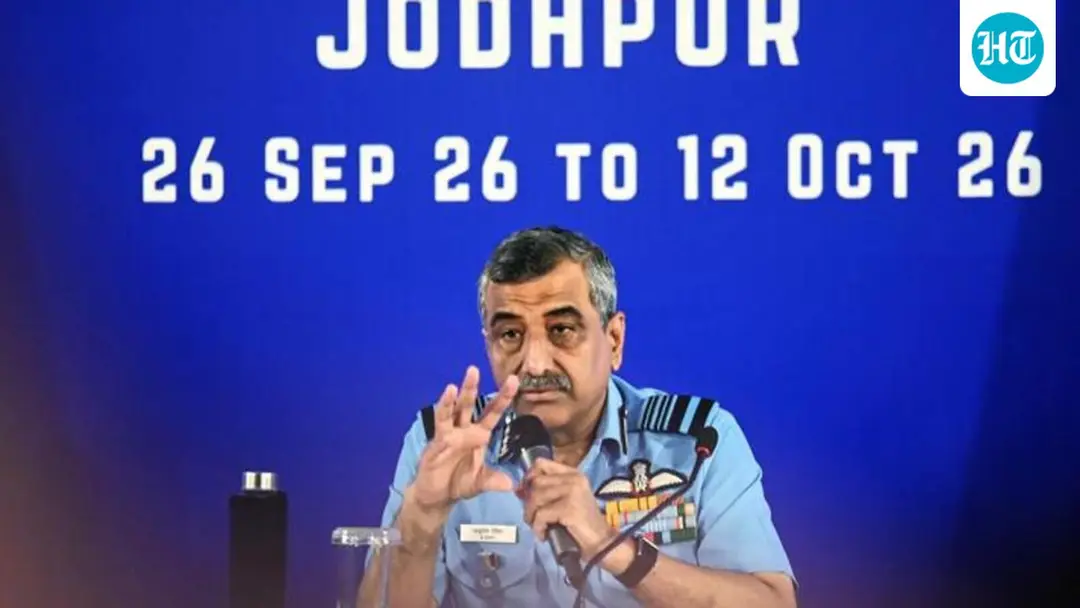
Dubai Tejas crash probe still under way, says IAF vice chief
The Indian Air Force's investigation into the fatal crash of a Tejas LCA Mk-1 at the Dubai Airshow last November is still in progress, IAF vice chief Air Marshal Ashutosh Dixit said, adding that the final technical analysis of some components is awaited. Wing Commander Namansh Syal was performing low-level aerobatic manoeuvres on the concluding day of the five-day airshow. In the first Tejas crash, near Jaisalmer in March 2024, the pilot ejected safely.
Source
Hindustan Times — India · read the original report ↗
Desk check · compared with the source
What the desk checked (5)
- The IAF probe into the Tejas crash at the Dubai Airshow is still under way pending final technical analysis of some components. — Directly attributed and quoted to IAF vice chief Air Marshal Ashutosh Dixit in the source.
- Wing Commander Namansh Syal was flying low-level aerobatic manoeuvres when the jet crashed on the concluding day of the five-day airshow. — Stated in the source without named attribution; consistent internally.
- The first Tejas crash occurred near Jaisalmer, Rajasthan, in March 2024 after the Bharat Shakti tri-services exercise; the pilot ejected safely. — Appears in source as background; no source cited.
- IAF has ordered 180 Mk-1A jets worth ₹1.1 lakh crore — 83 in February 2021 and 97 in September 2025 — with no deliveries so far. — Figures and dates appear in the source; delivery timelines are presented as expectations, not confirmed facts.
- IAF inducted its first LCA Mk-1 in July 2016 and operates two squadrons of 16-18 planes each. — Figure appears in source; unattributed.
Analysts’ view opinion
The IAF vice chief's statement that the Dubai Tejas crash probe is still awaiting final technical analysis is routine in procedural terms, but politically it leaves a vacuum — and in the absence of an established cause, questions about a jet that has become a symbol of indigenous defence manufacturing can drift into partisan debate. The fact that not a single aircraft from the ₹1.1 lakh crore, 180-jet Mk-1A orders has been delivered yet shifts the conversation quickly from the crash itself to the politically sharper issues of delivery delays and production capacity. That the crash happened at an international airshow adds a defence-export prestige dimension.
- An open-ended probe invites political interpretation before facts are settled; "investigation in progress" is the safest official line but also the least satisfying one publicly.
- For a government that has made indigenous weapons manufacturing a central narrative, any negative news around Tejas is read politically as much as technically.
- Zero deliveries so far against the 83-jet contract signed in 2021 gives critics a concrete peg for the "announcements outpacing delivery" argument.
- The distinction that both crashes involved early Mk-1 variants while the orders are for the more advanced Mk-1A is the strongest defence available to the government and manufacturer.
- With only two Mk-1 squadrons in service, the broader debate over fighter fleet strength and procurement pace could well move to Parliament.
What to watch — Watch when and how fully the investigation findings are made public, and whether the first Mk-1A delivery expected by year-end actually materialises.
The story establishes no cause for the crash — nothing here points to design, maintenance or any other factor — and it records no political reactions at all.
Deep dive
Research brief · 8 facts · 7 dates · exam-readyThe brief
Context
The Tejas Light Combat Aircraft (LCA) is India's indigenously developed single-engine fighter, inducted by the Indian Air Force from July 2016. A Tejas LCA Mk-1 crashed fatally at the Dubai Airshow in November, killing Wing Commander Namansh Syal, in only the second crash involving the type. IAF vice chief Air Marshal Ashutosh Dixit has now said the inquiry into that crash is still under way pending final technical analysis of some components. The crash comes as the IAF awaits deliveries of 180 more advanced Mk-1A jets ordered under two contracts worth ₹1.1 lakh crore.
Key facts
- IAF vice chief Air Marshal Ashutosh Dixit said the Dubai Tejas crash is still under investigation as the final technical analysis of some components is awaited.
- The fatal crash occurred at the Dubai Airshow last November, on the concluding day of the five-day event, while Wing Commander Namansh Syal was performing low-level aerobatic manoeuvres.
- It was the second crash involving the India-built single-engine Tejas fighter.
- The first Tejas crash was near Jaisalmer, Rajasthan, in March 2024, minutes after the jet took part in the tri-services Bharat Shakti exercise at the Pokhran firing range; the pilot ejected safely.
- The two crashed aircraft were from the IAF's Mk-1 fleet in the initial operational clearance (IOC) and final operational clearance (FOC) configurations, the first LCA variants.
- IAF inducted its first LCA Mk-1 in July 2016 and currently operates two squadrons; a squadron has 16 to 18 planes.
- The IAF has placed two orders for a total of 180 Mk-1A jets worth a combined ₹1.1 lakh crore: 83 jets contracted in February 2021 and 97 in September 2025.
- None of the fighters ordered five years ago has been delivered yet; the first of the 83 jets may arrive by the end of this year, with that contract likely executed over three to four years.
Timeline
- July 2016IAF inducts its first LCA Mk-1; it currently operates two Tejas squadrons.
- February 2021First contract signed for 83 Tejas Mk-1A fighters.
- March 2024First-ever Tejas crash, near Jaisalmer, minutes after flying in the tri-services Bharat Shakti exercise at Pokhran; pilot ejected safely.
- September 2025Second contract signed for 97 Tejas Mk-1A fighters; combined value of both orders ₹1.1 lakh crore.
- November (last year)Tejas LCA Mk-1 crashes on the final day of the five-day Dubai Airshow during low-level aerobatics; Wing Commander Namansh Syal killed.
- Expected by end of this yearIAF may receive the first of the 83 Mk-1A jets on order.
- 2027-28Deliveries under the second contract for 97 aircraft expected to begin, to be completed over six years.
Who has a stake
- Indian Air Force — Operates two Tejas squadrons, is investigating the Dubai crash, and depends on timely Mk-1A deliveries to shore up a depleting fighter fleet.
- Air Marshal Ashutosh Dixit, IAF vice chief — Publicly accountable for the status of the crash inquiry and the service's Tejas programme.
- Wing Commander Namansh Syal and his family — The pilot was killed flying low-level aerobatic manoeuvres at the Dubai Airshow.
- HAL (Hindustan Aeronautics Limited) — Maker of the Tejas; has called the crash an 'isolated occurrence' that won't affect business operations, and must execute 180 Mk-1A orders.
- Government of India / defence budget — ₹1.1 lakh crore committed across two Mk-1A contracts, with deliveries yet to begin five years after the first order.
Why it matters
The Tejas is the centrepiece of India's push for self-reliance in combat aircraft, and an unresolved fatal crash at a global airshow affects both operational confidence and the jet's export image. With 180 Mk-1As worth ₹1.1 lakh crore on order and not a single one delivered five years after the first contract, the IAF's fighter squadron strength depends on the programme's credibility and pace.
UPSC angle
Prelims pointers
- Tejas is an indigenously built single-engine light combat aircraft; IAF inducted its first LCA Mk-1 in July 2016.
- An IAF fighter squadron has 16 to 18 aircraft; IAF currently operates two Tejas squadrons.
- Tejas Mk-1 variants come in IOC (initial operational clearance) and FOC (final operational clearance) configurations.
- Bharat Shakti was a tri-services exercise held at the Pokhran firing range near Jaisalmer, Rajasthan (March 2024).
- Two Mk-1A contracts: 83 jets (February 2021) and 97 jets (September 2025), together worth ₹1.1 lakh crore.
- Tejas is manufactured by HAL, which termed the Dubai crash an 'isolated occurrence'.
Mains framing
The Dubai Airshow crash of a Tejas Mk-1, still under investigation pending final technical analysis of components, sits at the intersection of two challenges in India's defence-industrial story: flight safety assurance for an indigenous platform and chronic delays in production delivery. The Tejas has had only two crashes since induction in July 2016 - near Jaisalmer in March 2024, where the pilot ejected safely, and the fatal Dubai accident - but both involved the earliest IOC and FOC configurations, making transparent and timely inquiry findings essential for operational confidence and for export prospects showcased at international airshows. Simultaneously, the IAF has committed ₹1.1 lakh crore for 180 Mk-1As across contracts of February 2021 and September 2025, yet no aircraft from the first order has been delivered five years on, with the first jet expected only by the end of this year and the second batch beginning 2027-28 over six years. The way forward lies in completing and communicating the crash investigation, strengthening quality assurance and supply-chain readiness at the manufacturing end, and aligning delivery schedules with the IAF's squadron requirements so that indigenisation does not come at the cost of combat readiness.
Key terms
- Tejas LCA Mk-1
- India-built single-engine light combat aircraft; first inducted by the IAF in July 2016.
- IOC / FOC
- Initial and final operational clearance - the two certification configurations of the first Tejas Mk-1 variants.
- Mk-1A
- The latest, more advanced Tejas variant; 180 ordered by the IAF across two contracts worth ₹1.1 lakh crore.
- Bharat Shakti
- Tri-services exercise at the Pokhran firing range during which a Tejas flew before crashing near Jaisalmer in March 2024.
- HAL
- Hindustan Aeronautics Limited, maker of the Tejas, which called the Dubai crash an isolated occurrence.
- Squadron
- An IAF fighter unit comprising 16 to 18 aircraft; the IAF operates two Tejas squadrons.
Practice questions
- Examine the significance of the Tejas programme for India's self-reliance in defence manufacturing, in light of delivery delays in the Mk-1A contracts.
- Discuss how accident investigations and flight-safety transparency affect the operational credibility and export prospects of indigenous military aircraft.
- The IAF has ordered 180 Tejas Mk-1As worth ₹1.1 lakh crore but received none five years after the first contract. Analyse the causes and consequences of such delays for combat readiness.
Grounded only in the source report — figures and dates are the source's, not inferred.