
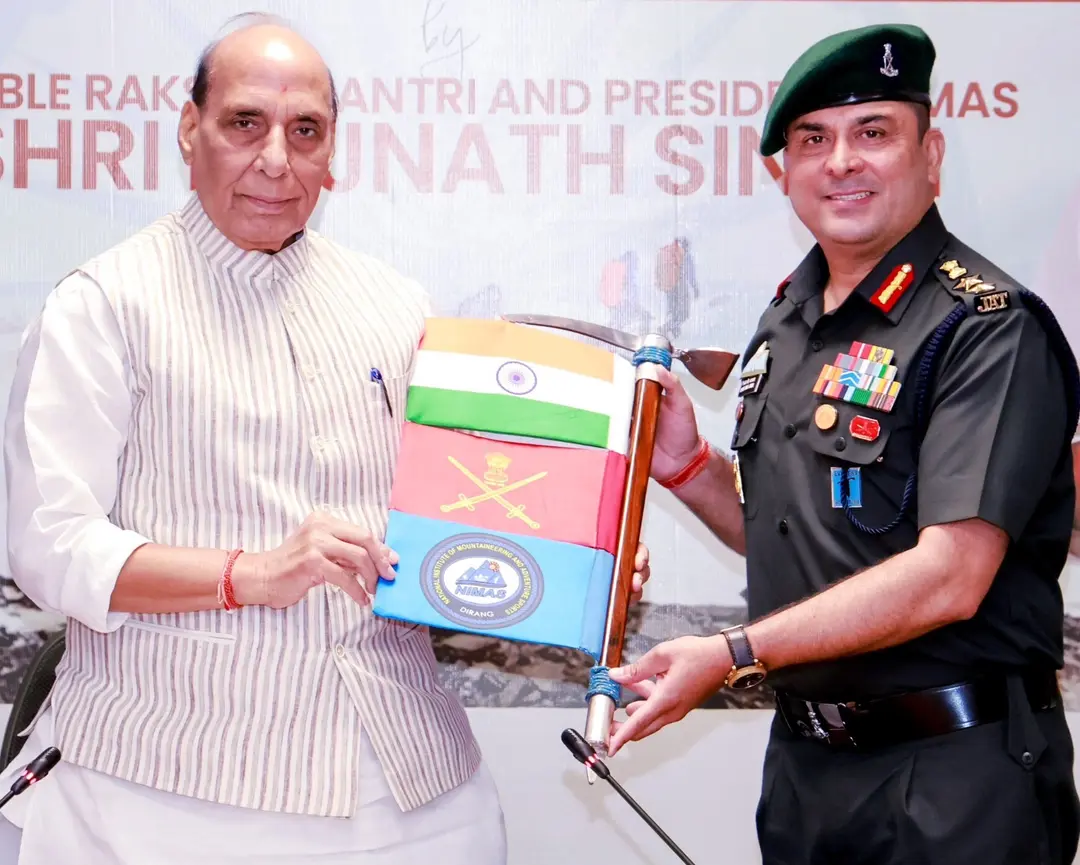
Rajnath flags in team that climbed 20 unclimbed Ladakh peaks
Defence minister Rajnath Singh on Friday flagged in the first Ascent mountaineering expedition, whose team summited 20 previously unclimbed peaks above 6,000 metres in Ladakh in 23 days, the defence ministry said. The 20-member team from the National Institute of Mountaineering and Adventure Sports, Dirang, was led by Col Ranveer Singh Jamwal. The first ascents were in the Chamser-Lungser, Gyama Nala and Chokula areas of the Ladakh Range. Defence secretary Rajesh Kumar Singh attended the ceremony at Kartavya Bhavan-2, New Delhi.
Source
Defence — Rajnath Singh · read the original report ↗
Desk check · compared with the source
What the desk checked (5)
- A 20-member NIMAS team summited 20 previously unclimbed peaks above 6,000 metres in Ladakh in 23 days. — Attributed to the defence ministry in the source; figures appear consistently in the text.
- Rajnath Singh flagged in the first Ascent expedition on Friday at Kartavya Bhavan-2, New Delhi. — Attributed to the defence ministry; no calendar date given, only 'Friday'.
- The first ascents were in the Chamser-Lungser, Gyama Nala and Chokula areas of the Ladakh Range. — Attributed to the ministry in the source.
- Col Ranveer Singh Jamwal was the first Indian to climb the Seven Summits and has summited Everest thrice (2012, 2013, 2016). — Stated in the source profile without a named source; biographical claim not externally verified.
- Defence secretary Rajesh Kumar Singh attended the ceremony. — Figure appears in source; attribution implicit to the ministry.
Analysts’ view opinion
On the surface this is an adventure-sports ceremony, but politically it is a carefully chosen stage. By personally flagging in a military-institute team that summited 20 previously unclimbed peaks in the Ladakh Range, the defence minister gets to project Indian presence and capability in high-altitude frontier areas without using any contentious language. The accompanying message about inspiring young climbers widens the political utility of the event.
- Because of Ladakh's strategic salience, any event set in high-altitude frontier terrain will be read as signalling well beyond adventure sports.
- The presence of both the defence minister and the defence secretary at a Delhi venue suggests this was a deliberately showcased occasion rather than routine departmental business.
- An achievement delivered through an army-linked institute leans on nationalism and respect for the armed forces — politically consensual ground that the opposition is unlikely to contest.
- The framing around inspiring young mountaineers fits a broader pattern of tying defence-linked events to youth, fitness and aspiration agendas.
- That an institute based in Dirang in the north-east recorded these firsts in Ladakh also helps knit the north-east and Himalayan frontier regions into a single national narrative.
What to watch — Watch whether the Ascent model becomes a recurring, institutionalised programme and gets linked to border tourism or youth outreach initiatives.
The story establishes no political motive behind the expedition, and says nothing about policy decisions, political reactions, costs or future plans.
Deep dive
Research brief · 8 facts · 6 dates · exam-readyThe brief
Context
The Ministry of Defence announced that Defence Minister Rajnath Singh flagged in the first "Ascent" mountaineering expedition in New Delhi on Friday. The expedition, mounted by the National Institute of Mountaineering and Adventure Sports (NIMAS), Dirang, climbed 20 peaks above 6,000 metres in Ladakh that had never been summited before, doing so in 23 days. It was led by Col Ranveer Singh Jamwal, NIMAS director and one of India's most decorated mountaineers. The ministry framed the feat as strengthening India's presence on the global mountaineering map and promoting adventure and exploration in high-altitude frontier regions.
Key facts
- A 20-member NIMAS team summited 20 previously unclimbed peaks above 6,000 metres in Ladakh in 23 days.
- The first-ever ascents were recorded in the Chamser-Lungser, Gyama Nala and Chokula areas of the Ladakh Range.
- The team was from the National Institute of Mountaineering and Adventure Sports (NIMAS), Dirang, and was led by Col Ranveer Singh Jamwal.
- Defence Minister Rajnath Singh flagged in the expedition at Kartavya Bhavan-2, New Delhi, on Friday; Defence Secretary Rajesh Kumar Singh also attended.
- Col Jamwal was commissioned into the Indian Army in 1998 and is presently director of NIMAS.
- He is the first Indian to climb the Seven Summits and has summited Mount Everest three times — in 2012, 2013 and 2016 — leading Indian Army expeditions each time.
- In 2022 he led the Har Shikhar Tiranga Mission, becoming the first person to hoist the national flag atop the highest peaks of all 28 Indian states.
- Jamwal has undertaken more than 70 mountaineering expeditions; honours include the Tenzing Norgay National Adventure Award, Sena Medal, a bar to the Vishisht Seva Medal and the Indian Mountaineering Foundation Gold Medal.
Timeline
- 1998Ranveer Singh Jamwal commissioned into the Indian Army.
- 2003Completed skiing and mountaineering courses at the High Altitude Warfare School, Gulmarg; later specialised in search and rescue at the Swiss Mountain School, Andermatt.
- 2012, 2013 and 2016Summited Mount Everest three times, leading Indian Army expeditions on each occasion.
- 2022Led the Har Shikhar Tiranga Mission, hoisting the national flag on the highest peaks of all 28 Indian states; also led a seven-member, 1,100-km cycling expedition across the north-eastern states.
- 23-day expedition (dates not stated in the source)NIMAS team makes first ascents of 20 peaks above 6,000 m in the Ladakh Range.
- Friday (date not stated in the source)Rajnath Singh flags in the Ascent expedition at Kartavya Bhavan-2, New Delhi.
Who has a stake
- Ministry of Defence — Announced and hosted the flag-in; presents the expedition as evidence of India's mountaineering excellence and leadership in adventure sports.
- NIMAS, Dirang — The institute that mounted the expedition; its training and technical capability are showcased.
- Col Ranveer Singh Jamwal — Expedition leader and NIMAS director; adds to a record of over 70 expeditions and multiple national honours.
- The 20-member climbing team — Credited with first ascents of 20 peaks; recognised by the defence minister for courage and determination.
- Young Indian mountaineers — Rajnath Singh said the ascents set new benchmarks and would inspire youth to take up adventure and exploration.
- High-altitude frontier regions of Ladakh — Targeted for promotion of adventure and exploration under the expedition's stated aim.
Why it matters
First ascents of 20 unnamed-in-record peaks above 6,000 metres expand documented exploration in the Ladakh Range, a sensitive high-altitude frontier region. The ministry links such expeditions to India's standing on the global mountaineering map and to promoting adventure tourism and exploration in border areas, while also reflecting the armed forces' high-altitude expertise.
UPSC angle
Prelims pointers
- NIMAS — National Institute of Mountaineering and Adventure Sports — is located at Dirang; its present director is Col Ranveer Singh Jamwal.
- Ascent expedition: 20 first ascents of peaks above 6,000 m in 23 days in the Chamser-Lungser, Gyama Nala and Chokula areas of the Ladakh Range.
- Col Jamwal is the first Indian to climb the Seven Summits — the highest peaks of all seven continents.
- Har Shikhar Tiranga Mission (2022): flag hoisted atop the highest peaks of all 28 Indian states.
- High Altitude Warfare School is at Gulmarg; Swiss Mountain School at Andermatt trains in search and rescue.
- Tenzing Norgay National Adventure Award and Indian Mountaineering Foundation Gold Medal are among Jamwal's honours.
Mains framing
The Ascent expedition — 20 first ascents above 6,000 metres in the Ladakh Range in 23 days by a 20-member NIMAS team — illustrates how India's institutional mountaineering capacity, largely nurtured within the defence establishment, is being used for both exploration and soft-power signalling. The Defence Ministry describes the feat as a showcase of planning, technical expertise, endurance and teamwork that strengthens India's presence on the global mountaineering map and promotes adventure and exploration in high-altitude frontier regions; the defence minister added that it sets benchmarks to inspire young mountaineers. The underlying drivers are the armed forces' operational need for high-altitude competence (reflected in training at the High Altitude Warfare School, Gulmarg, and specialised search-and-rescue training abroad) and a policy interest in opening frontier areas to adventure activity. Implications include documentation of hitherto unclimbed terrain, greater visibility for institutes such as NIMAS, and a pipeline of trained climbers and leaders, as Col Jamwal's record of over 70 expeditions and the Har Shikhar Tiranga Mission suggests. The way forward, on the source's own terms, lies in sustaining institutional expeditions that convert such achievements into wider youth participation in adventure and exploration.
Key terms
- NIMAS
- National Institute of Mountaineering and Adventure Sports, Dirang — the institute whose 20-member team carried out the Ascent expedition.
- First ascent
- The first recorded successful climb to a peak's summit; the team recorded first-ever ascents of 20 Ladakh peaks.
- Seven Summits
- The highest peaks on each of the seven continents; Col Jamwal is the first Indian to climb all of them.
- Har Shikhar Tiranga Mission
- 2022 mission led by Col Jamwal that hoisted the national flag on the highest peak of each of India's 28 states.
- High Altitude Warfare School, Gulmarg
- Indian Army school where Col Jamwal completed skiing and mountaineering courses in 2003.
- Kartavya Bhavan-2
- The New Delhi venue where the flag-in ceremony for the expedition was held.
Practice questions
- Discuss how institutional expeditions led by defence establishments contribute to exploration, adventure tourism and national visibility in India's high-altitude frontier regions.
- The Ascent expedition recorded 20 first ascents above 6,000 metres in Ladakh in 23 days. Examine the significance of such achievements for India's mountaineering ecosystem and for youth participation in adventure sports.
- What role do specialised institutions such as NIMAS, Dirang, and the High Altitude Warfare School, Gulmarg, play in building India's high-altitude capabilities?
Grounded only in the source report — figures and dates are the source's, not inferred.