
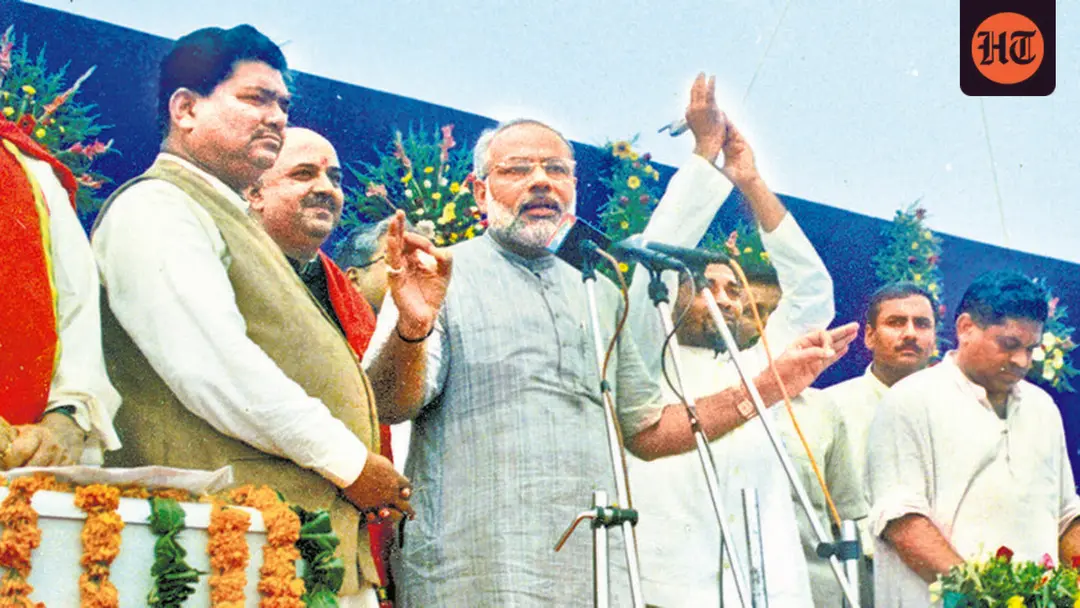
Modi to complete 25 years in public life on October 7
Narendra Modi will complete 25 years in public life on October 7. Months after the January 26, 2001 Kutch earthquake, which killed nearly 20,000 people, he was sworn in at Gandhinagar on October 7, 2001, as Gujarat's 14th chief minister by governor Surendra Singh Bhandari, replacing Keshubhai Patel. He has spent 4,495 days as India's longest continuously-serving elected prime minister, a report said.
Source
Hindustan Times — India · read the original report ↗
Desk check · some claims need care
What the desk checked (5)
- Modi took oath as Gujarat's 14th chief minister on October 7, 2001, sworn in by governor Surendra Singh Bhandari, replacing Keshubhai Patel. — Dates, designation and names appear in the source as reported detail; no document cited.
- The January 26, 2001 Kutch earthquake killed nearly 20,000 people. — Figure appears in source as an approximation, with no agency attribution.
- Modi completes 25 years in public service on October 7 and has spent 4,495 days as India's longest continuously-serving elected PM. — Figures appear in the source; no source given for the day count.
- Quotes on Modi's working style, welfarism and reinvention. — Attributed to an unnamed senior RSS leader, an anonymous BJP leader, a former chief minister and a second leader/Union minister.
- BJP ousted the Trinamool Congress and won West Bengal for the first time since independence. — Stated in source without attribution or poll date; editor should verify before publishing.
Analysts’ view opinion
Narendra Modi's swearing-in as Gujarat chief minister on October 7, 2001 — amid earthquake devastation, drought and public anger over administration — is a case study in converting a crisis-management assignment into durable political capital. Twenty-five years on, he remains the BJP's central figure and biggest vote-puller, though a reduced Lok Sabha strength in his third term and dependence on allies have subtly altered his power arithmetic. His ability to run a development pitch and an ideological agenda simultaneously remains the core of his political durability.
- He came in as a replacement for Keshubhai Patel through an internal party decision rather than an electoral mandate, which helps explain his organisation-first political style.
- The Gujarat template of infrastructure, investment and industry plus welfare was scaled up nationally after 2014, turning a state reputation into national dominance.
- Delivering long-pending Sangh demands — the Ram temple and abrogation of Article 370 — has kept ties with the BJP's ideological parent smooth.
- On the other side of the ledger, exam paper leaks, discontent over white-collar jobs, and reliance on JD(U), TDP and Shiv Sena give the Opposition an opening.
- Strong showings in Haryana, Maharashtra and especially West Bengal bolster the party's claim that his vote-pulling power is intact.
What to watch — Next year's assembly polls, including Uttar Pradesh, will test how far the Modi-centric campaign model still travels ahead of the 2029 Lok Sabha elections.
The story rests largely on assessments from BJP and RSS leaders, and does not establish Opposition counter-arguments, the scale of the governance lapses, or any succession planning.
Deep dive
Research brief · 8 facts · 8 dates · exam-readyThe brief
Context
Narendra Modi, then a 51-year-old BJP national general secretary (organisation), was sworn in as Gujarat's 14th chief minister on October 7, 2001, eight months after the January 26, 2001 Kutch earthquake that killed nearly 20,000 people. He replaced Keshubhai Patel, was administered oath by governor Surendra Singh Bhandari at Gandhinagar, and served as CM for about 12 years before leading the BJP to victory in the 2014 Lok Sabha polls. On October 7 he completes 25 years in public office, having spent 4,495 days as India's longest continuously-serving elected prime minister, according to the report.
Key facts
- The Kutch earthquake struck Gujarat on January 26, 2001, killing nearly 20,000 people; Modi was involved in relief and rehabilitation work.
- Modi took oath as Gujarat's 14th chief minister on October 7, 2001 at Gandhinagar, administered by governor Surendra Singh Bhandari.
- He replaced party colleague and mentor-turned-bete noire Keshubhai Patel; Modi was then 51 and BJP national general secretary (organisation).
- Modi has spent 4,495 days as India's longest continuously-serving elected prime minister, the report says.
- He worked as a party functionary from 1995 to 2001, travelling to Uttar Pradesh, Madhya Pradesh, Rajasthan, Assam and Himachal Pradesh.
- Practices from his first year as CM, such as 100-day timelines for big-ticket projects, were later replicated at the Centre after the 2014 Lok Sabha win.
- As CM he set up a climate change division and a forensic university in Gujarat, per a Union minister quoted in the report.
- In the third term, reduced BJP strength in the Lok Sabha has made the party rely on allies including JD(U), TDP, Shiv Sena and smaller parties.
Timeline
- 1995 to 2001Modi works as a BJP organisation man, travelling to Uttar Pradesh, Madhya Pradesh, Rajasthan, Assam and Himachal Pradesh.
- January 26, 2001Earthquake devastates large parts of Kutch in Gujarat, killing nearly 20,000 people.
- October 7, 2001Modi sworn in as Gujarat's 14th chief minister at Gandhinagar by governor Surendra Singh Bhandari, replacing Keshubhai Patel.
- 2013Modi declared the BJP's prime ministerial candidate.
- 2014Modi leads the BJP to a Lok Sabha win, with the party getting an absolute majority for the first time in three decades.
- 2025Modi recalls on X his mother's two conditions when he took oath as CM: always work for the poor and never take a bribe.
- October 7 (current year)Modi completes 25 years in public office.
- Next yearA crucial set of assembly polls, including in Uttar Pradesh, is due, ahead of the 2029 Lok Sabha elections.
Who has a stake
- Narendra Modi — His 25-year record as CM and PM, and his continuing role as the BJP's central electoral figure ahead of 2029.
- Bharatiya Janata Party — Depends on Modi as its biggest vote puller while managing reduced Lok Sabha strength and coalition dependence.
- RSS — The ideological fount of the BJP; its antyodaya thrust and long-pending demands like the Ram Temple and Article 370 abrogation.
- NDA allies (JD-U, TDP, Shiv Sena, smaller parties) — Their numbers now matter more for the government's Lok Sabha majority in the third term.
- Gujarat's quake-hit and drought-affected people — Rebuilding of towns and villages, water supply and basic amenities that defined Modi's first year as CM.
- Young job-seekers and exam aspirants — Discontent over examination paper leaks and the lack of white-collar jobs flagged as problem areas.
Why it matters
The story marks a quarter century in which one leader's administrative template travelled from a quake-hit state to the Union government, shaping the BJP's national expansion. It also sets out the pressure points of the third term — coalition dependence, paper leaks, white-collar joblessness and a harsher global environment — that will test that model before the 2029 Lok Sabha polls.
UPSC angle
Prelims pointers
- Kutch earthquake: January 26, 2001; nearly 20,000 deaths, as per the source.
- Modi sworn in as Gujarat's 14th CM on October 7, 2001, by governor Surendra Singh Bhandari at Gandhinagar; he replaced Keshubhai Patel.
- 4,495 days — Modi's tenure as India's longest continuously-serving elected prime minister, per the report.
- Antyodaya: RSS-linked idea of uplifting the last person in the queue, cited as the bedrock of Modi's social welfarism.
- Long-pending RSS demands cited as fulfilled: completion of the Ram Temple in Ayodhya and abrogation of Article 370 in Jammu and Kashmir.
- Current NDA allies named: Janata Dal (United), Telugu Desam Party, Shiv Sena and smaller parties.
Mains framing
Modi's 25 years in public office illustrate how a state-level administrative template can scale into a national governance model. The source traces the origin to crisis management after the January 26, 2001 Kutch earthquake, which killed nearly 20,000 people, and to a state also battling long-running drought and perceptions of ineffective administration; the response — deadlines, fixed accountability, 100-day timelines for big projects — became the so-called Gujarat model of infrastructure, investment and industry, later replicated pan-India after 2014, with social welfare framed around the antyodaya idea. Ideological commitments were pursued alongside development, with the Ram Temple's completion and the abrogation of Article 370 cited as long-pending RSS demands. The implications are twofold: personalised, delivery-focused governance has helped the BJP expand into states such as Haryana, Maharashtra and West Bengal, but the third term shows strains — reduced Lok Sabha strength requiring allies like JD(U), TDP and Shiv Sena, examination paper leaks, discontent over scarce white-collar jobs, and geopolitical turbulence from the Ukraine and West Asia wars and US trade policy. The way forward, on the source's own terms, lies in institutionalising administrative accountability, addressing employment and examination integrity, and managing coalition politics before the assembly polls next year and the 2029 general election.
Key terms
- Gujarat model
- Modi's CM-era focus on infrastructure, investment and industry, plus water and roads projects, later replicated nationally.
- Antyodaya
- Uplifting the last person in the queue; the RSS ideological thrust described as the bedrock of Modi's social welfarism.
- RSS
- Rashtriya Swayamsevak Sangh, described in the story as the ideological fount of the BJP.
- National general secretary (organisation)
- The BJP post Modi held in 2001 before becoming Gujarat chief minister.
- Article 370
- Constitutional provision on Jammu and Kashmir whose abrogation the story lists as a long-pending RSS demand fulfilled.
- 100-day timelines
- Modi's CM-era practice of setting a 100-day deadline to get big-ticket projects off the ground, later used at the Centre.
Practice questions
- Trace how the administrative template Modi set as Gujarat chief minister after the 2001 Kutch earthquake was later applied at the Centre. What are its strengths and limits?
- Discuss the challenges facing the NDA's third term as identified in the story — coalition dependence, examination paper leaks, white-collar unemployment and global turmoil.
- Examine the interplay between ideological commitments and the development agenda in the BJP's governance since 2014, with reference to the Ram Temple and Article 370.
Grounded only in the source report — figures and dates are the source's, not inferred.