
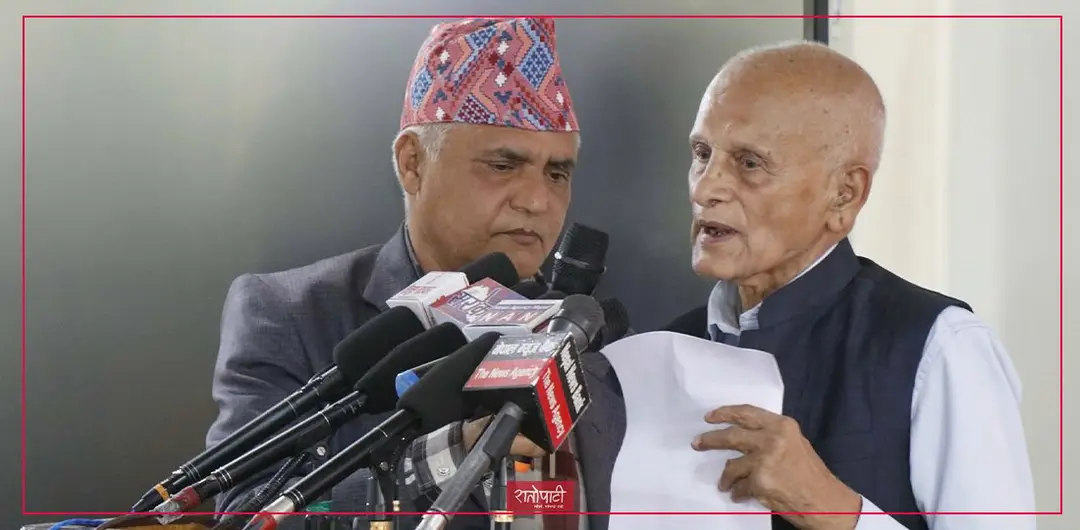
Singh marks Nirmal Lama's 26th death anniversary, calls party split a mistake
Marking the 26th death anniversary of communist leader Nirmal Lama, CPN (Masal) leader Singh said Lama made a great contribution to Nepal's democratic and leftist movement. He recalled that the two passed unity proposals together in Kathmandu's Bhadrakali Jail in 2026 BS and that the fourth general convention was held in Varanasi in 2031 BS. He called the split after the 2040 BS Gorakhpur conference a serious mistake, adding that party unity was Lama's dream.
Source
Nirmal — politics · read the original report ↗
Desk check · compared with the source
What the desk checked (5)
- The remarks were delivered at the 26th death anniversary of Nirmal Lama on Sunday. — Attributed in the source to a speech by Singh; date given only as 'Sunday'.
- The party's fourth general convention was held in Varanasi in June 2031 BS, forming what was then Nepal's largest communist party. — Figure and place appear in the source as the speaker's recollection; no independent documentation cited.
- A party conference in Gorakhpur in 2040 BS followed the public resignation of six central committee members, after which the party split into CPN (Masal) and CPN Fourth Convention. — Stated in the source by the speaker; numbers and year as given, unverified externally.
- Three proposals for party unity were passed during a month-long gathering in Kathmandu's Bhadrakali Jail in 2026 BS. — Speaker's first-person account; no secondary sourcing provided.
- CPN (Unity Center) was formed after unity talks that CPN (Masal) did not join. — Appears in source as the speaker's narrative of events.
Analysts’ view opinion
This reads as a memorial speech, but politically it is a contest over who gets to define the history of Nepal's left. By calling the split that followed the 2040 BS Gorakhpur conference a "serious mistake" while leaving the question of who was responsible to "history", Singh positions himself as the unity man and reopens an old internal argument in public. Invoking Nirmal Lama's legacy as a symbol of unity also prepares ideological ground for any future realignment among small left parties.
- By keeping the question of blame open rather than settling it, Singh lightens the share of responsibility that could fall on him while retaining the moral high ground.
- Framing his relationship with Lama as "unity in opposition and opposition in unity" recasts past ruptures as ideological process rather than personal enmity, which keeps future cooperation possible.
- His condition that unity must rest on Marxist-Leninist principles and a revolutionary political line means he seeks unity while also claiming the right to set its terms.
- His own reference to the old fault line of contesting versus boycotting elections signals that the same question still shapes alignments on the left today.
- For a small party such as CPN (Masal), historical legitimacy is the main political capital against larger left formations, and this speech is an attempt to spend it.
What to watch — Watch whether other leaders or parties claiming Lama's legacy push back on this "mistake" verdict or instead treat it as an opening for unity talks.
The story rests entirely on Singh's own speech and does not establish who bore how much responsibility for the split, how rival factions assess it, or whether any unity process is actually under way now.
Deep dive
Research brief · 8 facts · 10 dates · exam-readyThe brief
Context
Nirmal Lama was a veteran Nepali communist leader whose political career spanned the pre-Panchayat communist movement, imprisonment, exile-era conventions in India, and the repeated splits and mergers of Nepal's left. On the 26th anniversary of his death, CPN (Masal) leader Singh delivered a speech recalling decades of joint work with Lama — from a 2011 BS district secretaries' training in Kathmandu to the Darbhanga Plenum, the Bhadrakali Jail unity proposals of 2026 BS and the fourth general convention in Varanasi in 2031 BS. Singh also admitted that the split following the 2040 BS Gorakhpur conference, which divided the party into CPN (Masal) and CPN Fourth Convention, was a "serious mistake." The speech frames Nepal's communist history as one of "unity and opposition" — dialectical relationships that produced both mergers and ruptures.
Key facts
- Singh's speech was delivered on Sunday to mark the 26th death anniversary of communist leader Nirmal Lama, on behalf of CPN (Masal).
- In 2011 BS, Lama (secretary, Kathmandu District Committee) and Singh (secretary, Pyuthan District Committee) attended a district party secretaries' training in Kathmandu.
- In 2026 BS, the two passed three proposals during a month-long gathering in Kathmandu's Bhadrakali Jail to unite the then-divided party, later forming a central nucleus.
- The party's fourth general convention was held in Varanasi in June 2031 BS; the party formed then was described as the largest communist party in Nepal at that time.
- A party conference was held in Gorakhpur in 2040 BS after 6 central committee members resigned and made their resignations public; the party then split into CPN (Masal) and CPN Fourth Convention.
- After the fifth general convention, the party split into 'thin' and 'thick' Masal/Mashal factions.
- Unity talks involved CPN (Masal), CPN (Fourth Convention), CPN (Mashal) and the Proletarian Workers' Organization; CPN (Unity Center) was formed without CPN (Masal).
- In 2048 BS, Singh and Chitra Bahadur KC disagreed on using parliamentary elections — KC's pro-participation line won in the central committee, but boycott won at the conference.
Timeline
- 2010 BSThree-month residential training camp in Pyuthan; Communist Party formed in Pyuthan. Singh applies to Kamalraj Regmi for party membership the same year.
- 2011 BSLama and Singh attend district party secretaries' training in Kathmandu as Kathmandu and Pyuthan district secretaries.
- Not dated in sourceDarbhanga Plenum: Lama contributes to the majority obtained in favour of the Constituent Assembly.
- 2026 BSThree unity proposals passed during a month-long gathering in Bhadrakali Jail, Kathmandu.
- June 2031 BSFourth general convention held in Varanasi; party becomes the largest communist party in Nepal at the time.
- 2040 BSGorakhpur conference convened over the public resignation of 6 central committee members; party splits into CPN (Masal) and CPN Fourth Convention.
- After the fifth general conventionFurther split into 'thin' and 'thick' Masal/Mashal; CPN (Unity Center) later formed, joined then left by Lama's Fourth Convention.
- 2048 BSDisagreement with Chitra Bahadur KC over utilising parliamentary elections; boycott line prevails at the conference.
- Before Lama's deathSecret unity meetings among Lama, Chitra Bahadur KC and Singh at Lama's house in Mhepi; Lama steps down from Unity Center leadership and dies soon after.
- 2072 BSKamalraj Regmi reapplies to Singh for party membership; he dies soon after.
Who has a stake
- Nirmal Lama (deceased) — Veteran leftist leader credited with contributions to Nepal's democratic and leftist movement; party unity described as his unfulfilled dream.
- Singh, CPN (Masal) leader — Speaker who recounts shared history and publicly accepts the Gorakhpur-era split as a serious mistake requiring historical evaluation.
- CPN (Masal) — Party organising the commemoration; stayed out of the Unity Center merger and later united with it unsuccessfully.
- CPN Fourth Convention / CPN (Unity Center) — Formations born of the splits; Lama led the Fourth Convention and later a separate Unity Center.
- Chitra Bahadur KC — Long-time ally who clashed with Singh over 2048 BS parliamentary elections but accepted the conference majority, aiding party discipline.
- Proletarian Workers' Organization and CPN (Mashal) — Participants in the unity talks that produced CPN (Unity Center) without CPN (Masal).
Why it matters
Nepal's communist movement has been shaped as much by repeated splits as by mergers, and a senior surviving leader publicly calling the post-Gorakhpur split a "serious mistake" is a rare act of self-criticism with lessons for present-day left unity efforts. The speech also documents institutional history — jail-based unity proposals, conventions held on Indian soil, and the influence of India's Naxalite movement — that explains the lineage of today's parties. For readers tracking South Asian politics, it shows how ideological disputes over elections and class analysis translated into organisational fracture.
UPSC angle
Prelims pointers
- Nirmal Lama: Nepali communist leader; speech marked his 26th death anniversary, delivered by CPN (Masal) leader Singh.
- Bhadrakali Jail, Kathmandu (2026 BS): venue where three party-unity proposals were passed during a month-long gathering.
- Fourth general convention of the party: held in Varanasi, India, in June 2031 BS.
- Gorakhpur conference (2040 BS): led to the split into CPN (Masal) and CPN Fourth Convention.
- CPN (Unity Center): formed by unity of CPN (Fourth Convention), CPN (Mashal) and Proletarian Workers' Organization; CPN (Masal) stayed out.
- India's Naxalite movement is cited as the external influence behind extremist 'leftist' tendencies and an earlier split in the party.
Mains framing
The speech offers a primary-source account of why Nepal's communist movement repeatedly fragmented despite recurring unity drives. Three causes stand out in the narrative: ideological disputes over class analysis (whether the Nepali Congress was a national-capitalist friendly force or a feudal-comprador enemy force), tactical disputes over participation in elections (the Panchayat polls and the 2048 BS parliamentary elections), and organisational crises such as the public resignation of six central committee members that triggered the 2040 BS Gorakhpur conference. External influence — the spillover of India's Naxalite movement into "extremist leftist" deviation — added further strain, while geography itself (conventions and conferences in Varanasi and Gorakhpur) reflects the movement's semi-clandestine condition. The implications were costly: the largest communist party of its time splintered into CPN (Masal) and CPN Fourth Convention, then into 'thin' and 'thick' Masal/Mashal, and the later merger with CPN (Unity Center) did not hold. The way forward proposed is explicitly principled rather than arithmetical: unity built on Marxist-Leninist principles, a revolutionary political line, Leninist organisational systems and proletarian spirit, with disagreements aired fully before merger — and, crucially, an honest evaluation of responsibility for past splits rather than a cover-up of history.
Key terms
- CPN (Masal)
- Communist Party of Nepal (Masal), the faction led by Singh that emerged from the 2040 BS Gorakhpur split and stayed out of the Unity Center merger.
- CPN Fourth Convention
- The other faction from the Gorakhpur split, led by Nirmal Lama, named after the fourth general convention held in Varanasi in 2031 BS.
- CPN (Unity Center)
- Party formed by the merger of CPN (Fourth Convention), CPN (Mashal) and the Proletarian Workers' Organization; Lama's group later separated from it.
- Bhadrakali Jail proposals (2026 BS)
- Three documents passed by imprisoned leaders during a month-long gathering, which helped unite the divided party via a central nucleus.
- Naxalite influence
- The spillover of India's Naxalite movement, blamed in the speech for extremist 'leftist' tendencies and an earlier split in the Nepali party.
- Dialectical unity and opposition
- Marxist formulation Singh uses to describe relationships combining close cooperation with sharp disagreement, as with Lama, his father and Chitra Bahadur KC.
Practice questions
- Trace the pattern of splits and mergers in Nepal's communist movement as described in Singh's speech, and examine what they reveal about the relationship between ideology and organisation in left parties.
- "Disputes over electoral participation have been the single most divisive question for Nepal's communists." Discuss with reference to the Panchayat-era and 2048 BS debates recounted in the source.
- How did cross-border factors — Indian venues for party conventions and the Naxalite movement — shape the trajectory of Nepal's communist parties?
Grounded only in the source report — figures and dates are the source's, not inferred.