
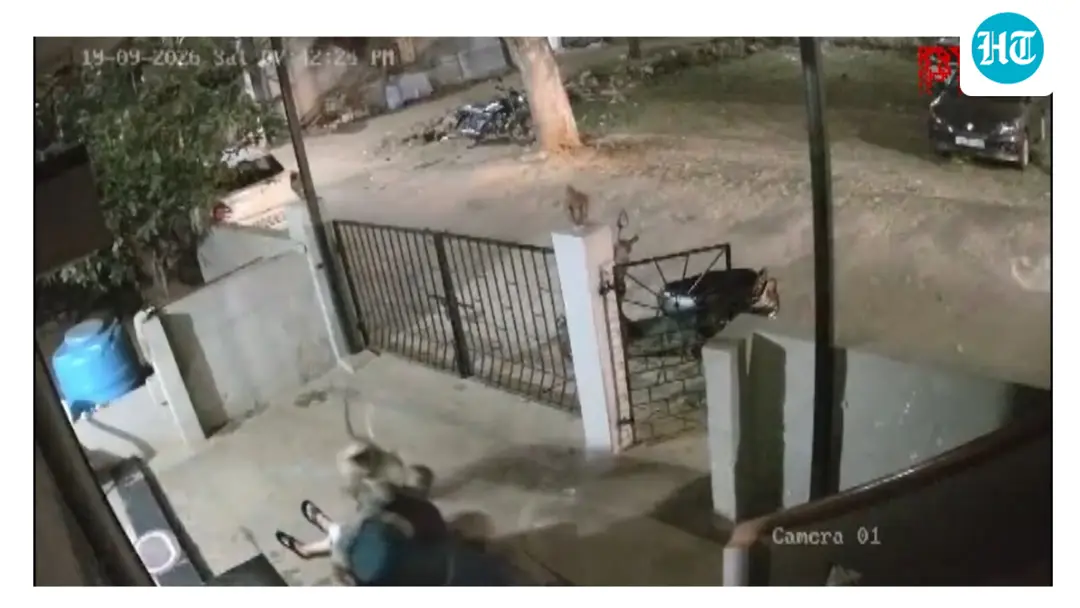
91-year-old woman dies after monkey attack in Karnataka's Koppal
A 91-year-old woman died after she was allegedly attacked and pushed by a monkey outside her home in BT Patil Nagar in Karnataka's Koppal district on Monday. CCTV footage, shared by news agency PTI on X, showed the animal suddenly jumping on the woman. Identified as Najamunisa Begum, she suffered serious injuries and was rushed to a hospital, but later succumbed. A further attack was averted after people from the area reached the spot and the monkey fled.
Source
Hindustan Times — India · read the original report ↗
Desk check · some claims need care
What the desk checked (5)
- A 91-year-old woman was attacked and pushed by a monkey outside her home in BT Patil Nagar, Koppal district, on Monday. — Stated in source as alleged; no police or official named.
- The victim, identified as Najamunisa Begum, suffered serious injuries, was hospitalised and later died. — Figure and name appear in source; no attributed medical or police source given.
- The incident was captured on CCTV, with footage shared by news agency PTI on X. — Attributed to PTI in the source.
- Locals who reached the spot prevented a further attack and the monkey fled. — Unattributed account in source.
- A Delhi Zoo caretaker suffered a severed finger and deep leg bites after a bonnet macaque escaped; a visitor was also bitten. — Attributed to earlier HT reporting and a senior zoo official; contextual, not part of the Koppal incident.
Analysts’ view opinion
At first glance this reads as a tragic accident — politically, it is a question about administrative capacity. The death of a 91-year-old woman in Koppal, read alongside the Delhi Zoo and Manesar incidents, exposes an accountability vacuum over who is actually responsible for managing monkeys in urban and residential areas. In Manesar the municipal body said it would "look into" the matter while forest officials said urban monkeys were outside their jurisdiction — that gap between two answers is the real opening for any opposition.
- Because the CCTV footage circulated via PTI on X, the story can escape the local-news bracket and become a politically combustible issue of public anger.
- The forest department–municipal jurisdiction dispute is a systems failure rather than a party failure, yet blame in practice tends to land on whoever holds office.
- That the victims are elderly people and children gives this unusual emotional force — precisely the kind of grievance that surfaces in local-body election campaigns.
- With different parties governing Karnataka, Delhi and Haryana, it is hard to frame this as one government's failure; it reads instead as a cross-state governance problem.
- The story records no reaction from any leader or party, which suggests the political response has either not begun or not been documented.
What to watch — Watch for any official statement or compensation announcement from local representatives, municipal bodies or the forest department, and whether it triggers a policy move that finally fixes clear responsibility for urban monkey management.
The story does not establish official negligence, nor does it say whether earlier complaints were made in Koppal or how authorities responded.
Deep dive
Research brief · 8 facts · 4 dates · exam-readyThe brief
Context
A 91-year-old woman, Najamunisa Begum, died after a monkey allegedly attacked and pushed her outside her home in BT Patil Nagar, Koppal district, Karnataka, on Monday. CCTV footage of the attack was shared by news agency PTI on X. The death comes amid a series of reported monkey attacks in residential and public spaces across the country, including at the Delhi Zoo and in a Manesar housing society, raising questions about who is responsible for managing urban monkey populations.
Key facts
- A 91-year-old woman was allegedly attacked and pushed by a monkey outside her home in BT Patil Nagar, Koppal district, Karnataka, on Monday.
- The victim, identified as Najamunisa Begum, suffered serious injuries, was rushed to hospital and later succumbed.
- CCTV footage of the attack, shared by news agency PTI on X, showed the animal suddenly jumping on the woman.
- The footage also shows another elderly woman coming outside after hearing the commotion.
- A second attack was averted when people from the surrounding area reached the spot, after which the monkey fled.
- At the Delhi Zoo, a bonnet macaque escaped its enclosure and entered the staff gallery, leaving a caretaker with a severed finger and deep bites on both legs; a visitor was also bitten on the thigh.
- A senior zoo official said the same Delhi Zoo monkey had injured another staff member in December 2025.
- In Manesar, residents said at least three children were injured or bitten over a 15-day period as monkey troops entered parks, balconies and common areas.
Timeline
- December 2025The same monkey at the Delhi Zoo had injured another staff member, according to a senior zoo official.
- Reported earlier (date not stated in the source)A bonnet macaque escaped its Delhi Zoo enclosure, severely injuring a caretaker and biting a visitor.
- Reported earlier (date not stated in the source)Manesar society residents allege three children injured or bitten by monkeys over a 15-day period.
- Monday (date not stated in the source)A monkey attacks 91-year-old Najamunisa Begum outside her home in BT Patil Nagar, Koppal; she later dies of her injuries.
Who has a stake
- Najamunisa Begum and her family — The 91-year-old died of injuries sustained in the attack outside her own home.
- Residents of BT Patil Nagar, Koppal — Local people intervened to drive the monkey away; they face continuing risk in public and residential spaces.
- Delhi Zoo staff and visitors — A caretaker suffered a severed finger and deep leg bites; a visitor was bitten, raising staff safety concerns.
- Residents of the Manesar society — Children reportedly injured; parents supervise outdoor play and senior citizens avoid common areas.
- Municipal Corporation of Manesar — Said it would look into the matter and take necessary action on the monkey menace.
- Forest department officials — Stated that monkeys in urban areas do not fall under their jurisdiction, leaving a gap in responsibility.
Why it matters
A fatal monkey attack on an elderly woman at her doorstep shows that human-wildlife conflict is no longer confined to forest fringes but is an everyday urban and semi-urban safety issue. The Manesar case, where the municipal body promised action while forest officials said urban monkeys are outside their jurisdiction, exposes a jurisdictional vacuum that leaves the most vulnerable — children and senior citizens — exposed.
UPSC angle
Prelims pointers
- Koppal is a district in Karnataka; the fatal monkey attack occurred at BT Patil Nagar.
- The victim was 91-year-old Najamunisa Begum; CCTV footage was shared by PTI on X.
- The Delhi Zoo attack involved a bonnet macaque that escaped its enclosure into the staff gallery.
- A senior zoo official said the same Delhi Zoo monkey had injured a staff member in December 2025.
- In Manesar, at least three children were reportedly injured or bitten by monkeys within 15 days.
- Forest department officials said monkeys in urban areas do not fall under their jurisdiction; the Municipal Corporation of Manesar said it would act.
Mains framing
The death of a 91-year-old woman in Koppal after a monkey attack, alongside injuries at the Delhi Zoo and in a Manesar residential society, illustrates how human-wildlife conflict has migrated into dense residential and public spaces. The immediate causes visible in the source are the presence of monkey troops in parks, balconies and common areas of housing complexes, and, in the zoo case, a containment failure that allowed a bonnet macaque to escape into a staff gallery — an animal that had reportedly injured a staff member earlier in December 2025, pointing to unheeded warning signs. The implications are sharpest for the elderly and children: residents said children could not play outdoors unsupervised and senior citizens avoided common areas. The deeper governance problem is institutional ambiguity — the Municipal Corporation of Manesar promised to look into the matter while forest officials said urban monkeys lie outside their jurisdiction, so repeated complaints yielded little. A way forward consistent with the source would involve clearly assigning responsibility for urban monkey management between municipal bodies and the forest department, acting on complaints before injuries occur, and strengthening safety protocols and enclosure maintenance for staff who work with captive animals.
Key terms
- Bonnet macaque
- The monkey species that escaped its enclosure at the Delhi Zoo and attacked a caretaker and a visitor.
- Human-wildlife conflict
- Harmful encounters between people and wild animals, here monkeys entering homes, housing societies and public spaces.
- Municipal Corporation of Manesar
- Urban local body that said it would look into residents' complaints about monkeys and take necessary action.
- Forest department
- State wildlife authority whose officials said monkeys in urban areas do not fall under its jurisdiction.
- PTI
- Press Trust of India, the news agency that shared the CCTV footage of the Koppal attack on X.
Practice questions
- Urban human-wildlife conflict in India is increasingly a governance problem rather than a purely ecological one. Discuss with reference to recent monkey attacks in residential areas.
- Who should be responsible for managing monkey populations in urban areas — municipal bodies or the forest department? Examine the consequences of jurisdictional ambiguity.
- What institutional safety measures are needed for zoo staff and visitors in light of the Delhi Zoo incident involving a bonnet macaque that had injured a staff member earlier?
Grounded only in the source report — figures and dates are the source's, not inferred.