
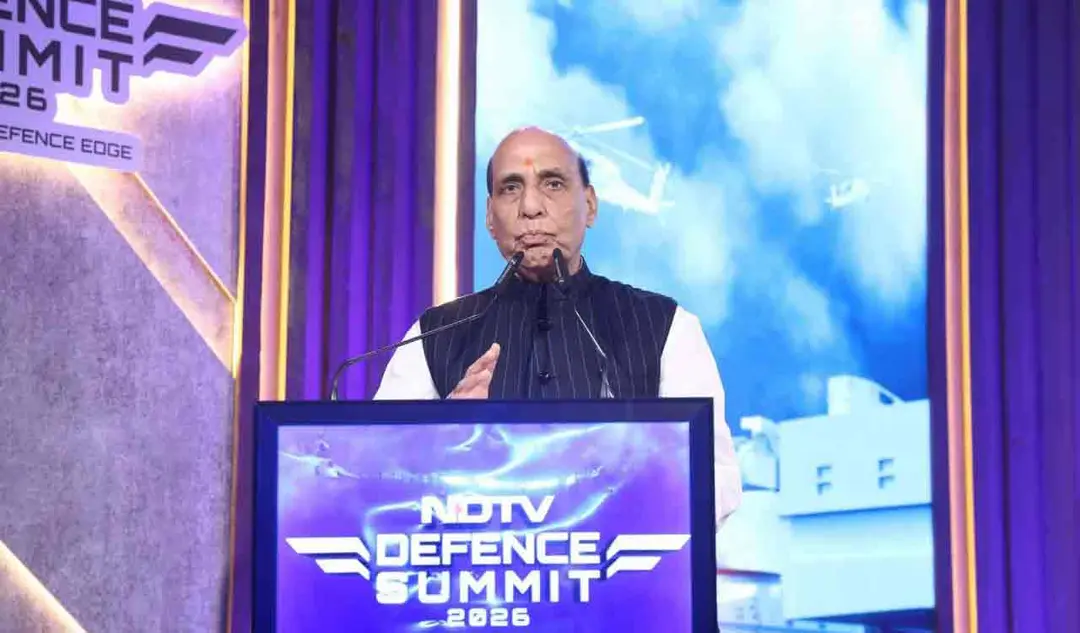
India ready for strikes against terrorists, says Rajnath Singh
Defence Minister Rajnath Singh said on Sunday that India is prepared to carry out strikes against terrorists as long as a neighbouring country continues to propagate terrorism. Speaking at the NDTV Defence Summit 2026, he said India believes in peace and does not want war, but will not compromise on security, adding there is a difference between silence and weakness. He said India's defence strategy is future ready and energy resources diversified, stressing self-reliance: why buy what can be produced here, from chips to ships.
Source
Defence — Rajnath Singh · read the original report ↗
Desk check · compared with the source
What the desk checked (4)
- Rajnath Singh said India is prepared for strikes against terrorists as long as a neighbouring country propagates terrorism. — Directly quoted and attributed to the Defence Minister at the NDTV Defence Summit 2026 in the source.
- The remarks were an apparent warning to Pakistan. — Presented by the source as an interpretation ('apparent'/'veiled reference'); Pakistan was not named in the quotes provided.
- Pakistan-based terrorists attacked tourists in Pahalgam on April 22, 2025, killing 26 including one Nepali national. — Figure and date appear in the source as background; attributed to India's consistently stated position, not independently sourced in the text.
- India's defence strategy is 'future ready' and energy resources have been diversified. — Attributed assertion by the minister; no supporting data given in the source.
Analysts’ view opinion
There is no new policy announcement in Defence Minister Rajnath Singh's remarks — but the political signal is clear: on national security the ruling side will keep restating its hard line on any available platform. The line that "there is a difference between silence and weakness" is pre-emptive language against opposition criticism, while "India does not want war" keeps the international audience reassured. By tying the tough security posture to self-reliance and domestic manufacturing, the message converts nationalism into an economic and jobs narrative as well.
- Choosing a defence summit as the venue lets one message travel simultaneously to Pakistan, to the wider world and to domestic voters.
- The "from chips to ships" framing usefully folds the security debate into the Make-in-India manufacturing story, which has clear political dividends.
- Saying dialogue ends the moment terrorism is promoted sets a condition without shutting the diplomatic door, preserving flexibility on both sides.
- Opposition parties are likely to respond along the lines of demanding results rather than rhetoric, since openly contesting a security posture is politically costly.
- The reference to diversified energy resources fits a broader political argument for strategic autonomy amid global pressures.
What to watch — Watch for any official Pakistani response, the tone of opposition reaction, and whether this rhetoric is followed by specific domestic defence procurement or policy announcements.
This is a stated posture in a speech — the story establishes no new military action, no timeline, and nothing about electoral calculation.
Deep dive
Research brief · 8 facts · 2 dates · exam-readyThe brief
Context
Defence Minister Rajnath Singh, speaking at the NDTV Defence Summit 2026 in New Delhi on Sunday, issued an apparent warning to Pakistan that India is prepared to carry out strikes against terrorists as long as a neighbouring country continues to "propagate terrorism". His remarks came against the backdrop of India's long-held position that Pakistani or Pakistan-based terrorists have carried out multiple attacks in India, including the April 22, 2025 attack on tourists in Pahalgam, Jammu and Kashmir, which killed 26 people. Alongside the security message, he outlined a "future ready" defence strategy, diversified energy resources and self-reliance in defence manufacturing.
Key facts
- Rajnath Singh said on Sunday (report published 27 September 2026) that India is prepared for strikes against terrorists as long as a neighbouring country propagates terrorism.
- He said: "India believes in peace, does not want war... But there is a difference between silence and weakness."
- He said India believes in dialogue, but if any country propagates terrorism, "the dialogue will end then and there".
- On April 22, 2025, Pakistan-based terrorists attacked tourists at Pahalgam in Jammu and Kashmir, killing 26 people including one Nepali national, and injuring several others.
- He asserted India's defence strategy is "future ready" and that the nation's energy resources have been diversified.
- He cited the sayings "If you want peace, prepare for war" and "the more you sweat in peace, the less you bleed in war".
- On self-reliance he said: "Our philosophy is simple: why buy what can be produced here?" and "From chips to ships, from screws to complete weapon systems, this will take India to strategic autonomy."
- He said the modern soldier is not merely a soldier but operates within a multi-domain environment.
Timeline
- April 22, 2025Pakistan-based terrorists attacked tourists at Pahalgam, Jammu and Kashmir, killing 26 people, including one Nepali national.
- 27 September 2026 (Sunday)Rajnath Singh, addressing the NDTV Defence Summit 2026, says India is ready for strikes against terrorists and stresses self-reliance and a future-ready defence strategy.
Who has a stake
- Ministry of Defence / Rajnath Singh — Articulating India's deterrence posture against terrorism and driving self-reliance in defence production.
- Pakistan (the veiled "neighbouring country") — Named indirectly as propagating terrorism; India links continuation of dialogue to an end to terrorism.
- Indian armed forces — Must be war-ready and capable of operating in a multi-domain environment.
- Indian defence industry and suppliers — Domestic manufacturing of everything "from chips to ships" is positioned as the route to strategic autonomy.
- People of Jammu and Kashmir and tourists — Directly exposed to terror attacks, as in the Pahalgam killings of 26 people.
- Foreign defence suppliers — India's stated aim of reducing dependence on foreign suppliers affects import demand.
Why it matters
The statement restates India's declared readiness to use force against terrorists and explicitly links the continuation of dialogue with a neighbour to an end to terrorism, which shapes expectations of how India may respond to future attacks. It also ties national security to industrial policy, arguing that controlling critical parts of the defence supply chain — from chips to ships — is the route to strategic autonomy.
UPSC angle
Prelims pointers
- Rajnath Singh is India's Defence Minister; he spoke at the NDTV Defence Summit 2026.
- Pahalgam terror attack: April 22, 2025; 26 killed, including one Nepali national, in Jammu and Kashmir.
- "Aatmanirbhar" (self-reliant) defence: reducing dependence on foreign suppliers for defence needs.
- Phrase used: "From chips to ships, from screws to complete weapon systems" as the path to strategic autonomy.
- Rajnath Singh said India's energy resources have been diversified and its defence strategy is "future ready".
- Multi-domain environment: the setting in which the modern soldier operates, per the Defence Minister.
Mains framing
The Defence Minister's remarks fuse two strands of Indian security policy: a declaratory deterrence posture against cross-border terrorism, and defence industrial self-reliance as the foundation of strategic autonomy. The cause is a record of repeated terror attacks that India attributes to Pakistani or Pakistan-based terrorists, the most recent cited being the Pahalgam attack of April 22, 2025 in which 26 people were killed; the response is an explicit readiness for strikes against terrorists and a conditionality that dialogue ends where terrorism begins. The implications are twofold — a lowered threshold of ambiguity about retaliation, and pressure on the domestic industrial base to deliver capability across the spectrum, "from chips to ships", so that supply-chain dependence does not constrain operational choices. The stated way forward, as per the source, rests on a "future ready" defence strategy, diversified energy resources, war-readiness in peacetime ("the more you sweat in peace, the less you bleed in war"), preparing soldiers for a multi-domain environment, and the philosophy of "why buy what can be produced here?" Any assessment must also weigh escalation management and the cost of sustaining cooperation with partners without compromising national interest.
Key terms
- NDTV Defence Summit 2026
- The forum in New Delhi where Rajnath Singh delivered the address reported in the story.
- Aatmanirbhar (in defence)
- Self-reliance; reducing dependence on foreign suppliers by producing defence equipment domestically.
- Strategic autonomy
- Ability to act independently, which Rajnath Singh links to India making and controlling critical parts of the defence supply chain.
- Multi-domain environment
- The setting the Defence Minister says the modern soldier operates in, beyond the role of a conventional soldier.
- Pahalgam attack
- April 22, 2025 attack on tourists in Jammu and Kashmir by Pakistan-based terrorists that killed 26 people.
- Future ready defence strategy
- Rajnath Singh's term for a defence approach oriented to future needs rather than only the current scenario.
Practice questions
- "There is a difference between silence and weakness." Examine how India's declaratory posture on cross-border terrorism balances deterrence with escalation control.
- Discuss how defence industrial self-reliance — "from chips to ships" — contributes to India's strategic autonomy.
- Should dialogue with a neighbour be made conditional on an end to terrorism? Critically evaluate in the light of recent statements by India's Defence Minister.
Grounded only in the source report — figures and dates are the source's, not inferred.