
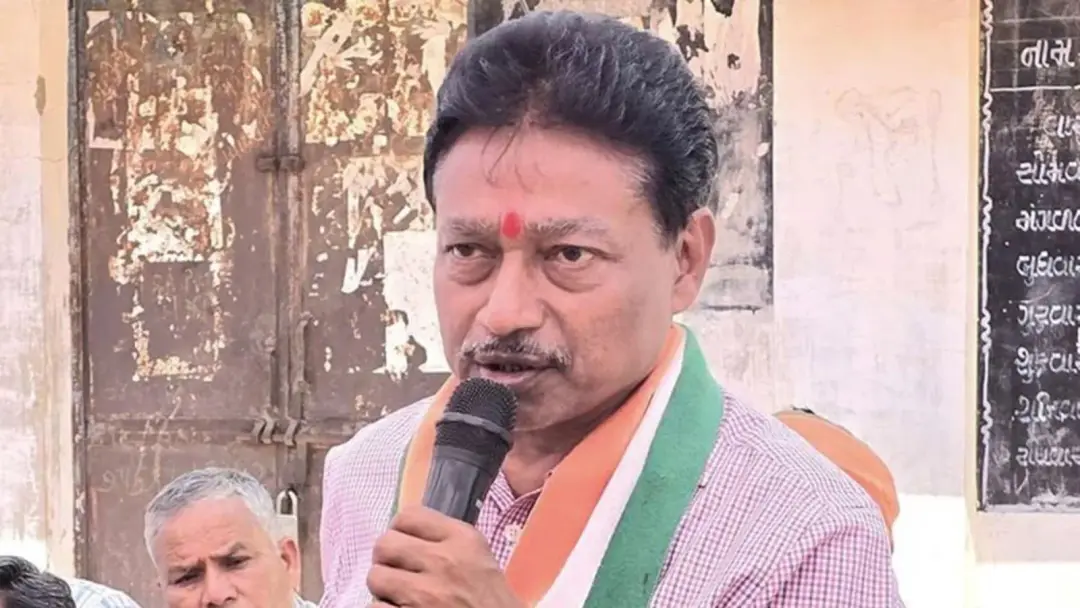
Gujarat Congress seeks EC explanation on SIR irregularities
The Gujarat Congress has demanded an explanation from the Election Commission over irregularities in the Special Intensive Revision process exposed in an Indian Express investigation on September 23. CLP leader Tushar Chaudhary said commissioners Sukhbir Singh Sandhu and Vivek Joshi complained 14 times in 10 months that voters were being dropped from rolls, calling it a mockery of democracy. Gujarat saw the highest second-phase deletions, 13.4% of voters or 68.12 lakh.
Source
Indian Express — Cities · read the original report ↗
Desk check · some claims need care
What the desk checked (4)
- Election Commissioners Sukhbir Singh Sandhu and Vivek Joshi complained 14 times in 10 months about serious irregularities in the SIR process. — Attributed by Tushar Chaudhary to an Indian Express investigation published September 23; not independently confirmed within the source.
- Gujarat recorded the highest deletions among second-phase SIR states, with 13.4% of voters (68.12 lakh) removed. — Figure appears in the source text as a statement of fact with no named source cited.
- CEC Gyanesh Kumar said there were zero appeals filed against deletions before district collectors in the 12 states where SIR was complete. — Attributed to Kumar via earlier Indian Express reporting during his September 10-11 Gujarat tour.
- Congress made representations to the Chief Electoral Officer and will decide next steps after Rahul Gandhi's press conference. — Direct quote attributed to Tushar Chaudhary.
Analysts’ view opinion
The Gujarat Congress is trying to shift this from a routine opposition grievance to a question about the Election Commission's own internal credibility — its central claim being that the objections came not from a rival party but from two commissioners inside the Commission. That Gujarat recorded the highest deletions in the second phase, 13.4% or 68.12 lakh voters, in what is the BJP's strongest fortress state gives the fight extra political value. But as Tushar Chaudhary himself says, the next step waits on Rahul Gandhi's press conference — marking this as part of a nationally coordinated campaign rather than a state-led agitation.
- The strength of the Congress framing is that it attributes the allegations to voices inside the Commission rather than to a political opponent, which makes it harder to dismiss as partisan noise.
- Gujarat's position at the top of the deletion table hands Congress a usable number, though the story does not establish which communities or constituencies the deletions affected.
- Chaudhary's line that the party will plan its move after "Rahulji's" press conference signals central control over the messaging rather than an independent state push.
- The CEC's earlier statement of "zero appeals filed against deletions" is the EC's ready defence — the opposition can read silence as fear or lack of awareness, the EC can read it as absence of genuine grievance.
- Attacking the Commission's credibility is a double-edged strategy for the opposition: it can build voter suspicion, but also invites the counter-charge of pre-emptively alibiing for defeat.
What to watch — Watch whether the Election Commission issues a formal response, and whether Congress converts this into a legal challenge or a street campaign after Rahul Gandhi's press conference.
The story does not establish independent verification of the commissioners' complaints, any EC rebuttal, or that the deletions disadvantaged any particular party — these remain opposition allegations resting on a single press investigation.
Deep dive
Research brief · 8 facts · 4 dates · exam-readyThe brief
Context
The Election Commission of India has been carrying out a Special Intensive Revision (SIR) of electoral rolls across states in phases, a house-to-house exercise that adds and deletes names from voter lists. An Indian Express investigation published on September 23 reported that two Election Commissioners, Sukhbir Singh Sandhu and Vivek Joshi, had internally flagged serious irregularities in the SIR process 14 times over 10 months. Gujarat, covered in the second phase of SIR, recorded the highest share of deletions among states — 13.4% of voters, or 68.12 lakh names. The Gujarat Congress has now demanded a public explanation from the EC.
Key facts
- The Indian Express investigation published on September 23 reported irregularities in the Special Intensive Revision (SIR) of electoral rolls.
- Election Commissioners Sukhbir Singh Sandhu and Vivek Joshi complained 14 times in the last 10 months about serious irregularities in the SIR process, per the report.
- Gujarat recorded the highest deletions among second-phase SIR states: 13.4% of voters, or 68.12 lakh, removed from the rolls.
- Congress Legislature Party leader and former Union minister Tushar Chaudhary demanded an explanation from the Election Commission, calling it a 'mockery of democracy'.
- Chief Election Commissioner Gyanesh Kumar was on a two-day tour of Gujarat on September 10-11, speaking extensively about the SIR.
- CEC Gyanesh Kumar said there were 'zero appeals filed against deletions' before district collectors in the 12 states where SIR was complete.
- Gujarat Congress had earlier made representations to the state Chief Electoral Officer on the issue.
- Chaudhary said the party's next move would be planned after Leader of Opposition Rahul Gandhi's press conference.
Timeline
- Over the last 10 months (as reported)Commissioners Sandhu and Joshi flag serious SIR irregularities 14 times internally.
- September 10-11CEC Gyanesh Kumar tours Gujarat for two days and speaks extensively about the SIR.
- September 23The Indian Express publishes its investigation exposing irregularities in the SIR process.
- After September 23Gujarat Congress demands an explanation from the EC; awaits Rahul Gandhi's press conference before deciding next steps.
Who has a stake
- Election Commission of India — Its institutional credibility and the integrity of the SIR process are under question after internal objections were reported.
- CEC Gyanesh Kumar — Publicly defended the SIR, citing zero appeals against deletions in 12 completed states; now faces contrary internal accounts.
- Commissioners Sukhbir Singh Sandhu and Vivek Joshi — Reported to have raised 14 complaints in 10 months about voters being dropped from rolls.
- Gujarat Congress / CLP leader Tushar Chaudhary — Seeking an explanation from the EC and planning further political and legal action.
- Voters in Gujarat — 68.12 lakh names (13.4%) deleted from rolls, raising risk of denial of the right to vote.
- Chief Electoral Officer, Gujarat — Received earlier Congress representations on SIR-related grievances.
Why it matters
Electoral rolls are the foundation of a credible election; large-scale deletions without effective grievance redress can disenfranchise genuine voters. That objections reportedly came from within the Election Commission itself — 14 times in 10 months — turns a partisan complaint into a question about the transparency of the SIR and the EC's internal decision-making. With Gujarat losing 68.12 lakh names, the highest share among second-phase states, the dispute is likely to shape political and legal contestation ahead of polls.
UPSC angle
Prelims pointers
- SIR stands for Special Intensive Revision of electoral rolls, conducted by the Election Commission of India in phases.
- Gujarat saw the highest second-phase SIR deletions: 13.4% of voters, i.e., 68.12 lakh.
- Chief Election Commissioner named in the story: Gyanesh Kumar; Election Commissioners: Sukhbir Singh Sandhu and Vivek Joshi.
- CEC Gyanesh Kumar said 'zero appeals' were filed against deletions before district collectors in 12 states where SIR was complete.
- Appeals against electoral roll deletions lie before the district collector, as referenced by the CEC.
- Gujarat Congress's representations on SIR were made to the state Chief Electoral Officer (CEO).
Mains framing
The Gujarat SIR controversy raises the core democratic question of how roll revision balances purification of electoral rolls against the risk of wrongful disenfranchisement. The immediate trigger is a media investigation reporting that two Election Commissioners internally objected 14 times in 10 months that voters were being dropped and denied their right to vote — objections that sit uneasily beside the CEC's public assertion of 'zero appeals' against deletions in 12 completed states. Gujarat's 13.4% deletion rate (68.12 lakh voters) magnifies the stakes: if appeals are genuinely nil despite deletions of this scale, it may indicate either genuine correction of duplicate or dead entries, or a grievance mechanism that affected voters are unable to access. The implications extend to public trust in the EC as a constitutional body and to the Opposition's ability to contest rolls before elections. The way forward, on the source's own terms, lies in the EC publicly explaining the internal objections, disclosing deletion categories and district-wise data, and ensuring that appeal routes before district collectors are known and usable; the Gujarat Congress, having already petitioned the Chief Electoral Officer, says its next step awaits the Leader of Opposition's press conference.
Key terms
- Special Intensive Revision (SIR)
- An intensive Election Commission exercise to revise electoral rolls, involving additions and deletions of voter names, conducted state-wise in phases.
- Congress Legislature Party (CLP) leader
- The head of the Congress bloc of MLAs in a state assembly; in Gujarat, former Union minister Tushar Chaudhary.
- Chief Election Commissioner (CEC)
- Head of the Election Commission of India; currently Gyanesh Kumar, who defended the SIR during his Gujarat visit.
- Chief Electoral Officer (CEO)
- The senior officer who supervises election work in a state; the Gujarat Congress made SIR representations to this office.
- Appeals against deletion
- The remedy available to a voter whose name is struck off the roll, filed before the district collector as referred to by the CEC.
Practice questions
- Large-scale deletions during electoral roll revision can undermine the right to vote even as they aim to purify rolls. Critically examine with reference to the SIR exercise in Gujarat.
- The reported internal dissent of two Election Commissioners raises questions about collective decision-making in the Election Commission of India. Discuss the implications for the institution's credibility.
- The CEC cited 'zero appeals' against deletions in 12 states as proof of a sound process. Evaluate whether the absence of appeals is a reliable indicator of fairness in electoral roll revision.
Grounded only in the source report — figures and dates are the source's, not inferred.