
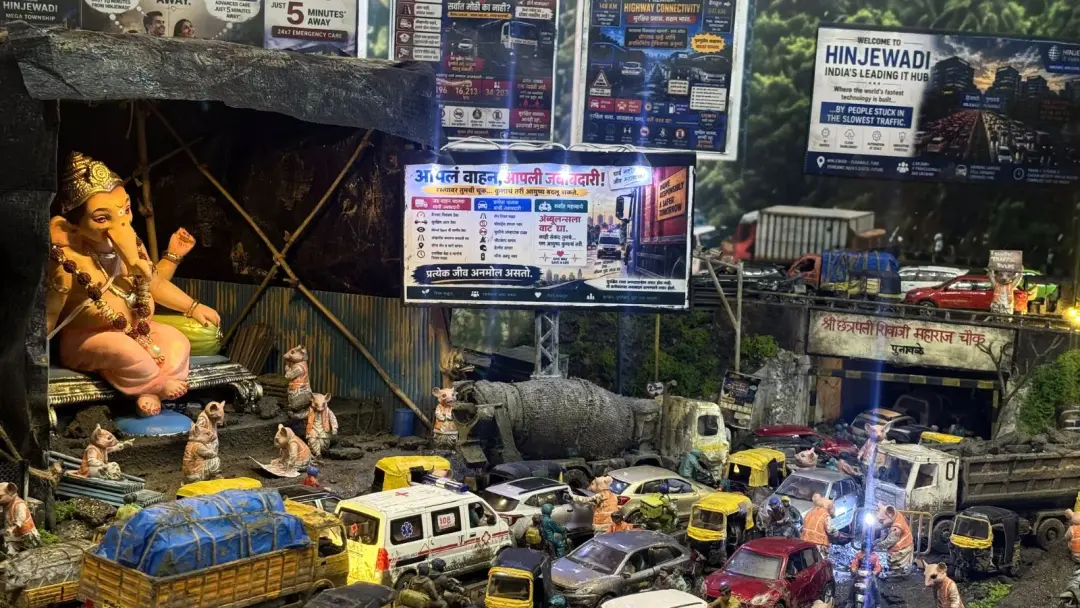
Pune artist turns Ganeshotsav decoration into road safety message
Ravi Chauhan, an IT professional and artist, has built a Ganeshotsav installation carrying a road safety message at his home in Pune's Hinjewadi. He says his mother, who suffered a heart attack on New Year's Day, died in an ambulance seven minutes from the hospital after traffic failed to clear at Shri Chhatrapati Shivaji Maharaj Chowk in Punawale. The installation shows Ganesha viewing a congested road with a trapped ambulance. It is open to the public till September 25.
Source
Indian Express — Cities · read the original report ↗
Desk check · compared with the source
What the desk checked (4)
- Ravi Chauhan's mother died in an ambulance on New Year's Day after a heart attack, seven minutes from the hospital. — Attributed to Chauhan's own account in the source; no independent record cited.
- The ambulance was stuck in congestion at Shri Chhatrapati Shivaji Maharaj Chowk in Punawale. — Stated in the source as part of Chauhan's account; not independently corroborated.
- The Ganeshotsav installation at his Hinjewadi home is open to the public till September 25. — Date appears in the source text as reported detail.
- The installation depicts Ganesha and Mushaks managing traffic, repairing potholes and clearing the road. — Descriptive detail reported by the journalist and explained in Chauhan's quotes.
Analysts’ view opinion
This is a personal, grief-born piece of art rather than a campaign, but its political force lies in the platform it chose — Ganeshotsav, the festival with the largest public footfall and media gaze in Maharashtra. Pandals and home installations have long doubled as vehicles for social messaging; Ravi Chauhan has pointed that tradition squarely at local governance, road quality and contractor accountability. Crucially, it names no party, which is precisely what makes it hard to dismiss — nobody can brand it partisan, yet whoever holds administrative responsibility must answer for it.
- Infrastructure strain in IT-corridor pockets like Hinjewadi and Punawale is already a sore point for urban voters, and this installation gives that grievance a human face.
- By asking 'who is responsible' without naming any party, the message becomes difficult to write off as politically motivated.
- Placing responsibility on citizens' own driving behaviour alongside administration and contractors widens the appeal beyond a blame contest.
- As a rule, emotive and broadly popular civic causes invite low-cost political engagement — visits, sympathy and assurances from local representatives.
- The real test is whether this sentiment survives the festival; traffic and road quality tend to surface as an agenda mainly around election season.
What to watch — Watch the public and media response while the installation stays open till September 25, and whether any local representative or civic body responds officially with steps on ambulance passage or congestion at the chowk.
The story records no response from any party, official or civic body, and rests on one family's account — it does not establish any official finding of administrative or contractor failure.
Deep dive
Research brief · 8 facts · 3 dates · exam-readyThe brief
Context
Ganeshotsav in Pune is marked by elaborate home and public installations, often themed on social messages. This year, Ravi Chauhan, an IT professional and lifelong artist based in Pune's IT hub Hinjewadi, has built a decoration around road safety and civic responsibility. The trigger was personal: on New Year's Day, his mother died in an ambulance stuck in traffic at Punawale's Shri Chhatrapati Shivaji Maharaj Chowk, seven minutes short of the hospital. The installation is open to the public till September 25.
Key facts
- Ravi Chauhan, an IT professional and artist, created the Ganeshotsav installation at his home in Pune's IT hub of Hinjewadi.
- On New Year's Day, Chauhan was in an ambulance with his mother, who had suffered a heart attack, at Punawale's Shri Chhatrapati Shivaji Maharaj Chowk.
- Traffic did not move despite the wailing siren and his appeals; his mother died in the ambulance, seven minutes away from the hospital.
- The installation shows Ganesha watching with concern over a road with cars, trucks with blue tarpaulin-covered loads, two-wheelers, construction workers and autorickshaws.
- At its centre is a trapped ambulance with a woman in pink on a stretcher and two men representing Chauhan and his father watching helplessly.
- In the concept, Bappa questions his team of Mushaks on the road's condition, wrong-side driving and why the ambulance is not given way; the Mushaks then manage traffic, repair potholes and clear the road.
- The installation is open to the public till September 25.
- Chauhan's appeal is directed at the administration and contractors to complete roads on time with proper quality and safety, and at citizens to avoid wrong-side driving and follow lane discipline.
Timeline
- New Year's Day (January 1)Chauhan's mother suffers a heart attack; the ambulance is stuck in congestion at Shri Chhatrapati Shivaji Maharaj Chowk, Punawale, and she dies seven minutes from the hospital.
- This GaneshotsavChauhan unveils a road safety-themed Ganeshotsav installation at his Hinjewadi home.
- Till September 25The installation remains open to the public.
Who has a stake
- Ravi Chauhan and his family — Lost his mother in a traffic-stalled ambulance; now uses art to push for road safety so no other family faces the same.
- Emergency patients and ambulance services — Delayed passage in congestion can be fatal, as in the case at Punawale.
- Civic administration — Called upon to fix broken roads, manage traffic and ensure timely, quality road work.
- Road contractors — Urged to complete roads on time and ensure proper quality and safety.
- Citizens and motorists of Pune — Asked to avoid wrong-side driving, follow lane discipline and immediately give way to ambulances.
- Punawale and Hinjewadi residents — Live with the congestion at Shri Chhatrapati Shivaji Maharaj Chowk described as infamous in the source.
Why it matters
A single blocked junction cost a life within seven minutes of a hospital, showing that urban congestion and poor road discipline are emergency-response failures, not mere inconvenience. By turning a religious festival installation into a civic appeal, the story shows how public art and festivals can carry accountability messages to both administration and citizens.
UPSC angle
Prelims pointers
- Ganeshotsav installation with a road safety theme built at Hinjewadi, Pune's IT hub, by artist and IT professional Ravi Chauhan.
- Site of the fatal ambulance delay: Shri Chhatrapati Shivaji Maharaj Chowk, Punawale, Pune.
- The ambulance was seven minutes from the hospital when Chauhan's mother died on New Year's Day.
- Installation open to the public till September 25.
- Mushaks (Ganesha's mouse attendants) are depicted managing traffic, repairing potholes and clearing the road.
- Vighnaharta - remover of obstacles - is the epithet Chauhan uses to urge citizens to act themselves.
Mains framing
The story illustrates how urban infrastructure and behavioural failures converge into a public health emergency: a heart attack patient died in an ambulance stalled by congestion at a single Pune junction, seven minutes from care. The causes named in the source are twofold - institutional (broken roads, delayed and poor-quality road work, weak traffic management by administration and contractors) and behavioural (wrong-side driving, absence of lane discipline, failure to give way to ambulances). The implication is that emergency response times in fast-growing peri-urban IT corridors like Hinjewadi-Punawale depend as much on everyday civic conduct as on capital works. The way forward suggested by the artist is a shared-responsibility model: timely completion of roads with assured quality and safety on the administration-contractor side, and disciplined driving with immediate right of way for ambulances on the citizen side. His framing - "Don't just ask who will solve the problem. Ask what I can do... Bappa has come not just to remove obstacles, but to make us Vighnahartas" - positions festivals and public art as vehicles for civic mobilisation rather than only celebration.
Key terms
- Ganeshotsav
- The Ganesh festival, in Pune marked by elaborate installations and decorations, often built around social themes.
- Mushak
- The mouse, Ganesha's vehicle and attendant; depicted in the installation as a team fixing potholes and managing traffic.
- Vighnaharta
- Remover of obstacles, an epithet of Ganesha; used here to urge citizens to become problem-solvers themselves.
- Shri Chhatrapati Shivaji Maharaj Chowk, Punawale
- Pune junction described in the source as infamously congested, where the ambulance carrying Chauhan's mother was stuck.
- Hinjewadi
- Pune's IT hub, where Chauhan lives and has set up the installation open to the public till September 25.
Practice questions
- How do congestion and poor road infrastructure in India's fast-growing IT corridors affect emergency medical response? Discuss with reference to the Punawale ambulance case.
- Examine the role of festivals and public art as instruments of civic awareness and accountability in Indian cities.
- "Road safety is as much a matter of citizen behaviour as of infrastructure." Critically evaluate, using the responsibilities of administration, contractors and motorists.
Grounded only in the source report — figures and dates are the source's, not inferred.